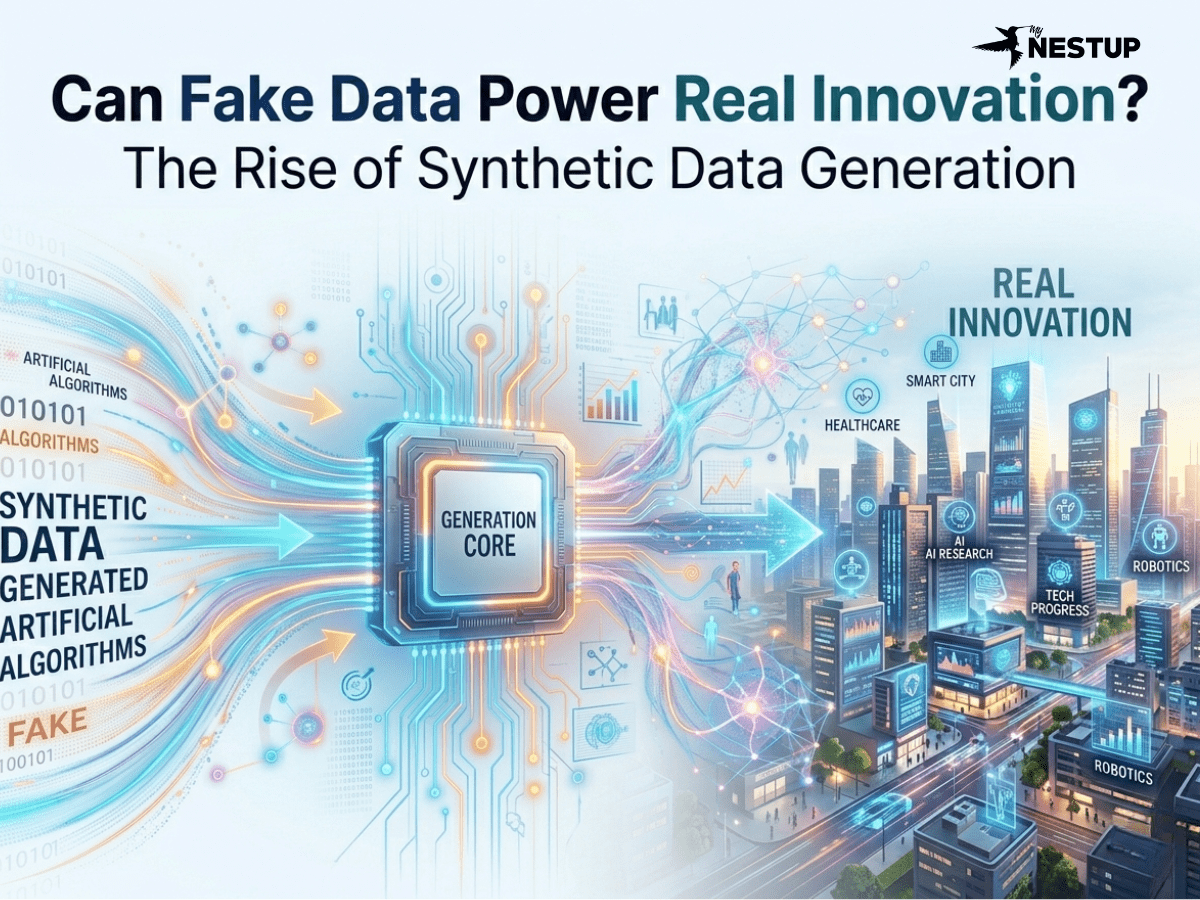
What is Synthetic Data?
Synthetic data is information that is created artificially instead of being gathered from real-world events or people. While it is not real data, it is designed to closely reflect the statistical patterns and structure of real datasets. It is made without exposing anyone’s personal details. A simple example is training a facial recognition model using computer-generated faces rather than images of real individuals.
There are three common forms of synthetic data. Fully synthetic data is produced entirely by algorithms and contains no real records. Partially synthetic data blends real data with artificial values to protect sensitive information. Hybrid datasets combine synthetic data with anonymized real-world samples. The right option depends on how the data will be used and how strict the privacy requirements are.
What makes synthetic data especially powerful is that it is not just a substitute for real data. It can actually be more practical. It can be generated at scale and intentionally adjusted to test rare or extreme scenarios. It can be used in simulations that would be costly or unethical to carry out using real people.
It is important to know that synthetic data is not “fake” in the sense of being unreliable. It is carefully engineered to behave like real data. When created properly, whether manually or through automated tools, it maintains the statistical accuracy and behavioral patterns of the original dataset. For data scientists, this means faster experimentation and quicker deployment. It means the ability to innovate without waiting for new data or worrying about privacy concerns.
Key Techniques Used in Synthetic Data Generation
1. Generative AI
Technologies such as Generative Pre-trained Transformers (GPT), Generative Adversarial Networks (GANs), and Variational Auto-Encoders (VAEs) are trained on real datasets to understand their underlying distributions. They then use this knowledge to generate new data that closely mirrors the original patterns.
2. Rules-Based Data Generation
In this approach, artificial data is created using predefined business rules. The system can produce realistic datasets that maintain logical and relational consistency. They do this by defining relationships between data elements.
3. Entity Cloning
This method takes data related to a single business entity from source systems. It masks sensitive fields to meet compliance requirements and then creates multiple cloned versions. Each clone is assigned unique identifiers to preserve individuality while protecting the original data.
4. Data Masking
Data masking involves substituting sensitive information with fictional but structurally accurate values. The goal is to prevent data from being traced back to real individuals while keeping the overall data relationships and statistical properties intact.
Advantages of Synthetic Data
Synthetic data comes with several benefits that make it an attractive alternative to real-world datasets across many industries:
• Highly customizable
Synthetic data can be tailored to specific business or technical requirements. Organizations can design datasets that reflect rare or hypothetical conditions. These conditions are difficult, or impossible, to capture in real life. This makes it especially useful for software testing and quality assurance in workflows.
• Cost-efficient
Creating synthetic data is generally far less expensive than collecting real-world data. For instance, gathering actual vehicle crash data can be costly and time-consuming for automakers, whereas simulated crash scenarios can be generated at a fraction of the cost.
• Built-in data labeling
Labeling real data for supervised learning often requires significant manual effort and is prone to human error. Synthetic data can be automatically labeled as it is generated. This speeds up model training while ensuring high labeling accuracy.
• Faster data creation
Since synthetic data does not depend on real events or user activity, it can be produced quickly using the right tools. Large volumes of data can be generated in a short timeframe. This helps in accelerating development and experimentation.
• Complete and accurate annotation
With synthetic data, every element in a dataset can be perfectly annotated by design. This removes the need for manual labeling and data collection. This results in significantly reducing effort and cost compared to working with real data.
• Enhanced privacy protection
Although synthetic data mimics real-world patterns, it does not contain identifiable information tied to actual individuals. This makes it safe to share and ideal for privacy-sensitive sectors such as healthcare, life sciences and pharmaceuticals.
• Total control over data characteristics Synthetic data gives users full control over how datasets are constructed. Developers and data scientists can adjust factors like event frequency, class balance, sample size, noise levels and separation between classes. This allows them to shape data precisely to meet model training and testing needs.
Challenges of Using Synthetic Data
While synthetic data offers many advantages, it also comes with a set of limitations that organizations need to consider:
• Risk of bias or misleading outcomes
Synthetic data can reflect existing biases or oversimplify complex relationships if not generated carefully. Limited variation or weak correlations may lead to results that are skewed, incomplete or even discriminatory.
• Potential accuracy issues
Since synthetic data is produced by algorithms, it may not always capture real-world complexity with complete precision. This can sometimes result in outputs that do not fully align with real data behavior.
• Additional time and validation effort
Synthetic datasets often require extra verification, such as comparing model outcomes against real, human-annotated data. These validation steps are essential but can add time and extend project timelines.
• Missing outliers
Synthetic data is designed to imitate patterns, not perfectly reproduce every data point. As a result, rare or extreme cases present in the original dataset may be underrepresented or lost.
• Reliance on source data quality
The effectiveness of synthetic data is closely tied to the quality of the real data used to generate it. If the original dataset is flawed or incomplete, the synthetic data built from it may inherit those weaknesses.
• Consumer trust concerns
As organizations increasingly rely on synthetic data, some users and customers may question its credibility. This can lead to calls for greater transparency around how the data is generated. It requires stronger assurances that personal information remains protected.
Despite these challenges, synthetic data continues to play a valuable role in modern data analysis. When applied thoughtfully and validated properly, it can still deliver meaningful insights that closely reflect real-world behavior.
Industry analysts and investors expect synthetic data to make up a large share of AI training datasets in the coming years, with adoption accelerating across sectors. Its advantages have drawn strong interest from data scientists and business leaders alike. It enables faster development cycles, lower costs and in many cases, more efficient AI implementations.
Like any technology initiative, producing high-quality synthetic data requires the right skills and experience. However, these challenges do not have to slow progress.
References:
https://www.ibm.com/think/insights/synthetic-data-generation