
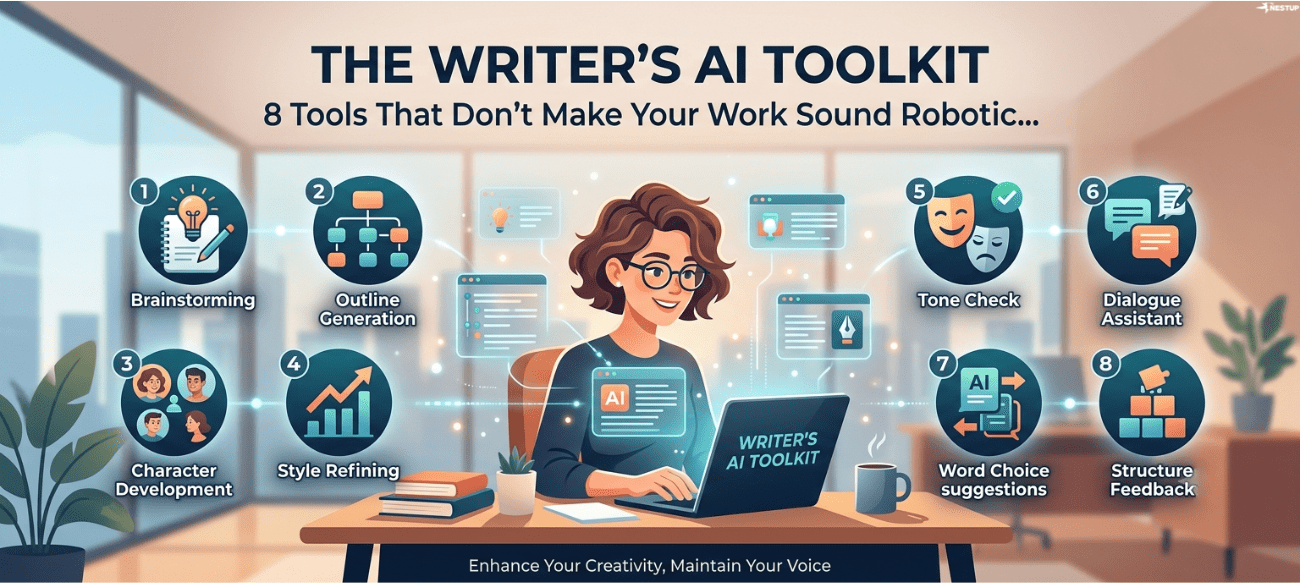
The Hook: The Robot in the Room
AI writing has an image problem, and rightfully so. By 2026, the digital landscape has been so thoroughly saturated with "robotic sludge" that the average reader has developed a biological-grade allergy to it. You know the symptoms: that eerie, over-polished corporate sheen, the fake enthusiasm, and the rhythmic monotony of a machine trying too hard to please. This "painfully obvious" synthetic quality doesn't just bore readers; it erodes trust. However, the elite authors of today aren't abandoning technology—they are evolving with it. The competitive edge in 2026 belongs to the writer who treats AI as an intellectual scaffold rather than a production engine. The question is no longer whether AI can write, but how it can amplify your brilliance without leaving a single fingerprint on the prose.
From "Ghostwriting" to Collaboration: The Augmentation Shift
The modern writer’s toolkit has undergone a fundamental transition from replacement to augmentation. In 2026, serious creators view AI as a mechanism to remove friction while fiercely protecting their original perspective. We are no longer "outsourcing thinking"; we are leveraging "long-form thinking." This means using AI to process massive source materials, synthesize sprawling research, and identify structural gaps that the human eye might miss. By letting the machine handle the heavy lifting of organization, the writer is freed to focus on what truly matters: the soul of the argument.
"Think of Claude as: an intelligent editorial collaborator, not a ghostwriter."
To achieve this, top-tier writers utilize Claude’s "Style Matching" capabilities. By uploading a corpus of their previous work, they train the model to respect their specific cadence, sentence rhythm, and vocabulary preferences. This ensures the output reflects the author's unique "voice signature" rather than a generic internet average.
The Silent Threat of Stylistic Convergence
The greatest danger of the current era is not that AI will replace writers, but that it will make everyone sound exactly the same. We call this "stylistic convergence." When writers lean too heavily on standard LLM outputs, their vocabulary narrows and their sentence structures begin to homogenize. Readers in 2026 have developed a keen ear for this specifically because they’ve been drowned in low-quality SEO spam for years. To remain relevant, you must consciously avoid these robotic markers:
- Predictable Rhythms: Sentences that all share the same approximate length and weight.
- Syntactic Homogenization: A lack of "voice quirks" or conversational fragments.
- The "Uncanny Valley" of Polishing: Prose that is so grammatically perfect it feels devoid of human touch.
- Generic Filler: Phrases that sound profound but carry zero informational density.
Choosing Tools for Emotional Texture and Nuance
The choice of software in 2026 is a statement of creative philosophy. We now distinguish between "friction-reduction tools" and "creative expansion tools."
Productivity staples like Notion AI or Grammarly are essential for cleanup, but they come with a warning: over-reliance on Grammarly can quickly sterilize a piece of writing. The most sophisticated writers use these tools to catch errors while intentionally rejecting suggestions that threaten their stylistic fragments or unusual rhythms.
Conversely, creative environments like Sudowrite are favored for "emotional texture." Unlike sterile business AI, these tools are optimized for sensory description and narrative flow. Similarly, minimalist workspaces like Lex provide a "flow-state" environment. By offering contextual suggestions without the overwhelming "clutter" of full automation, Lex allows the writer to maintain momentum while preventing the "AI dependency" that leads to uninspired drafts.
Drafting at the Speed of Thought: The Voice-First Revolution
A defining shift in professional efficiency has been the move toward "speaking" the first draft. In 2026, the keyboard is often the bottleneck. Utilizing tools like Otter.ai, writers are capturing their insights in real-time. This isn't just about speed; it's about authenticity. We often think more clearly and speak more naturally than we type. Voice-first drafting captures spontaneous insights and conversational rhythms that are usually lost in the "performative" act of writing.
The 2026 Power Workflow:
- Voice Ideation: Dictate raw thoughts, arguments, and "lived experience" into a voice memo.
- AI Transcription & Synthesis: Use Otter to convert the recording into a searchable, structured scaffold.
- The Human Polish: Edit the transcript to inject nuance, refine the argument, and verify all details.
Note for Researchers: While tools like Perplexity have revolutionized source gathering, the "Expert’s Rule" remains: AI tools still hallucinate. Always verify statistics, quotes, and citations before they make it into your final manuscript.
The Paradox of Value (Human Voice is the New Scarcity)
As AI-generated content floods the internet, we are witnessing a "Paradox of Value": the human voice has become more valuable precisely because it is becoming more scarce. In 2026, a boring truth is less valuable than a polarizing, lived experience.
Readers are increasingly turning away from generic summaries and gravitating toward "strong opinions" and "deep expertise." They want to feel the weight of a person behind the words. AI can help you organize your research and sharpen your clarity, but it cannot replicate your "taste" or your unique history. Your distinctive voice is no longer just a stylistic choice; it is your most important economic asset.
Final Thoughts: The Future is Hybrid
The most successful writers in 2026 are technologist-philosophers. They use AI for research acceleration, outlining, and managing the "knowledge management" chaos in tools like Notion, but they retain total sovereignty over the insight and the emotional arc of their work.
The future belongs to the hybrid writer—the one who uses the machine to build the house but provides the warmth, the art, and the life that makes it worth inhabiting. The technology is here to serve the craft, not to replace the craftsman.
How will you ensure your real human voice remains the loudest thing in the room?