
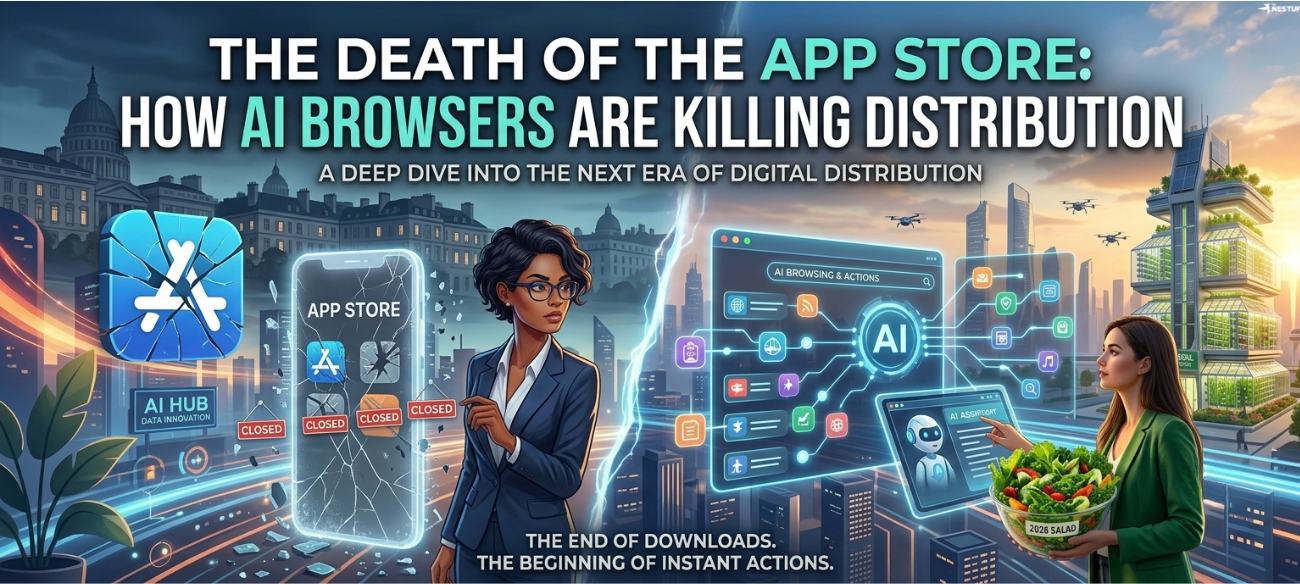
Introduction: The End of the "Download the App" Era
For nearly two decades, the digital economy has been governed by a single, friction-heavy mandate: "Download the app." This era of mobile computing, characterized by fragmented workflows and constant context-switching, forced users to navigate app stores, manage updates, and learn myriad distinct interfaces just to accomplish basic tasks. It is a world where the user serves as the manual integrator, stitching together services through sheer cognitive labor.
By 2026, we are entering a reality where this manual paradigm is being dismantled. The emergence of a sophisticated "intelligence layer" is beginning to supersede the application itself. We are transitioning from a world of manual navigation to one of pure "Intent." In this new architecture, the AI browser and the autonomous agent act as the primary operational layer, rendering the underlying software effectively invisible to the end-user.
From Manual Navigation to Raw Intent
Traditional software design requires the user to be the primary engine of integration. To execute a single workflow, you might open a banking app to verify a balance, a spreadsheet to log data, and a messaging platform to coordinate a payment. The AI orchestration layer eliminates these hurdles by shifting the fundamental focus from the tool to the desired outcome.
Instead of requiring the user to master five different interfaces, the user transition moves toward a single conversational command: “Handle this for me.” The implications go beyond simple convenience; we are witnessing the erosion of cognitive load as a barrier to entry.
"AI interfaces collapse those steps into conversation."
By collapsing navigation into intent, AI interfaces remove the friction of manual execution. The "Orchestration Layer" assumes the burden of knowing where the data lives and how the buttons are pushed, allowing the human to remain at the level of high-level decision-making.
Apps are Becoming "Invisible Infrastructure"
A new breed of AI-native browsers, such as Comet and Atlas, is redefining our interaction with the web. These platforms represent a shift from treating the browser as a passive viewing tool to an active operational assistant. Comet, for instance, does not merely display a page; it summarizes information, coordinates disparate tools, executes tasks, and maintains context across multiple tabs.
In this model, the "Website as Database" concept takes hold. Platforms like Atlas allow users to think in terms of outcomes—"Book my trip" or "Find the cheapest supplier"—while the AI treats websites and apps not as destinations, but as data environments to be scraped and utilized.
Apps as Service Containers
This evolution presents a catastrophic strategic threat to traditional brand moats:
- Distribution Commoditization: If AI agents choose services automatically based on efficiency, brand loyalty evaporates. The user cares about the completed task, not the icon they clicked to get there.
- Reduced Interface Differentiation: Beautiful UX and "delightful" onboarding become irrelevant if a human never sees the frontend.
- Platform Dependency: Developers face a new form of "agent marketplace" lock-in, where their survival depends on being indexed and prioritized by the AI assistant.
- Margin Compression: Because AI agents can compare pricing, speed, and reliability across dozens of providers instantly, competition will intensify, leading to aggressive price wars in previously shielded software categories.
The API is the New User Interface
In a post-app economy, the hierarchy of value flips. When the primary user is an AI agent rather than a human, backend functionality and machine-readability become the ultimate competitive advantages. The "prettiest" app will invariably lose to the most functional, accessible API.
To achieve success in an AI-browser world, a company’s technical strategy must prioritize:
- API Quality: High-speed, high-availability data access.
- Automation Compatibility: Systems designed for agents to navigate without human intervention.
- Machine Trust: Robust security protocols that allow agents to verify, authenticate, and execute transactions without a human in the loop.
- Interoperability: The ability for a service to plug seamlessly into broader AI-managed workflows.
- Agent Accessibility: Ensuring that data is structured for conversational retrieval and autonomous execution.
This transition disproportionately empowers "invisible" infrastructure companies—those specialized in fintech, logistics, and payment systems—while threatening consumer-facing "destination" apps that rely on manual, ad-driven engagement.
The High Stakes of the New Interface Layer
Historically, the layer that sits between the user and the service captures the lion's share of economic value. We have observed this lineage throughout the evolution of computing: from desktop software to websites, then to mobile apps, and now toward AI-mediated services.
AI browsers represent an existential threat to the Apple and Google App Store model. As agents handle discovery and commerce directly, the traditional pillars of platform power—search advertising, 30% commission fees, and platform lock-in—begin to crumble.
"Whoever controls that layer could gain extraordinary influence over discovery, commerce, and attention."
The battle for this orchestration layer is the next great technological frontier. Whoever owns the agent that interprets the user's intent effectively owns the customer relationship, relegating once-mighty apps to the role of silent subcontractors.
The "Post-App" Reality: Challenges and a Hybrid Future
While the momentum toward a post-app world is significant, the transition faces steep obstacles. Security and privacy remain the primary friction points; users are understandably hesitant to grant AI systems deep operational control over sensitive data. Furthermore, the risk of "hallucinations" and reliability failures makes AI mediation a high-risk proposition for sensitive fields like banking, healthcare, and legal workflows.
Consequently, we are moving toward a hybrid future. In this scenario, AI will act as the orchestration layer for simple, repetitive tasks—summarizing news, booking travel, or managing logistics—while humans will retain direct control via traditional app interfaces for high-stakes, complex workflows. However, even this partial shift will be enough to fundamentally break the current app-store dominance.
Conclusion: The New Rules of Distribution
The core of the digital economy is being rewritten in real-time. We are moving from a battle for "downloads and clicks" to an era of "agent preference and machine trust." Success will no longer be determined by how many people open your app, but by how effectively an AI agent can access your service to fulfill a user's intent.
Convenience has always been the ultimate gravity in technology. While we may feel a lingering nostalgia for the specialized interfaces of the mobile era, history suggests we will gladly trade them for the seamless execution of a world where our software simply works in the background.
As these boundaries blur, every business leader must confront a singular, defining question: Is your business a destination people want to visit, or is it a service an agent can actually use?