
The New AI Arms Race
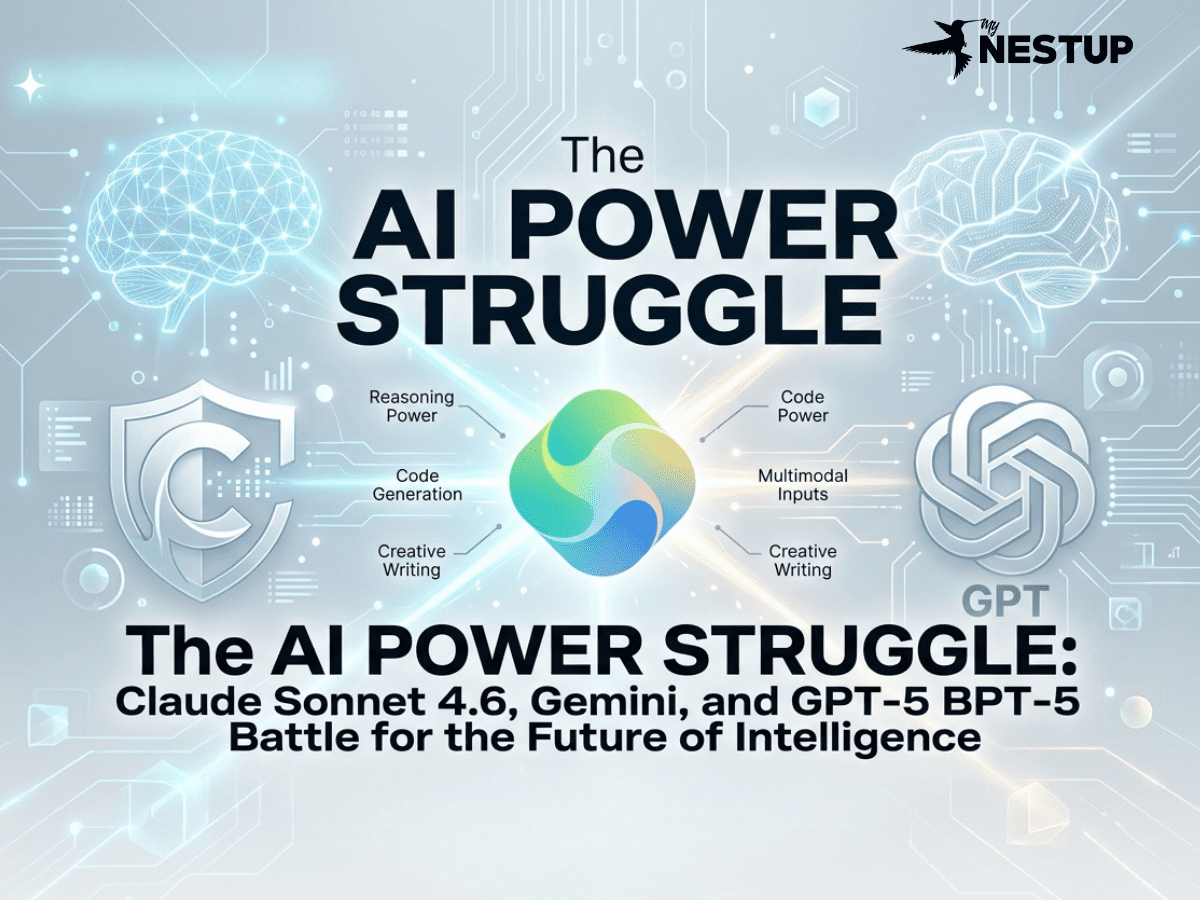
The race to build the most capable artificial intelligence has become one of the defining technological competitions of our time. Three giants currently dominate the conversation: Claude Sonnet 4.6 from Anthropic, Gemini from Google, and GPT-5 from OpenAI. Each embodies a distinct philosophy about what AI should prioritize and how it should integrate into human work — and the resulting competition is reshaping industries faster than most anticipated.
The Real Battleground: Practical Intelligence
The central question isn't which model scores highest on benchmarks — it's which delivers the most useful intelligence for real work. Reliability, reasoning depth, tool integration, and context capacity have become the metrics that actually matter. The models that win users aren't necessarily the most powerful; they're the ones that consistently help people get things done.
Claude Sonnet 4.6: The Precision Thinker
Claude Sonnet 4.6 has carved out a reputation for careful reasoning and instruction-following. Anthropic's approach prioritizes thoughtful, structured responses over flashy capability claims — making Claude the preferred choice for knowledge workers navigating complex documents, nuanced writing tasks, or multi-step analysis. When precision matters more than speed, Claude's methodical style becomes a genuine competitive advantage.
Gemini: Google's Integrated Intelligence
Gemini represents something different: AI as infrastructure. Embedded across Google's ecosystem — search, productivity tools, development environments — it doesn't ask users to change their habits. It meets them where they already work. Its multimodal capabilities (text, image, video, and audio in a single model) are formidable, but Gemini's true strength is ubiquity. Intelligence woven invisibly into the tools billions of people use daily is a distribution advantage no benchmark can replicate.
GPT-5: The Frontier Model
GPT-5 remains the most visible symbol of the generative AI revolution. Building on the cultural footprint of ChatGPT, OpenAI's flagship pushes aggressively on reasoning, creativity, and autonomy. Rapidly expanding context windows and deep tool integration allow GPT-5 to move beyond answering questions into planning and executing multi-step workflows — functioning less like a chatbot and more like a capable digital collaborator.
Three Philosophies, One Race
The competition reflects genuinely different visions. Anthropic bets on alignment and safety — AI that behaves predictably. Google bets on ecosystem integration — AI that's already everywhere. OpenAI bets on general capability — AI that can do almost anything. These aren't just marketing differences; they shape product design, deployment strategy, and long-term roadmap in fundamental ways.
The Shift Toward Autonomous AI
The next frontier isn't smarter responses — it's autonomous action. The models gaining ground are those capable of planning tasks, gathering information, and executing complex workflows with minimal human direction. The winner of this phase may not be the model with the highest score, but the one that most reliably completes work without hand-holding.
Why Context Windows Are Becoming Critical
As context windows expand into the hundreds of thousands — or millions — of tokens, AI stops being a tool for quick answers and becomes one for deep analysis. Entire codebases, lengthy research reports, and full business documentation sets can now be processed in a single interaction. This shift fundamentally changes what professionals can delegate to AI.
A Multi-Model Future
The AI race is unlikely to produce a single winner. Different models will dominate different domains — developers may gravitate toward one system for coding, writers toward another for long-form content, enterprises toward whichever integrates best with existing infrastructure. The likely outcome is a strategic, multi-model ecosystem rather than one model to rule them all.
The Bigger Question
New versions are arriving faster than ever, each promising sharper reasoning, richer multimodal capabilities, and greater autonomy. But the most important question isn't who wins the race — it's how the race itself changes the way humans work, create, and solve problems. With Claude Sonnet 4.6 refining the art of precision thinking, Gemini embedding intelligence across the internet's backbone, and GPT-5 pushing the frontier of what AI can autonomously accomplish, we're witnessing the opening moves of a transformation that will define the next era of computing.