
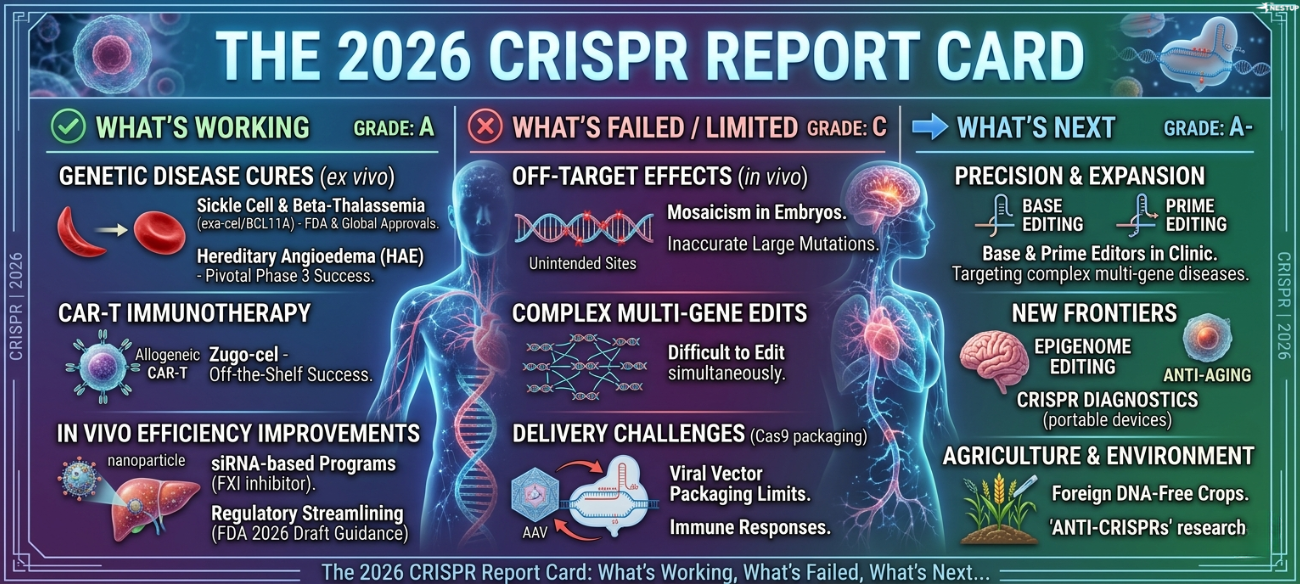
A half-decade ago, CRISPR gene editing was the crowning achievement of speculative science—a theoretical "word processor for life" confined largely to the controlled environments of petri dishes and academic white papers. As we close out 2026, that speculation has hardened into a high-stakes clinical reality. We have moved past the era of asking whether we can rewrite human DNA; we are now witnessing the first generation of patients whose lives have been saved by the edit. Yet, this progress is anything but a straight line. We have entered a transitional period where the central tension of biotechnology is laid bare: while the act of editing genes is becoming "easy," delivering those edits to the right cells safely, equitably, and affordably remains exceptionally hard.
For its performance over the last twelve months—a year defined by breathtaking clinical triumphs overshadowed by a sobering economic reality—the CRISPR field earns an overall grade of B+.
The Science is Outpacing the Business Model
The primary reason the CRISPR revolution fell short of an "A" this year has little to do with molecular biology and everything to do with the "million-dollar paywall." In 2026, the industry collided with a harsh truth: "The science works better than the business model."
While gene-editing therapies for blood disorders are clearing regulatory hurdles with ease, they are stumbling at the point of patient access. These "functional cures" often carry price tags that strain even the most robust insurance systems. Furthermore, the current delivery method is a logistical nightmare; patients must often endure a grueling gauntlet of chemotherapy to clear their marrow, followed by weeks of hospitalization in specialized centers. When a cure requires the infrastructure of a world-class surgical suite and the budget of a small corporation, it ceases to be a medical breakthrough and becomes a luxury good. The grade reflects this gap: a miracle is effectively useless if it remains biologically possible but economically impossible for the vast majority of the "biological puzzles" it was meant to solve.
In-Vivo Editing: Cutting the Tether to the Laboratory
For years, CRISPR was a laborious "ex vivo" process—removing a patient’s cells, editing them in a sterile lab, and re-infusing them like a high-tech transplant. In 2026, we finally began cutting the tether to the laboratory. The momentum has shifted decisively toward in-vivo editing, where the molecular machinery performs its work directly inside the patient’s body.
The watershed moment came from Intellia Therapeutics, which reported sterling Phase 3 results for its treatment of hereditary angioedema (HAE). By delivering the CRISPR components directly into the bloodstream to target the liver, Intellia demonstrated that we could bypass the invasive, expensive extraction of cells. This shift isn't just a technical upgrade; it is the "next major goal" for simplifying treatment, turning what was once a multi-month ordeal into something approaching a standard outpatient infusion.
We Are Seeing "Functional Cures" in Real-Time
The most evocative evidence of CRISPR’s power lies in the raw data of the human experience. In a landmark 2026 study focused on severe blood disorders, 27 of 28 sickle cell patients achieved what researchers called a "functional cure."
The medical significance of this is hard to overstate. These patients have transitioned from lives dictated by the "excruciating pain crises" and frequent hospital visits described in the source, to years of being entirely symptom-free. We are no longer looking at incremental improvements or managed symptoms; we are looking at the permanent correction of a genetic error. For these individuals, they are no longer victims of their own code, but the first beneficiaries of a rewritten future.
The Technology is Shrinking (Literally)
In the world of molecular engineering, the greatest barrier to entry has often been the size of the tools themselves. 2026 marked the era of "genomic miniaturization." Researchers successfully engineered ultra-compact CRISPR systems that can fit into delivery vehicles—such as Adeno-associated viruses (AAVs)—that were previously too small to carry the standard Cas9 "scissors."
In the world of genetic delivery, size matters.
This shrinking of the toolkit is the key that unlocks the rest of the body. By fitting CRISPR into smaller, more agile delivery shells, scientists can now reach previously inaccessible tissues like the brain and deep muscle fibers. This breakthrough is the direct bridge to treating devastating neurological and muscular disorders that were, until now, beyond the reach of genetic medicine.
CRISPR is Moving from "Rare" to "Common"
Initially, CRISPR was the province of "orphan" diseases—rare conditions affecting a few thousand people. That changed in 2026 as the tech moved into the crosshairs of cardiovascular disease, diabetes, and autoimmune disorders. As major pharmaceutical companies pivot their R&D budgets toward gene editing, the scale of the ambition has shifted.
"CRISPR is no longer just for the few; it is becoming relevant to millions of patients rather than thousands."
If gene editing can successfully manage high cholesterol or regulate insulin production, it moves from being a "niche rescue" to a "public health pillar." This expansion is the signal that the market finally views CRISPR not as an experimental gamble, but as a viable foundation for the next century of medicine.
The Unsung Hero: Lipid Nanoparticles
While the CRISPR "scissors" get the glory, the lipid nanoparticles (LNPs) are the workhorses, making it possible. In 2026, these microscopic fat bubbles—the same delivery tech used in mRNA vaccines—became the "unsung heroes" of the field.
The breakthrough this year was "extra-hepatic" targeting. Researchers developed LNPs that can bypass the liver to home in on specific organs like the heart or the pancreas. This is the connective tissue between the science and the common diseases mentioned above: you cannot cure cardiovascular disease if you cannot get to the heart. As the industry has realized, "Improved delivery may ultimately be as important as improvements in the editing technology itself." The most precise edit is a ghost if it cannot find the correct cell.
The Road to 2027
As we look toward 2027, the industry is pivoting from the question of "Does it work?" to "How do we scale it?" The coming year promises the first-ever regulatory approval of an in-vivo CRISPR therapy and a desperate, necessary push toward using automation to collapse manufacturing costs.
The science has largely fulfilled its promise to rewrite the code of life, but the logistics are still catching up. As we automate the "code" and refine the "delivery," we must finally confront the question that 2026 left unanswered: In a world where the very instructions for human life can be edited, will that power be a universal human right, or a luxury reserved for the few who can afford the upgrade?