
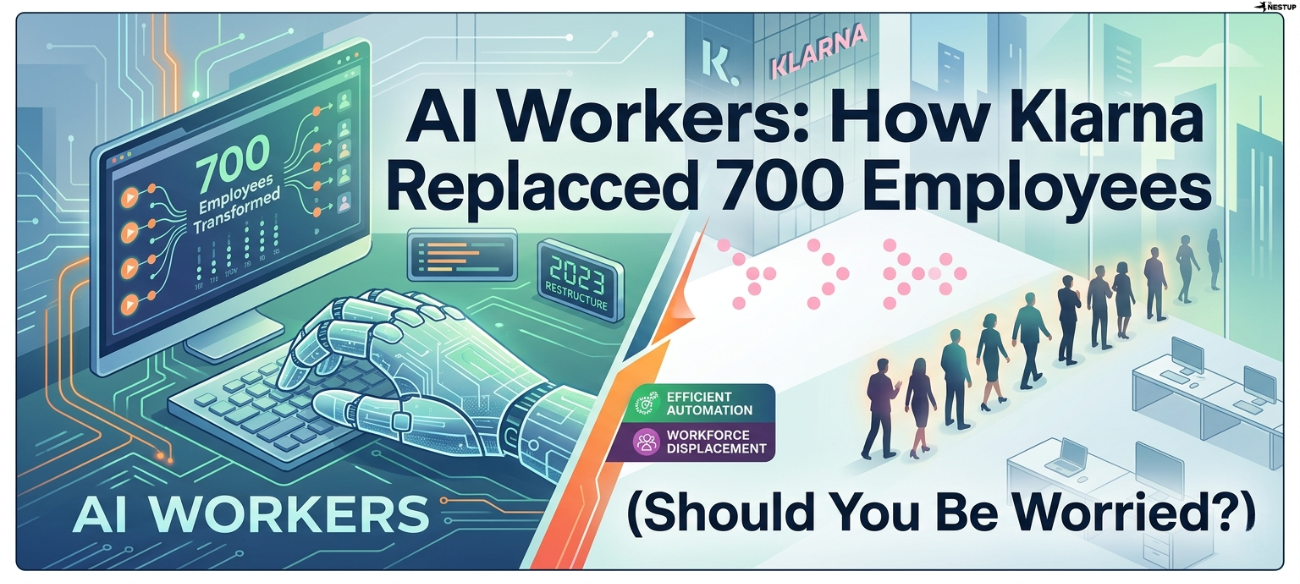
The AI Workforce Revolution Just Got Real
For years, conversations about artificial intelligence replacing human workers felt like something far off in the future. Company leaders talked about automation. Experts debated what might happen. Employees wondered whether AI would eventually affect their jobs. Then companies started sharing real results. One of the most talked-about examples came from Klarna, a major fintech company, which reported that its AI-powered customer service systems were handling work that was previously done by hundreds of support agents. The headline was hard to ignore: AI was doing the equivalent work of around 700 customer service employees. For some people, it was proof that a major wave of job replacement had already started. For others, it showed that companies could become much more efficient without hurting customer service. The truth is more complicated—and much more important—than either of those views. This case study looks at what actually happened at Klarna, how the company introduced AI into customer service, what results it achieved, and what workers and businesses can learn from it.
Who Is Klarna?
Klarna is one of the world's largest financial technology companies. It is best known for its buy-now-pay-later services, consumer financing products, and online payment solutions. The company serves millions of customers across many countries and handles huge numbers of customer support requests every day.Like many online businesses, customer service is both an essential part of the business and a major expense. That made Klarna a strong candidate for testing AI on a large scale.
What Klarna Actually Did?
The popular version of the story is simple: "AI replaced 700 workers." But what happened was much more detailed than that. Klarna introduced advanced AI customer-service systems powered by large language models that could handle customer conversations through chat and messaging platforms. The AI systems were trained to help with common support requests, including:
- Payment questions
- Refund requests
- Account management
- Order tracking
- Basic troubleshooting
- Frequently asked questions
Instead of sending every customer to a human agent, Klarna allowed AI to solve many issues on its own. The result was a major reduction in the amount of human work needed to manage routine customer service requests.
Why Customer Service Became AI's First Big Target
Customer service is one of the easiest business functions to automate. Several factors make it a good fit for AI:
- High Volume: Support teams deal with thousands or even millions of similar requests.
- Structured Workflows: Many customer questions follow the same patterns.
- Existing Documentation: Most companies already have detailed support articles and knowledge bases.
- Digital Communication: Many customer interactions happen through text, which works well with language models.
Unlike jobs that require physical work, relationship-building, or complex creative thinking, customer service includes many tasks that AI can handle effectively. This does not mean customer service jobs disappear completely It means many routine tasks can now be automated.
The Quality Question Everyone Asked
The biggest concern was not cost savings. It was quality. Would customers actually be happy talking to AI? Traditional automated customer-service systems have never been very popular. People became used to:
- Endless phone menus
- Unhelpful chatbots
- Robotic responses
- Frustrating experiences
Modern AI changed that. Large language models can understand context, carry on conversations, and respond in a way that feels much more natural than older chatbots. Klarna reported that its AI systems successfully handled a large share of customer questions while maintaining service quality levels that were similar to human agents. This may have been the most important result. If AI had been cheaper but noticeably worse, businesses would have been much slower to adopt it. Instead, many companies saw evidence that AI could improve efficiency without seriously damaging the customer experience.
Where Humans Still Outperformed AI
Even with strong results, AI did not remove the need for human support agents. Some situations are still difficult for AI to handle.
- Complex Cases: Financial disputes involving multiple steps often require human judgment.
- Emotional Situations: Upset customers usually respond better to a real person who can show understanding and empathy.
- Edge Cases: Unusual situations often do not fit standard processes.
- Regulatory and Compliance Issues: Financial services operate under strict rules and regulations that frequently require human review.
In reality, AI handled routine requests while human agents focused on more difficult and sensitive cases. This type of teamwork between AI and humans may become common across many industries.
Did 700 People Actually Lose Their Jobs?
This is where many headlines oversimplify the story. When a company says AI is doing work equal to hundreds of employees, it does not automatically mean hundreds of people were fired. In many cases, companies use automation in other ways. They may hire fewer new employees, reduce outsourced work, choose not to replace workers who leave, move employees into different roles, or simply slow the growth of their workforce. Every company approaches automation differently. However, the larger trend is clear. Businesses can now serve more customers without hiring people at the same rate as before. That has major effects on workforce planning across many industries.
The Economics Behind the Decision
From a business point of view, the reasons are easy to understand. AI systems can operate around the clock, support customers in multiple languages, handle huge numbers of conversations at the same time, and do so without overtime pay or scheduling challenges.
For companies managing millions of customer interactions every year, even small efficiency gains can save millions of dollars. Once one major company proves that the system works, competitors often feel pressure to adopt similar technology in order to remain competitive.
What This Means for Employees
The lesson is not that every job will disappear. The lesson is that every task will be examined.
In the past, companies viewed jobs as complete roles. AI changes that way of thinking. Businesses are increasingly looking at individual tasks and asking which activities can be automated, which require human judgment, and which are best handled through collaboration between humans and AI. Workers whose jobs involve highly repetitive digital tasks face the greatest risk of disruption. Meanwhile, employees who combine technical knowledge, communication skills, creativity, problem-solving, and decision-making abilities remain much harder to replace.
The New Skill That Matters Most
Many people assume the future belongs only to AI specialists. But the most valuable workers may actually be those who know how to work effectively with AI. Future jobs are likely to involve supervising AI systems, reviewing AI-generated work, handling unusual situations, managing customer relationships, and making important business decisions. Rather than replacing every worker, AI often changes the kind of work people do. The shift is similar to how spreadsheets transformed accounting or how search engines transformed research. Productivity increased dramatically, but human expertise remained essential. The same pattern may play out with AI.
Lessons for Other Companies
The Klarna case provides several useful lessons for businesses thinking about adopting AI. Companies should begin with repetitive and predictable processes because automation works best when tasks follow clear patterns. They should also carefully measure outcomes, since saving money alone is not enough if customer satisfaction suffers. Successful companies maintain clear paths for customers to reach human agents when problems become complicated. Many organizations also find that AI delivers the greatest value when it helps employees become more productive before replacing tasks entirely.
Most importantly, businesses should treat AI as a transformation project rather than simply a technology purchase. Training, leadership, business processes, and change management are just as important as the software itself.
Should You Be Worried?
The answer depends less on your job title and more on the type of work you do.
If most of your daily work involves:
- Repetitive information processing
- Standard communication
- Routine paperwork
- Predictable decisions
AI will probably affect your role.
If your work requires:
- Building relationships
- Leadership
- Creativity
- Strategic thinking
- Complex judgment
- Coordinating across teams
AI is more likely to become a helpful tool than a replacement.
The biggest risk may not be being replaced by AI.
It may be being replaced by someone who knows how to use AI more effectively.
The Bigger Picture
Klarna's AI project is not a one-time event.
It is part of a larger shift in how businesses think about work, productivity, and technology.
Customer service was one of the first areas to change because it was especially well suited for automation.
Other knowledge-based jobs are already seeing similar changes.
Marketing.
Research.
Finance.
Legal operations.
Human resources.
Software development.
The question is no longer whether AI will reshape these industries.
The question is how quickly companies and workers can adapt.
Final Thoughts
The story of Klarna using AI to perform the equivalent work of 700 customer-service employees is not really a story about job losses.
It is a story about productivity.
Every major technology revolution has allowed fewer people to accomplish more work.
Artificial intelligence appears ready to continue that trend.
For businesses, that creates opportunities to grow faster and operate more efficiently.
For workers, it creates a need to build skills that work alongside automation instead of competing against it.
The people most likely to succeed in the AI era will not be those who ignore the technology—or those who fear it.
They will be the ones who learn how to use it better than everyone else.