
The modern productivity industry is selling you a lie of complexity. You have been conditioned to equate efficacy with elaborate systems: waking up at 4:30 a.m., color-coding every minute of your existence, or juggling a dozen different apps that require more work to maintain than the tasks they track.
This chaos is a smokescreen. Most high-performers don’t succeed because they have more hours or better software; they succeed because they have mastered the art of ruthless elimination. Modern work isn't a productivity problem—it’s a prioritization problem. The 1-3-5 Rule is the architecture that allows you to stop "doing more" and start achieving what actually matters.
The 37-Task Trap: Why Your To-Do List is Failing
Traditional to-do lists are not tools; they are graveyards for your focus. Open a typical professional’s list and you will likely find 37 unfinished tasks—a mixture of critical milestones, low-priority admin, and forgotten reminders with no deadlines.
When your list is an infinite scroll, every item appears equally important. This creates a psychological paralysis that drives you toward "easy" wins. You answer emails, update a spreadsheet, or organize files. These tasks feel productive because they trigger a minor dopamine hit, but they are hollow. They keep you busy while your major projects remain stagnant.
"Most people don't have a productivity problem. They have a prioritization problem."
The 1-3-5 Rule ends this cycle by forcing you to define impact before the day begins.
The Rule of Nine: A Blueprint for Impact
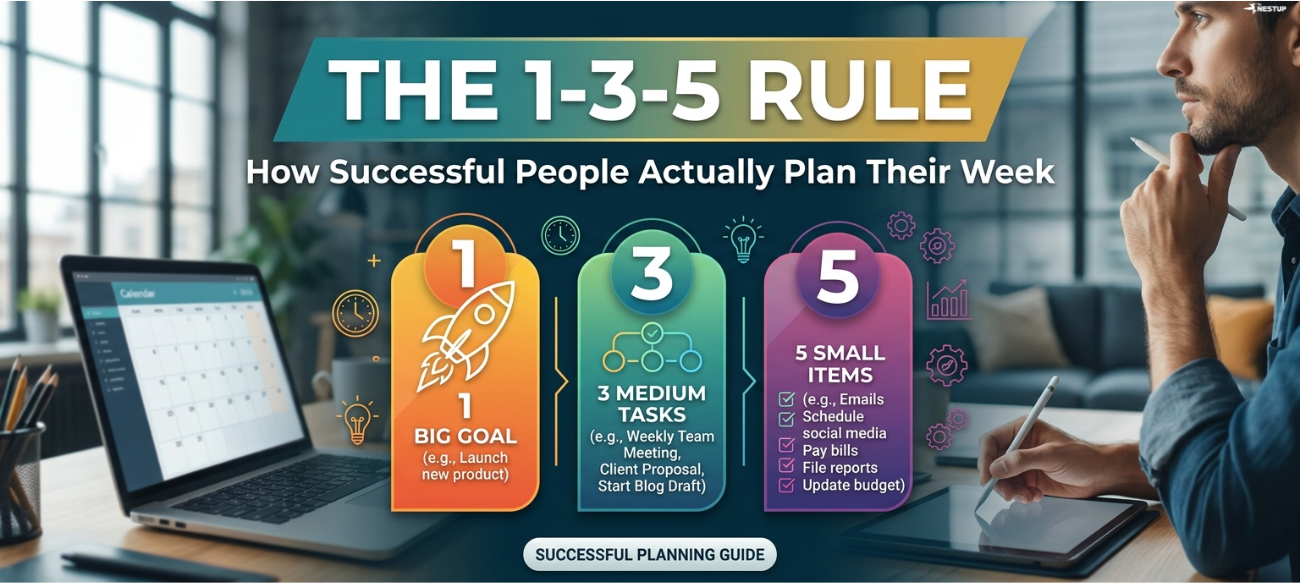
The 1-3-5 framework creates a structured "Rule of Nine." It limits your daily output to nine specific tasks, categorized by their weight and necessity. To understand how this works in practice, consider the day of a freelance marketing consultant:
1 Big Task
This is the primary outcome. It is a substantial objective that requires your peak cognitive energy. If you complete this, the day is a success—even if nothing else gets done.
- Consultant Example: Finalizing a complete marketing strategy proposal for a new high-value client.
- Other Examples: Completing a product design or launching a marketing campaign.
3 Medium Tasks
These are supporting goals. They are important and move the needle, but they don't require your entire day.
- Consultant Example: Conducting a client discovery call, reviewing advertising performance reports, and drafting social media content.
- Other Examples: Conducting a project meeting or researching competitors.
5 Small Tasks
These are the maintenance and administrative "taxes" of professional life. They keep the lights on but should never dominate your calendar.
- Consultant Example: Replying to emails, sending invoices, updating the project tracker, scheduling next week's meetings, and reviewing contract changes.
- Other Examples: Approving documents or returning phone calls.
The 5-8-20 Trap: Why More is Actually Less
The most common failure in this system is "task inflation." Ambitious professionals often attempt to hack the framework by choosing five big tasks and eight medium ones—the "5-8-20" trap.
When you ignore the constraints of the rule, the system collapses. The power of this framework isn't found in the list itself, but in the boundaries it sets.
"The power of the framework comes from constraints. You are deliberately limiting yourself to what can realistically be accomplished."
By respecting the reality of a finite workday, you stop the "busy work" from cannibalizing the time required for high-impact deep work.
Generating "Automatic" Progress
Human beings have a finite supply of decision-making capacity and energy. This is why you must tackle your 1 Big Task during your peak morning hours, when your cognitive battery is full.
Narrowing your focus creates a psychological shift: you stop relying on fickle motivation and start generating momentum. When the most critical task is consistently completed every single day, your major long-term goals begin to move forward almost automatically. You are no longer reacting to your day; you are architecting it.
From Daily Wins to Weekly Success
The 1-3-5 Rule scales effectively into a high-level strategic roadmap. Instead of starting your week in a defensive crouch, use a Monday Morning Review to audit your previous week's performance and set the trajectory for the next five days. Identify your One Major Weekly Goal—the achievement that would define the week as a win—and break it down using this template:
Weekly 1-3-5 Planning Template
| Category | Strategic Objective |
| 1 Big Goal | e.g., Launch new website or finish book chapter |
| 3 Medium Priorities | 1. <br> 2. <br> 3. |
| 5 Small Tasks | 1. <br> 2. <br> 3. <br> 4. <br> 5. |
Beyond Chatbots: AI as a Workflow Architect
You shouldn't just use AI to generate text; you should use it to audit the logic of your day. AI can act as a planning assistant that identifies dependencies and estimates the time required for your objectives, transforming a raw list into a realistic execution plan.
To turn AI into a strategist, use the following prompt:
Copy-Paste Prompt: "Analyze the following task list and organize it using the 1-3-5 framework.
Requirements:
- Select one high-impact task as the 'Big Task.'
- Choose three medium-priority tasks.
- Select five small administrative tasks.
- Identify any dependencies (tasks that must be done before others).
- Explain the strategic logic for why each task belongs in its category.
- Estimate the time required for each item.
Task List: [PASTE YOUR RAW LIST HERE]"
Choosing Better Priorities
High performance is not a result of working longer hours; it is the result of choosing better priorities. The 1-3-5 Rule works because it is simple enough to survive the chaos of a busy week, yet rigid enough to prevent the overwhelm that leads to burnout.
Stop asking: "How can I get more done?" Start asking: "What's the one thing that matters most today?"
Build your day around that answer. By consistently focusing on what moves the needle, you will achieve more in a single week than most people achieve in a month of scattered, unprioritized effort.