
Introduction: The "What Actually Changed?" Problem
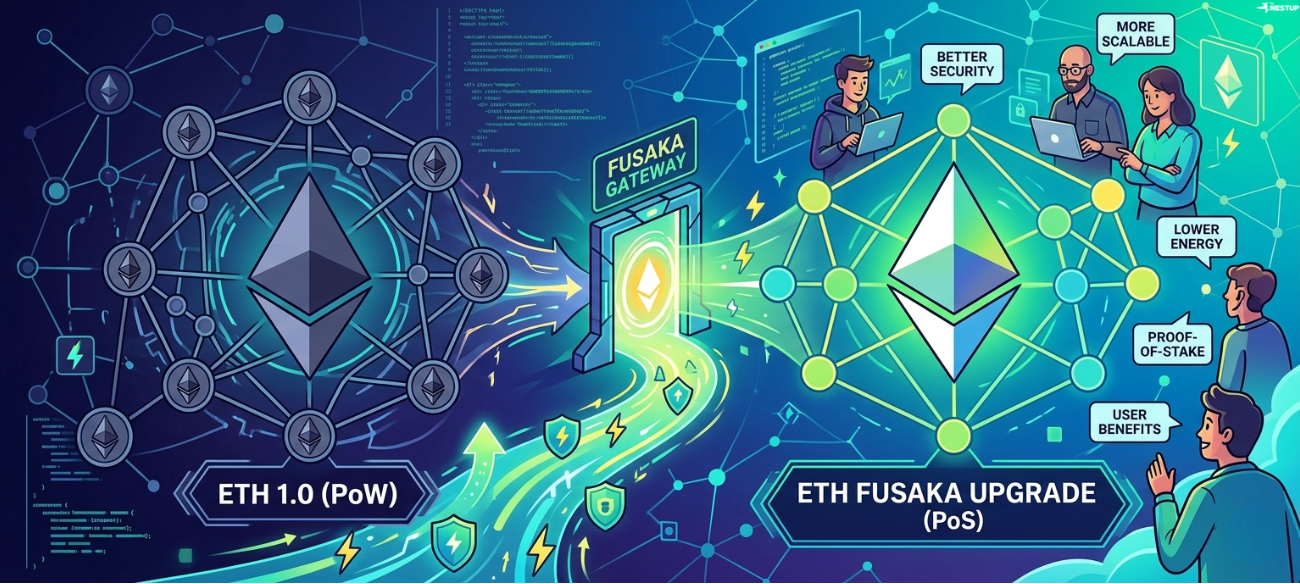
Ethereum upgrades often arrive trailing a cloud of technical acronyms and developer jargon. For many, these milestones feel like "alphabet soup"—significant to those writing the code, but opaque to everyone else. When the Fusaka upgrade went live in December 2025, it didn’t come with a flashy rebrand or a dramatic marketing campaign, yet it represents a pivotal infrastructure shift.
Following the momentum of previous milestones like Dencun and Pectra, Fusaka—a name derived from the combination of the Fulu (consensus layer) and Osaka (execution layer) upgrades—is more than just a routine patch. It is the bridge between a congested, expensive past and a future where Ethereum acts as the invisible foundation for a massive global crypto economy. For those looking past the technical labels, Fusaka is the moment Ethereum’s long-term scaling strategy moved from theory to reality.
PeerDAS—The "Quality Control" Hack for Data
The crown jewel of the Fusaka upgrade is a feature called Peer Data Availability Sampling, or PeerDAS. To understand its significance, we have to look at the "Before" state: previously, every Ethereum validator was required to download and verify every "blob" of data posted by Layer 2 networks. It was like requiring every librarian to read every single page of a multi-volume encyclopedia just to prove the books arrived. As Layer 2 activity grew, this became a massive burden on bandwidth and hardware.
PeerDAS replaces this exhaustive process with an intelligent "Random Check" method:
- Before: Validators downloaded every single blob of data to confirm it existed.
- After: Validators only need to sample small, random portions of the data to mathematically confirm its validity.
By shifting to this sampling model, Ethereum can support significantly more activity without overwhelming the people running the network. This ensures that even as the network scales, the hardware requirements for validators remain sustainable, keeping the dream of true decentralization alive.
The End of High L2 Fees?
Because PeerDAS expands Ethereum’s capacity to handle data, Layer 2 (L2) networks—such as Arbitrum, Optimism, Base, and zkSync—can post their transaction data much more efficiently. For the end user, this translates directly into a dramatic reduction in transaction costs.
Whether you are swapping tokens in DeFi, playing a blockchain-based game, or sending a stablecoin payment, the reduction in overhead for L2s makes these actions nearly frictionless.
"Some ecosystem estimates suggested 40–60% lower Layer 2 costs, with potentially even larger reductions during low congestion periods."
This shift reinforces Ethereum’s core architecture: keeping the main network (Layer 1) highly secure while pushing high-volume, daily activity onto cheaper, more responsive Layer 2 systems.
Boosting the "Engine" (The 60 Million Gas Limit)
Beyond data sampling, Fusaka physically increased the capacity of the Ethereum "engine." The network’s block gas limit—a measure of how much computation can happen in a single block—was increased from a range of 36–45 million gas to a new 60 million gas capacity.
In plain English, this means:
- Higher Throughput: More transactions can be processed at once.
- Reduced Congestion: The network can handle spikes in activity without fees skyrocketing as quickly.
- Room for Complexity: Developers can build smarter, more sophisticated applications that require more "power" to run.
This capacity hike is supported by the EVM Object Format (EOF), a major win for developers. EOF restructures how smart contracts are packaged, leading to cleaner contract structures and faster innovation. For the user, this means fewer bugs and more performant applications. Crucially, these increases were balanced with safety mechanisms to ensure the network remains stable even under the higher workload.
Goodbye Seed Phrases, Hello FaceID
One of the most practical improvements in Fusaka involves a cryptographic standard known as secp256r1. While it sounds like a serial number, its inclusion is a massive victory for the "human-first" blockchain experience.
Most modern smartphones and laptops use this specific standard for their secure enclave chips. By supporting it natively, Ethereum allows wallets to integrate mobile-native authentication like FaceID, Fingerprints, and Passkeys.
This is a major step toward "account abstraction." For years, the greatest barrier to entry was the emotional friction of the seed phrase—the persistent "terror" and "anxiety" of losing a 12-word string and with it, all your assets. By moving toward the seamlessness of FaceID, Fusaka quietly moves crypto closer to a "mobile-first" reality that the average person can actually navigate with confidence.
The "Modular" Vision Becomes Reality
Fusaka marks a point of no return for Ethereum’s strategic evolution. It solidifies the "Modular" roadmap, where the network functions as a specialized stack of layers.
In this model, Layer 1 acts as the high-security settlement and security layer, but it also remains the vital economic coordination layer where value is anchored. Meanwhile, Layer 2s handle the heavy lifting of execution and scale.
For long-term holders and investors, this makes the scaling story far more credible. It proves that Ethereum can evolve to support millions of users by serving as the foundation for other networks. This upgrade provides the necessary infrastructure for the next major roadmap phase, "Glamsterdam," expected in 2026.
Conclusion: The Quiet Foundation of the Future
The Fusaka upgrade may not have changed the price of ETH overnight, but it provided the essential plumbing required for a global economy. By making Layer 2s cheaper, improving validator efficiency, and allowing for biometric security, Ethereum has addressed the twin pillars of infrastructure sustainability and user experience.
Infrastructure is rarely exciting until it works so well that you forget it’s there. As we look toward a future of global stablecoin economies and institutional adoption, we must ask: do we value the "flashy" updates that dominate headlines, or the "quiet" infrastructure that makes mass adoption possible?