
It is a striking contradiction I see throughout the corporate world: most executives spend more time meticulously planning a one-week vacation than they do architecting their entire year. This lack of strategic structure leads to a predictable failure cycle. Most professionals sabotage their 2027 before it even begins by relying on "January motivation"—a fleeting spark that inevitably fades into a haze of forgotten goals by mid-March.
High-performance CEOs do not rely on hope; they treat their life like a strategic operation. They understand that a breakthrough year is the result of a rigorous, focused review process. The "4-Hour Annual Review" is the executive secret to breaking the cycle of unfinished goals and ensuring every action taken is aligned with a high-leverage strategy.
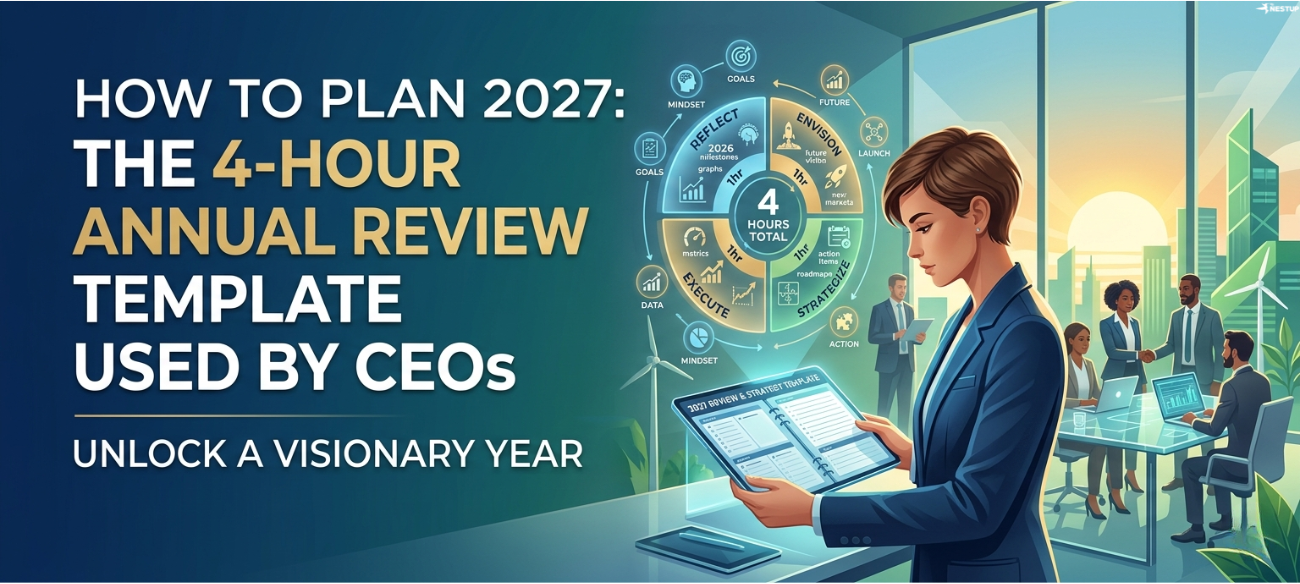
To ensure your 2027 is engineered for maximum ROI, your four-hour investment is divided into a precise blueprint:
- 60 Minutes: The Post-Mortem (Reflection)
- 60 Minutes: The 4-Quadrant Analysis (Pruning)
- 45 Minutes: Identifying Keystone Objectives (The Rule of Three)
- 45 Minutes: 12-Week Execution Blueprint
- 30 Minutes: Establishing Review & Thinking Disciplines
Step 1: The 60-Minute Strategic Post-Mortem
Before looking ahead, you must understand the terrain behind you. Most people enter a new year carrying the weight of unexamined failures. An Executive Strategist knows that intelligence is gathered from history. You must perform a honest diagnostic on the past 12 months by asking three critical questions:
- What Went Well? Identify your biggest wins in career, finance, health, and relationships. High performers often underestimate their achievements because they never stop to catalog them.
- What Didn't Go Well? Be ruthless. Look at missed opportunities, bad habits, and projects that drained resources without a return. This isn't self-criticism; it’s data collection.
- What Surprised You? Unexpected challenges or interests often provide the most valuable clues for where your future focus should shift.
Step 2: The Power of the "Stop Doing" List
Strategic clarity is achieved not by what you add, but by what you remove. While the average person obsesses over "Start Doing" lists, high-performance coaching dictates a focus on elimination. Using a 4-Quadrant Analysis, categorize your activities into: Keep Doing, Stop Doing, Start Doing, and Improve.
The "Stop Doing" quadrant is your highest priority. This is where you identify the time-wasters, unnecessary meetings, and negative relationships that serve as anchors on your productivity. Furthermore, you must avoid the trap of copying other people’s goals. Your 2027 must reflect your internal values, not someone else’s social media highlight reel.
"Clarity often comes from reflection, not action."
Step 3: The Keystone Objective (Concentration of Force)
In annual planning, not all goals are created equal. High performers ignore the "Top 20" list and identify Keystone Objectives—goals that, when achieved, create a positive domino effect across every other area of life.
The classic example is Health. Improving physical vitality doesn't just impact your fitness; it sharpens mental focus, increases energy for business, and boosts confidence. By selecting goals with the highest leverage, you ensure your efforts yield compounding returns. To maintain this concentration of force, you must adhere to The Rule of Three. Setting more than three major objectives for the year guarantees diluted focus. Your strategic filter for 2027 should be:
- Improve health and fitness.
- Increase annual income by 30%.
- Build a valuable new professional skill.
Step 4: The 12-Week Execution Sprint
A calendar year is a dangerously long horizon that encourages procrastination. To maintain a high-performance tempo, you must shorten your perspective from 12 months to 12 weeks. This psychological shift turns a marathon into a manageable sprint.
The March Deadline Mindset
Instead of focusing on December, define exactly what must be accomplished by the end of March. This requires moving from "vague intentions" to "trackable actions." If your goal is health, "getting fit" is a wish; "exercising four times per week" and "walking 10,000 steps daily" are executive mandates. Specificity is the only antidote to frustration.
Step 5: The "Thinking Habit" as a Professional Discipline
The most underrated productivity habit in the world is the discipline of scheduled reflection. I see a recurring failure in the C-suite where leaders spend 100% of their time reacting to emails and meetings rather than thinking about strategy.
You must transition from working in the day-to-day to working on the strategy of your life. This requires two non-negotiable disciplines:
- The Thinking Habit: Scheduled time every month to review goals, finances, and priorities without the noise of notifications.
- The 15-Minute Course Correction: A weekly review asking: What worked? What didn't? What is the next important action? These small weekly adjustments prevent major year-end failures.
"If it isn't scheduled, it probably won't happen."
Your 4-Hour Investment
The difference between a year of stagnation and a year of breakthrough performance is clarity. A successful 2027 is not built on hope; it is built on a simple, focused plan. You do not need a complex system; you need four focused hours of honest reflection and the discipline to prioritize what actually moves the needle.
As you look toward the horizon, I challenge you: what could your life and career look like by 2028 if you stopped relying on luck and started relying on a plan? Hope is not a strategy. Take one afternoon, review the data, and decide what matters. A year from now, you will be glad you did.