
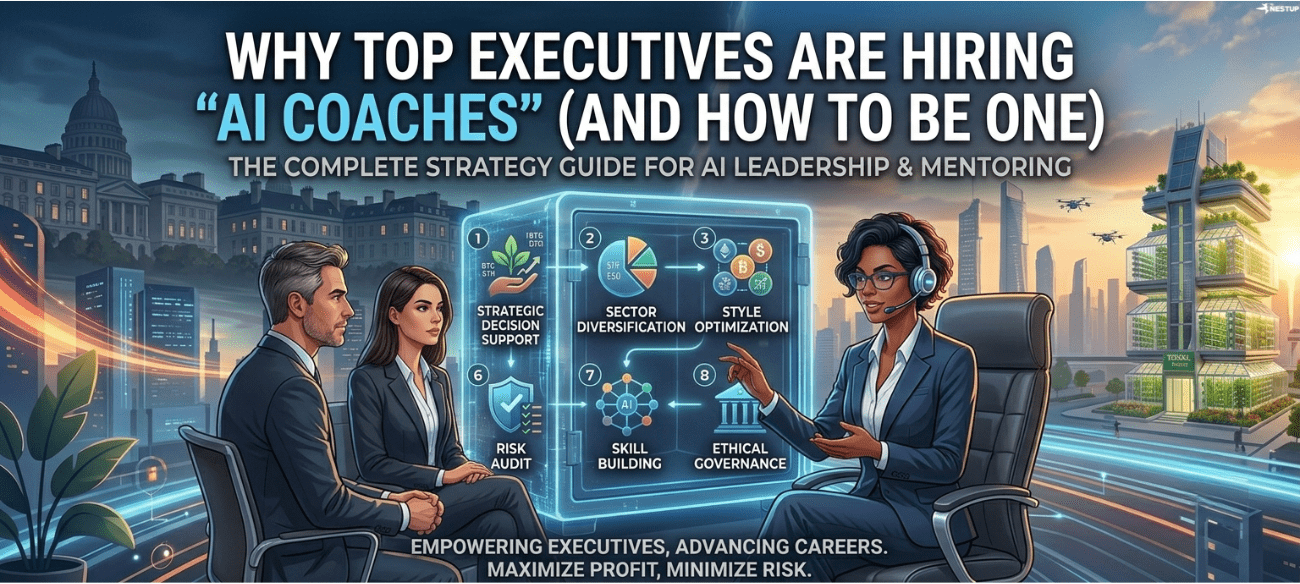
The Executive’s Quiet Panic: Bridging the Competence Gap
In boardrooms across the globe, artificial intelligence has transitioned from a technical curiosity to a non-negotiable boardroom priority. CEOs, founders, and senior leaders face immense pressure to revolutionize their operations, yet they are trapped in a unique paradox: they are mandated to lead an AI transformation while privately harboring a sense of personal incompetence. They lack the technical background to navigate this shift and, more critically, they lack the time to master it through trial and error.
This gap between institutional mandate and individual bandwidth has birthed a lucrative new professional role: the AI Coach. This is not a role for the data scientist or the software engineer, but for the high-level advisor who can solve the "operational friction" of the modern C-suite. They are the "trusted guides" who help leaders bridge the chasm between what AI can theoretically do and how it can be deployed today to secure a competitive advantage.
The Interpreter: Why Your Coding Skills Are Irrelevant
The prevailing myth—that AI mastery requires a background in Silicon Valley—is not just wrong; it’s a barrier to entry. For the elite AI coach, the role is not about engineering software; it is about serving as a "translation layer" between technological capability and business value.
The core of the work involves teaching strategic thinking, automating repetitive workflows, and refining leadership communication. While the AI acts as the technical engine, the coach provides the only thing the machine cannot: organizational context and leadership nuance. You are not there to explain model architecture; you are there to facilitate human adaptation to a new era of work.
"You do not need to sound like an engineer. You need to sound useful."
Business fluency is the ultimate premium. Executives don't need to know how a transformer model functions; they need to know how to use Large Language Models for sales proposal automation, inbox management, or meeting summarization. In this ecosystem, being "useful" beats being "technical" every time.
The Asymmetric Advantage: Why Executives Pay $2,500 per Hour
The financial logic of AI coaching is rooted in the value of executive time. While entry-level practitioners might charge $50 to $150 per hour, the market for top-tier advisors serving the C-suite is vastly more lucrative. These consultants command between $500 and $2,500+ per hour, moving quickly from hourly sessions into six-figure enterprise retainers and $100,000+ consulting engagements.
This premium is justified by a clear return on investment. For a CEO earning millions annually, time is the most expensive asset in the organization. If an AI coach implements a "Signature Framework" like the AI Executive Workflow System that saves a leader just five hours a week, the value of that reclaimed time—and the resulting clarity in decision-making—far exceeds the cost of the coaching. In the high-stakes world of executive leadership, speed is the primary currency.
The Psychology of Adoption: Navigating the Boardroom Paradox
Behind the professional exterior, many leaders are navigating a genuine fear of falling behind. They require a guide who can provide clarity in a rapidly changing environment without making them feel uninformed. This is a psychological transition as much as a technical one.
Traditional corporate training fails because it lacks this personalization. As noted in current industry insights:
"Corporate AI workshops are often too broad or technical. Executives want practical guidance tailored to their industry, goals, and leadership style. That personalization is what makes AI coaching valuable."
An effective coach acts as both educator and strategist, helping the executive build confidence and integrate AI tools gradually into their unique leadership style.
Selling Outcomes: The Blueprint for a Premium Practice
To command elite rates, you must pivot away from being a "generic AI expert" and position yourself around high-value transformations. Specialists who target specific niches—such as Legal (document drafting and research summarization), Sales (prospect research and proposal writing), or Finance (data interpretation)—consistently out-earn generalists.
Consider the difference in market positioning:
- Weak Positioning: "I teach teams how to use ChatGPT."
- Strong Positioning: "I help legal firms reduce document drafting time by 60% using custom AI workflows."
The most successful coaches use an AI Productivity Audit as an entry offer. By reviewing an executive’s communication habits, reporting systems, and research processes, they can identify exactly where AI can save 10+ hours weekly. This immediate, measurable value builds the trust required for long-term, six-figure advisory roles.
Conclusion: The Rise of the "Human-in-the-Loop" Advisor
The profession of AI coaching is in its infancy, but its trajectory is clear: it is evolving into a permanent pillar of corporate AI advisory and executive transformation consulting. As AI tools become standard, the winners in this new economy will not be the most technical individuals, but the most effective communicators—those who can simplify the complex and make innovation actionable.
We are entering an era of "Human-in-the-Loop" leadership, where the coach is the vital catalyst for organizational change. As you survey your own industry, ask yourself: Who is currently bridging the gap between the latest innovation and the practical execution your leadership requires? If that bridge doesn't exist, the opportunity is yours to take.