The February Slump
We’ve all felt that surge of midnight adrenaline on December 31st. We declare a "New Year, New Me," promising a total lifestyle overhaul, only to find ourselves back at square one by mid-February. If your resolutions have historically failed, it is not due to a personal lack of willpower.
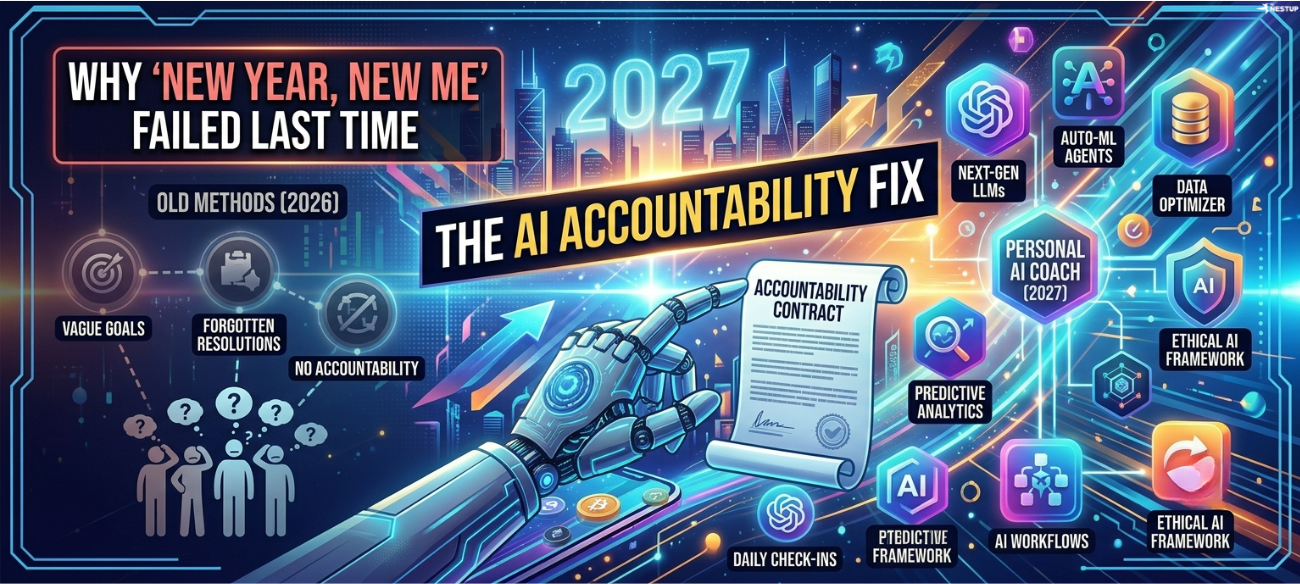
As a behavioral strategist, I view this not as a character flaw, but as a design failure. Traditional goal-setting relies on fleeting emotional waves. To achieve lasting change, you must transition from relying on motivation to building an unshakeable infrastructure of execution. Artificial Intelligence is the missing architectural component in this system.
The "False Hope" Trap: Why Your Brain Short-Circuits
Most resolutions collapse under the weight of "false hope syndrome." This occurs when we set massive, vague expectations—like "mastering AI workflows" or "fixing my routine"—without modifying our actual environment.
In our modern world, your prefrontal cortex is under constant siege from notifications and decision fatigue. This part of the brain is responsible for complex habit formation, but it is a limited resource. When you have a stressful day or a poor night's sleep, your brain runs out of the mental energy required to force new behaviors. You default to old, comfortable patterns because your environment hasn't been engineered to support anything else.
We do not rise to the level of our grand goals; we fall to the level of our systems.
Shift from Motivation to Systems
Long-term change requires moving away from inconsistent human emotion and toward a system of execution. Human willpower is a fluctuating variable; an objective external system is a constant.
AI provides an advantage that no human accountability partner can match: total objectivity. An AI doesn’t have "bad days," it doesn’t get tired of your excuses, and it doesn't experience emotional fatigue. It serves as a frictionless, interactive scaffolding that remains stable even when your personal motivation wanes.
Pillar 1: The AI "Chief of Staff" Daily Check-In
The primary gap in personal growth is the absence of a daily feedback loop. You can utilize an AI assistant as a non-judgmental "chief of staff" to evaluate your performance.
There is a critical behavioral insight here: The "Shame Gap." Humans often lie to human coaches or friends to avoid judgment, but they are remarkably honest with data-driven AI. Set a recurring calendar alarm for 9:00 PM. At this time, provide the AI with a brief summary of your day using this prompt:
Act as my direct, supportive, and data-driven accountability coach. I am going to give you my target habits and a quick summary of my day. Your job is to analyze my execution, note any recurring patterns or obstacles, and provide exactly one actionable tweak to make tomorrow more frictionless. Keep it grounded and brief.
Pillar 2: The Power of the Habit "Post-Mortem"
Static paper trackers are easy to ignore and offer zero insight. Instead, feed your daily transcripts into a workspace to map out consistency trends. The real power of this system lies in the "post-mortem" analysis performed when a habit is missed.
When we fail, we often experience guilt, which triggers the "what the hell" effect—a behavioral spiral where one mistake leads to total abandonment of the goal. A post-mortem re-engages the logical prefrontal cortex, moving you from emotion to analysis:
- Log the Miss: Tell the AI exactly which habit was skipped.
- Identify Triggers: Describe the environmental factors (e.g., "I stayed late at the office and was too tired to cook").
- Adjust the Environment: Use the AI to suggest a specific friction reduction for the next time that trigger occurs.
Pillar 3: Atomic Sprints and "Implementation Intentions"
Macro-goals (the "what") are often too heavy to lift. AI excels at chunking these into micro-steps (the "how"). By using "Implementation Intentions"—also known as "If-Then" triggers—you remove the friction of decision-making and preserve mental energy for deep execution.
Instead of a vague goal like "researching emerging tech," use AI to design 15-minute atomic sprints. Examples of these triggers include:
- If I pour my first cup of morning coffee, then I will open my research folder and read for ten minutes.
- If I close my laptop to end the workday, then I will spend fifteen minutes writing my article draft.
Engineering a Consistent Future
Upgrading your life is not about becoming a rigid, flawless robot. It is about cognitive offloading. By automating the tracking and planning of your habits, you free up your brain’s processing power for the actual work of execution.
This digital infrastructure grants you the grace to be human while providing the structure to be consistent. You are no longer fighting your brain; you are engineering its success.
What is the single biggest goal you want to systematize using an AI accountability partner this week?