
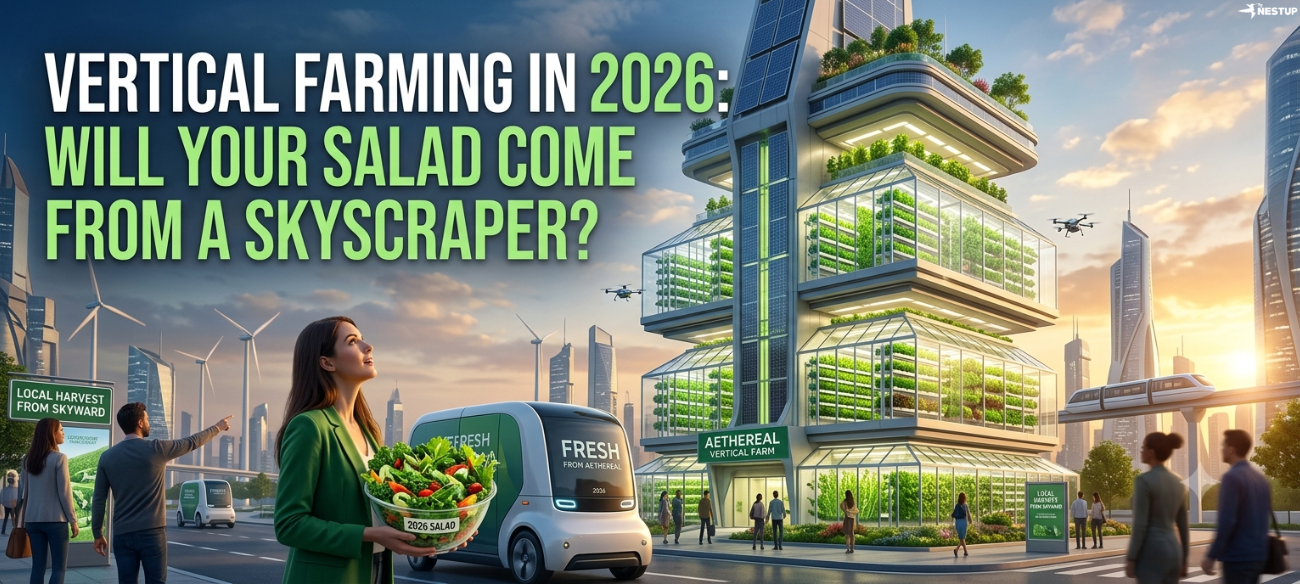
The Great Agricultural Disruption That Wasn’t
A decade ago, the "skyscraper farm" was the darling of the food-tech world. Investors and startups promised a utopian revolution where traditional outdoor agriculture, with its reliance on unpredictable weather and heavy pesticide use, would become as obsolete as a coal power plant. The industry was propelled by a series of irresistible, high-concept promises:
- Pesticide-free produce cultivated in sterile, laboratory-grade environments.
- Hyper-local production that effectively moved the farm inside the city gates.
- Year-round harvests that decoupled food production from the changing seasons.
- Climate resilience against the increasing volatility of the natural world.
- Dramatic water reduction through sophisticated, closed-loop recycling systems.
By 2026, however, the "irresistible" vision has collided with a brutal economic reality. The landscape is no longer defined by soaring glass towers and endless growth, but by facility shutdowns, funding collapses, and painful consolidation. Yet, as the initial hype cycle disintegrates, a more disciplined and operationally sober industry is beginning to emerge from the wreckage of the venture-capital era.
The Bowery Effect: Why Easy Money Couldn't Beat Biology
The collapse of Bowery Farming remains the most sobering case study for the sector. As a flagship of vertical farming, Bowery leveraged the "easy money" of the low-interest-rate era of the 2010s to raise hundreds of millions. They built advanced, AI-powered facilities that looked more like semiconductor labs than farms. However, Bowery’s demise illustrated the fundamental friction between "venture-scale growth" expectations and the slow, low-margin reality of biological cycles.
The "Bowery Effect" proved that software-style scaling does not apply to photosynthesis. While companies like AeroFarms also faced significant financial restructuring during this period of industry stress, they survived by pivoting toward operational efficiency and disciplined scaling rather than "growth at all costs." The contrast is clear: the industry has been forced to accept an inescapable economic truth:
"Plants are cheap. Indoor infrastructure is not."
This collapse marked the end of the speculative era. It confirmed that even the most advanced AI and robotics cannot bypass the core requirement of unit economics: you must be able to produce food at a price point the market can actually absorb.
OPEX and the Energy Crisis: The End of the "Free Sun"
The ultimate "industry killer" post-2022 was the global energy surge. Traditional agriculture benefits from a resource that vertical farms cannot replicate at scale: the sun, an energy source that is both remarkably efficient and entirely free. In contrast, vertical facilities are defined by staggering Operational Expenditure (OPEX), driven primarily by the massive electricity requirements of LED arrays and HVAC systems.
To maintain a controlled environment, operators must pay for every photon of light and every breath of air. The technical burden of maintaining precise CO2 levels, temperature regulation, and automated nutrient delivery adds layers of infrastructure costs that soil-based farming simply ignores. When electricity prices spiked, the vulnerability of the indoor model was laid bare. Many operators discovered that even with record-breaking crop yields, the revenue generated was insufficient to cover the mounting utility bills. In the harsh light of a high-energy-cost world, "strong yields" are meaningless if the burn rate outpaces the harvest.
The Lettuce Trap: Competing in Premium Niches
High operational costs have forced the industry into what analysts call the "Lettuce Trap." To achieve even a semblance of viability, vertical farms must focus exclusively on high-margin, fast-growing crops like leafy greens, herbs, and microgreens. This is not a choice, but an economic necessity driven by specific technical advantages:
- Rapid Growth Cycles: Frequent harvests are required to keep up with high fixed costs.
- Space Efficiency: These crops require minimal vertical clearance, allowing for denser stacking.
- Supply-Chain Compression: By growing near urban centers, farms reduce transportation time and "inventory loss" for retailers.
- Waste Reduction: Freshness premiums and longer shelf lives provide a tangible value proposition for supermarkets trying to mitigate spoilage.
Conversely, commodity staples like wheat, corn, and soy—the true foundation of global food security—remain economically unrealistic for vertical systems. These crops require massive scale and offer thin margins that cannot support capital-intensive infrastructure. Consequently, the industry has abandoned the goal of "replacing agriculture" and has instead focused on competing in premium niches.
The Pivot to Capital-Light "Picks and Shovels"
As the "Lettuce Trap" revealed the limits of direct farming, many founders realized their proprietary IP was more valuable than their actual produce. This has sparked a transition from "capital-heavy" farming operations to a "capital-light" licensing model.
In this "picks and shovels" strategy, companies are no longer taking the risk of growing spinach. Instead, they sell the specialized tools of the trade:
- Proprietary automation and harvesting robotics.
- Agricultural AI and monitoring software suites.
- Advanced climate control and nutrient optimization algorithms.
This shift mirrors the classic gold rush dynamic: during periods of extreme volatility, the people selling the tools often find a more sustainable path to profitability than the people doing the digging.
Climate Instability: The Industry’s Unlikely Lifeline
Ironically, the worsening environmental instability that threatens traditional farming may be the only thing that saves the vertical industry. As droughts, floods, and unpredictable seasons make outdoor yields less reliable, the "strategic relevance" of controlled-environment agriculture increases regardless of market price.
The sector’s "Water Efficiency Advantage" is a genuine technical marvel; by recycling water and eliminating evaporation, these systems can thrive in water-constrained regions where traditional irrigation is a non-starter. This has made vertical farming a cornerstone of "Government-Supported Food Security" in places like Singapore and the Middle East. In these regions, the priority is not necessarily the lowest price per pound, but the guarantee of a local supply in a climate-stressed world.
Conclusion: The Disciplined Future of Food
The evolution of vertical farming from 2016 to 2026 represents the painful but necessary transition from "easy optimism" to "operational discipline." The dream of the ubiquitous skyscraper farm has narrowed into a more practical reality: targeted urban facilities, specialized premium crops, and regional resilience systems.
The industry is no longer promising to reinvent all of agriculture. Instead, it is fighting for a foothold in a world where the climate is increasingly unpredictable and water is increasingly scarce. The core challenge for the next decade remains the same: balancing the high cost of artificial environments against the volatile price of natural ones.
Your salad may not come from a skyscraper today, but as our climate becomes more unpredictable, are we ready to pay the premium for a guaranteed harvest?