
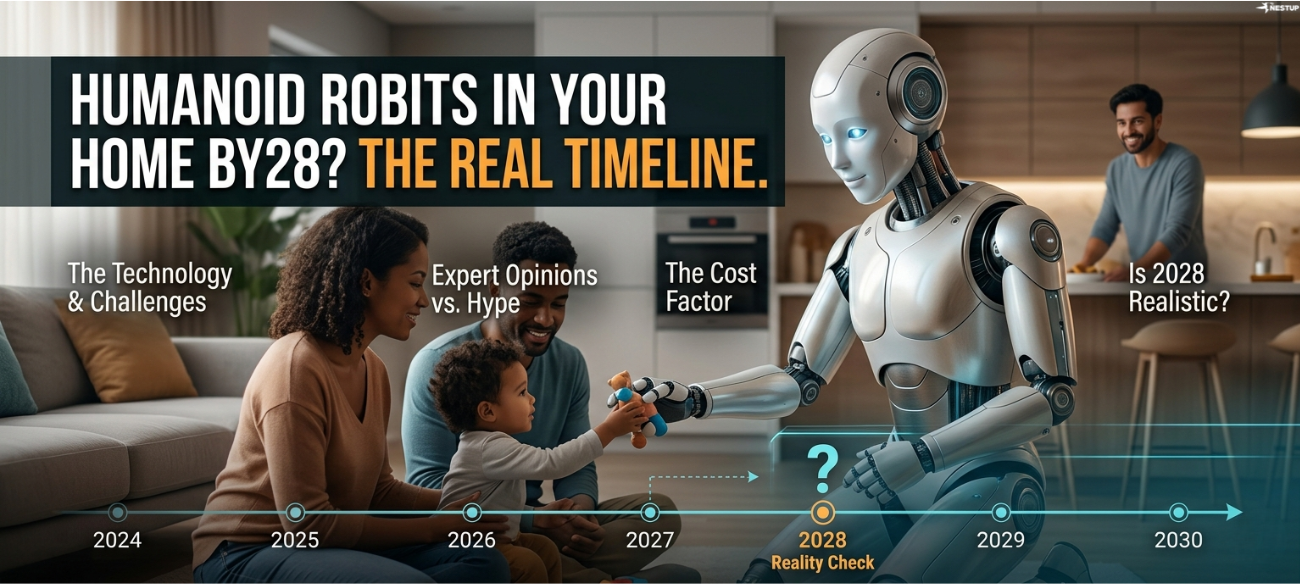
For decades, the promise of a robotic Rosie cleaning our homes has been the ultimate "vaporware" of the tech world. But by 2026, that sci-fi dream has pivoted into a high-stakes arms race, fueled by billions in CAPEX from heavyweights like Tesla, 1X, and Figure. As we look toward 2028, the central strategic question isn't whether these machines will be in our hallways, but whether they’ll be indispensable assets or just the world’s most expensive conversation pieces.
2028: The Era of the Elite Alpha Tester
Make no mistake: 2028 is a milestone, not a mass-market explosion. We are currently tracking the classic "Early Adopter" curve, where units like Tesla’s Optimus will likely be reserved for industrial pilots and the "more-money-than-time" demographic. While the tech is maturing, the unit economics simply don't support middle-class adoption yet. We expect the true "Great Expansion"—the period where production scales and the price-to-utility ratio begins to make sense for the average household—to fall squarely between 2029 and 2032.
The "Fetching" ROI vs. The Cooking Bottleneck
By 2028, robots will have mastered the "Low-Complexity Fetch." Carrying laundry, hauling trash, and retrieving groceries are tasks defined by predictable kinematics and limited decision-making. These are the "low-hanging fruit" of the domestic world. However, the "Cooking Dream" remains a bridge too far because of the "unstructured environment" problem.
Unlike a factory floor, a home cannot be redesigned to suit a robot’s limitations. This creates a massive cognitive bottleneck. As the data suggests:
"Cooking involves hundreds of small decisions. Ingredients vary. Kitchen layouts differ. Unexpected situations occur constantly. Most home robots will not be preparing complete family dinners by 2028."
Until a robot can distinguish between a ripe avocado and a bruised one—and adjust its grip pressure accordingly—your Michelin-star robotic chef remains a fantasy.
Strategic Divergence: Figure AI’s Factories vs. 1X’s Home-First Neo
In the race for dominance, we see two distinct strategies. Figure AI is playing the "Enterprise-First" long game, betting that the predictability of warehouses—where every shelf is a known coordinate—is the only way to refine the hardware. They believe success in the factory is the mandatory precursor to the chaos of the living room.
Conversely, 1X Technologies is taking the fight directly to the foyer with its Neo robot. Specifically designed for domestic environments, Neo is being engineered to safely navigate around the most unpredictable "objects" of all: pets and children. While Figure optimizes for torque and industrial throughput, 1X is optimizing for soft-touch interaction and human-centric safety, providing a vital counterpoint to the industrial-first narrative.
The Reliability Paradox: Why 95% is a Failing Grade
In the world of strategic analysis, we look at the "Reliability Paradox." A humanoid that functions perfectly 95% of the time sounds like a miracle of engineering, but in a consumer household, it’s a liability. If your robot drops a glass of red wine on a white rug once out of every twenty attempts, it isn’t a labor-saver—it’s a source of anxiety.
For a humanoid to transition from a novelty to a household appliance, it must solve for the "edge cases" of daily life with the same boring consistency as a dishwasher. Reliability, not intelligence, will be the metric that determines market survival.
The $30,000 Question: Robot vs. Human Labor
Tesla’s target price of $20,000 to $30,000 is an ambitious North Star for mass production, but "Day One" reality will likely see much higher price tags. This presents a brutal economic hurdle. When you calculate the three-year Total Cost of Ownership (TCO), including maintenance and software subscriptions, hiring a part-time human housekeeper remains the more affordable and flexible option for most families in the near term.
The early ROI for the 2028 robot won't come from cleaning floors, but from specialized high-value tasks: Elderly Assistance and Home Security. A robot that can monitor for falls, provide medication reminders, and patrol the perimeter of a home provides a level of 24/7 "peace of mind" that traditional human help cannot easily match at the same price point.
The Specialized Few Over the Autonomous Many
The 2028 breakthrough won't be a robot that does "everything"; it will be a robot that does three things—monitoring, fetching, and basic tidying—with 99.9% reliability. We are trading the dream of total autonomy for the reality of specialized utility.
If a humanoid could only do two of your most hated chores, but did them perfectly every single time, would you be ready to invite it into your home?