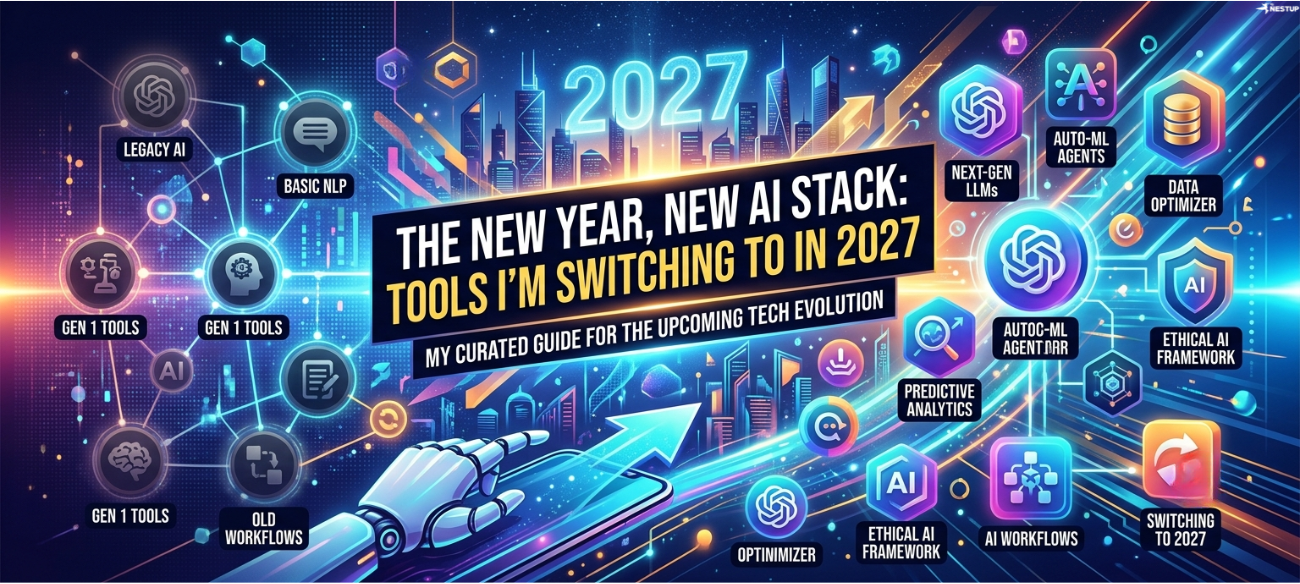
If your 2027 infrastructure is a carbon copy of your 2026 stack, you aren't just overspending—you're operating on a legacy architecture that is fundamentally broken. We are currently witnessing the structural collapse of the centralized AI model. In 2026, we were satisfied with "basic chatbots" that functioned as passive digital encyclopedias. Today, the standard has shifted toward Agentic Workflows—autonomous digital workers that don't just reply to prompts, but execute complex, end-to-end projects.
This rebuild isn't a mere software update; it is a strategic migration designed to reclaim your Digital Sovereignty, eliminate the hidden cognitive taxes of manual management, and ruthlessly slash your monthly overhead.
The Death of the Premium Chatbot Subscription
The $20/month cloud tax for general text generation is officially obsolete. As a Digital Architect, I view the transition to Local-First reasoning models not just as a cost-saving measure, but as a mandatory move for security and performance. Running open-source models on your own hardware creates a Private Sandbox for proprietary code and sensitive research—data that should never touch a third-party server.
By moving reasoning local, we achieve:
- Absolute Sovereignty: Your data never leaves your silicon.
- Zero Latency: Elimination of the "data lag" inherent in cloud-based API calls.
- Unrestricted Performance: Local hardware now handles dense coding pipelines and structured research with greater reliability than oversubscribed cloud clusters.
The paradigm has shifted from "talking to a bot" to "deploying an employee." As the 2027 migration guide notes:
"We moved away from simple chatbots that just reply to text, and stepped into an era of fully autonomous digital workers—or 'agents'—that can handle complex workflows from start to finish."
Transitioning from Manual Entry to Ambient Intelligence
The most pervasive "hidden cost" in any workspace is the Cognitive Tax of manual task entry. Every time you stop to type a reminder or update a calendar, you trigger a context switch that shatters deep-work states.
In the 2027 rebuild, we replace static planners with Proactive Voice and Audio Companions. These background utilities utilize Contextual Awareness via ambient audio to log action items and summarize real-world meetings in real-time. By automating the administrative layer of your life, you move from a "Manual Entry" mindset to a "Hands-Free" flow, allowing your brain to focus exclusively on high-leverage creative execution.
The End of App Fragmentation and Tab-Hopping
Fragmented toolsets suffer from a Data Gravity problem: your insights are trapped in disconnected browser tabs, creating massive mental friction during technical synthesis. The 2027 strategy demands an Integrated Research and Writing Ecosystem.
Instead of siloed apps, we use single-screen interfaces that function as a Narrative Refiner. Whether you are feeding the system a messy brain-dump or a series of technical articles, the platform assists in organizing and rephrasing the data instantly. This eliminates the "tab-hopping" fatigue and ensures your research and drafting happen within the same unified context.
The Financial Reality: Doing More with $25 Less
Consolidating your stack isn't just about streamlining; it's about Return on Investment (ROI). The $25 monthly savings generated by this migration effectively funds your local hardware upgrades over time, turning a recurring expense into a long-term asset.
| Tool Category | Old 2026 Stack Cost | New 2027 Stack Cost | Net Savings |
| Core Intelligence & Reasoning | $20 / month (Cloud Subs) | $0 (Local Open-Source) | +$20 / month |
| Task Management & Audio | $10 / month (Static Apps) | $8 / month (AI Audio Assistant) | +$2 / month |
| All-in-One Writing & Research | $15 / month (Siloed Tools) | $12 / month (Integrated Platform) | +$3 / month |
| Total Monthly Spend | $45 / month | $20 / month | +$25 / month |
The 4-Step Blueprint for a Frictionless Migration
To transition your infrastructure without systemic failure, follow this architectural blueprint:
- The Clean Data Export: Prioritize portability. Export all legacy data in universal formats—Markdown (.md) or JSON. If your data isn't in a clean, readable format, you don't own it; you're just renting it.
- Set Up the Trigger Foundations: Automate your environment through Pre-loading Context. Establish "If-Then" systems: If it is 7:00 AM and you open your primary workspace, then your local reasoning engine must automatically boot and present the day’s critical architectural priorities.
- The Automated Knowledge Ingestion: This is the Style-Sync phase. Feed your project archives and personal style guides into your new platform. The system must analyze your structural habits and vocabulary to mirror your natural voice, ensuring the output is a reflection of your expertise rather than a robotic approximation.
- The One-Week Trial Run: Run your old and new stacks in parallel for seven days. This redundancy allows you to stress-test your automation pipelines and verify data integrity. On Day 8, ruthlessly cancel the legacy subscriptions.
Efficiency Over Hype
The 2027 philosophy is a rejection of the "hype cycle" in favor of pure operational efficiency. We are moving from a world of Passive Tools to a world of Active Teammates. By reclaiming your creative time and optimizing your financial output, you build a workspace that doesn't just work for you, but works with you.
Which legacy components of your current workspace are you ready to prune to make room for a high-leverage, agentic workflow?