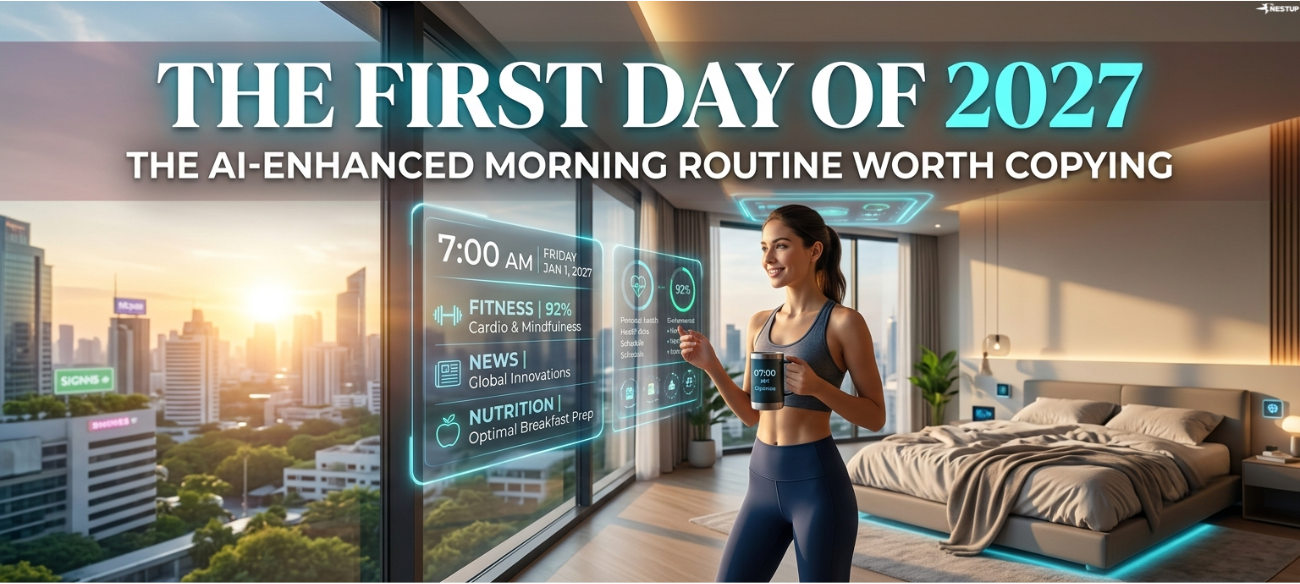
As the digital dust of 2027’s first dawn settles, many high-performers are still clutching the "legal pad resolution"—a static list of ambitions fueled by the fragile hope that this year, their grit will simply be stronger. But in a landscape defined by rapid cognitive demands and asynchronous workflows, relying on sheer willpower is a legacy error. True peak performance is no longer about "trying harder"; it is about cognitive architecture.
To thrive, you must transition from vague intentions to a high-leverage system that manages your neural friction. By offloading logistical overhead to AI, you don't become a rigid machine—you safeguard the "human" energy required for deep work. This is how you move beyond the friction of the morning and into a state of intentional, systemic focus.
From Doomscrolling to Curation: The Audio-First Briefing
Engaging with a social feed or generic news aggregate upon waking is a dopamine-hijacking error. It spikes your cortisol and forces your brain into a reactive "defense mode" before you’ve even finished your first espresso. To safeguard your dopamine baseline, you must pivot from algorithmic chaos to curated synthesis.
Shifting to an audio-first briefing preserves your visual attention and minimizes early-morning cognitive load. By using AI to aggregate and summarize, you transform a passive, stressful habit into an active, high-signal briefing that respects your focus.
The Curation Prompt Give me a concise, 5-minute audio summary of the top three global tech and business headlines from this morning. Omit any clickbait, emphasize systemic trends, and deliver it in a calm, conversational tone.
The Adaptive Priority Review: AI as Your Chief of Staff
Traditional to-do lists are fundamentally broken because they lack context; they treat a multi-layered strategic initiative with the same visual weight as a routine Slack reply. As we enter 2027, the "wall of text" approach is a primary source of executive dysfunction.
"Most traditional to-do lists fail because they don't account for reality—they treat a massive, deep-focus project the same way they treat replying to an email."
To solve this, deploy your AI as a digital "Chief of Staff" to facilitate an adaptive priority review. By feeding your raw tasks and calendar into a model, you move from static listing to intelligent time-blocking. This ensures your day is built around reality—accounting for energy depletion and the necessity of "neural resets" between high-stakes meetings.
The Chief of Staff Prompt Here is my raw task list for today and my scheduled calendar events. Based on a standard 8-hour workday, design a realistic time-blocked schedule. Group similar administrative tasks together, isolate a 3-hour block for uninterrupted deep work, and build in a 15-minute buffer after meetings for cognitive resets.
Breaking the Blank Page with AI Body Doubling
The most significant barrier to deep work is the "activation energy" required to start a complex project. In psychology, "body doubling"—the act of working alongside another to maintain focus—is a proven tool for productivity. In 2027, we can automate this collaborative presence using voice-interactive AI.
Rather than staring at a blank document and inviting procrastination, use your AI as a real-time sounding board to externalize mental clutter.
The Strategy:
- Activate Voice Interaction: Put on your headphones and open your workspace.
- Externalize Thoughts: Speak your raw ideas, half-formed arguments, and data points out loud.
- Real-Time Outlining: Direct the AI to structure these thoughts into a logical framework as you speak. This identifies "logical gaps" in your thinking before you ever commit a word to the final draft.
The Body Doubling Prompt I am about to spend the next hour drafting a complex strategy proposal. I want you to act as my collaborative partner. I am going to talk out my main bullet points, and I want you to structure them into an organized outline in real-time, pointing out any logical gaps or areas where I need more data as we go.
Philosophy in the Machine: The Mindful Reflection Prompt
Tactical execution without philosophical grounding is a recipe for burnout. In an era of hyper-automation, character is the only remaining competitive advantage. If your morning is spent solely on "doing" without a connection to "being," your productivity will eventually feel hollow.
By utilizing philosophy-driven prompts—specifically those rooted in Stoic principles like those of Marcus Aurelius—you can challenge your perspective and align your daily actions with your long-term vision. This practice helps you distinguish between the noise you cannot control and the character-driven actions you can.
The Stoic Mentor Prompt Act as a philosophical mentor grounded in the principles of Marcus Aurelius and Seneca. Give me three deeply targeted, highly practical morning reflection questions focused on distinguishing between what I can control today versus what I cannot. Keep the tone grounded, direct, and free of fluff.
Reclaiming Human Creative Energy
Designing your morning with AI isn't about surrendering your autonomy; it’s about reclaiming the cognitive space required to be truly human. When you offload the logistical friction of your life, you aren't just "saving time"—you are preserving your highest faculties for the work that matters.
"By offloading the logistical friction of your day... you free up your cognitive energy for what truly matters: deep creative thinking, strategic decision-making, and being present in your life."
As you look toward the horizon of this new year, ask yourself: How are you planning to structure your focus on this first day of 2027?