
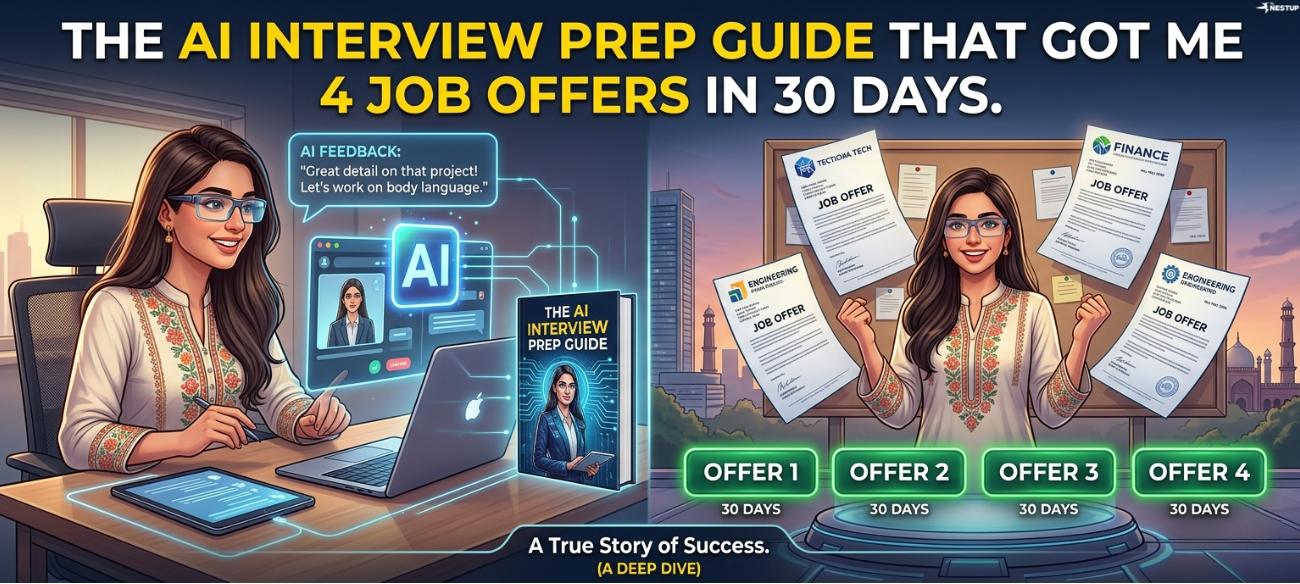
The volume trap is a siren song for the desperate. Most job seekers fall into a frantic, repetitive cycle: spraying applications into the void, obsessively tweaking resumes, and watching generic "how to interview" videos while the anxiety mounts. I was there a month ago. I was repeating the same weak answers and hoping for a miracle.
Everything changed when I stopped treating Artificial Intelligence as a shortcut for generating text and started using it as a personalized "interview operating system." By shifting from manual guesswork to a structured, AI-driven workflow, I stopped being a candidate who was hoping to get hired and started being a candidate already operating at the required level. The result? In just 30 days, I landed four job offers. This is how you move from the volume trap to the offer letter.
Stop Applying Randomly: The Argument for Less is More
The most common mistake in a job search is prioritizing volume over positioning. If you apply everywhere, you end up interviewing for roles where you aren’t a natural fit, leading to vague answers that lack conviction.
The first step in this operating system is a cold, intentional narrowing of your focus. I stopped asking "How do I get more interviews?" and started asking "Which roles can I position myself for most convincingly?" This requires a strict filtering process based on four criteria:
- Experience Match: Does your background genuinely align with the requirements?
- Relevant Achievements: Do you have specific wins that move the needle for this company?
- Narrative Feasibility: Can you tell believable, high-stakes stories about your past work?
- Business Model Understanding: Do you actually grasp how this specific company makes money?
By narrowing your focus, you eliminate the "vague candidate" problem. You enter the room with the confidence that you are the logical solution to their problem.
Reading Between the Lines: AI as Your Research Assistant
Job descriptions (JDs) are usually a mess of corporate buzzwords and unrealistic wish lists. However, they contain the "hidden clues" of a company’s true pain points. Using AI as a research assistant allows you to decode the subtext.
By feeding an AI the job description, your resume, and company context, you shouldn't just ask for a summary. You must prompt it to identify five specific categories:
- The Top 5 Qualities: What is the hiring manager actually optimizing for?
- Pain Points: What specific problems is this role meant to solve?
- Alignment: Which parts of your resume resonate most with those needs?
- Predicted Questions: What is the likely line of questioning?
- Gaps: What weaknesses in your profile will they likely attack?
"AI often identified themes I completely missed... That allowed me to tailor stories intentionally instead of improvising."
When you identify themes like "ownership mentality," "startup adaptability," or "customer obsession" before the call, you stop guessing and start targeting.
From Improvisation to Inventory: Building Your Story Bank
The highest ROI in interview prep comes from moving away from live improvisation. Behavioral interviews are predictable; most questions are just variations on the same core themes.
Instead of inventing answers on the fly, use AI to audit your work history and build a "Story Bank" of 15 STAR (Situation, Task, Action, Result) narratives. Your inventory must specifically cover these behavioral pillars:
- Leadership and Ownership
- Conflict Resolution and Teamwork
- Failure, Recovery, and Handling Pressure
- Ambiguity and Problem Solving
- Prioritization and Influencing Stakeholders
The goal is to feed the AI your resume bullets and project summaries, then instruct it to structure them into professional, conversational narratives under two minutes. You aren't creating a script to read; you are building an inventory to adapt. This shifts your delivery from "robotic corporate language" to a strategic, experience-driven dialogue.
The Mock Interview: Why AI Feedback is Your Secret Weapon
The true power of AI isn't the questions it asks, but the critique it provides. Passive preparation is useless; you need an iterative feedback loop.
Ask the AI to simulate a specific persona—such as a hiring manager at a fast-growing SaaS company—and conduct a mock interview one question at a time. The key is the prompt logic: instruct the AI to critique your clarity, confidence, specificity, executive presence, and storytelling.
This process exposes the "blind spots" that kill your candidacy:
- The Ramble: Talking too long without reaching the point.
- The Metric Bury: Hiding your impact under a mountain of context.
- Weak Language: Using reactive words like "helped" instead of "led," "owned," or "transformed."
The Strategic Intro: Fixing "Tell Me About Yourself"
The first 90 seconds of an interview are the most expensive real estate in the conversation. Most candidates waste it by rambling through a chronological resume history. To reclaim this moment, you must use a four-part strategic structure:
- Current Role: A punchy snapshot of your current impact.
- Strongest Strengths: The 2-3 things you do better than anyone else.
- Major Wins: High-impact, relevant achievements that prove your value.
- The Pivot: Why this specific role is the only logical next step for your career.
Positioning yourself strategically from the start shifts the interviewer’s perception of you from a "hopeful applicant" to a "strategic asset."
The Prediction Engine: Anticipating Interview Themes
Interviews only feel unpredictable if you haven't mapped the territory. By feeding AI the company’s leadership principles, values, and industry context, you can predict interview questions with shocking accuracy.
However, the "Operating System" goes deeper: ask the AI to explain why each question matters. Understanding that a question about "prioritization" is actually an assessment of your "decision-making logic under pressure" allows you to answer the underlying concern, not just the surface-level prompt. This reduces anxiety by transforming the "unknown" into a known, manageable entity.
The Authenticity Guardrail: Why You Must Never "Replace Your Thinking"
The biggest mistake candidates make is letting AI manufacture a fake, robotic personality. Over-polished, generic language is a red flag to any experienced interviewer. The goal is to use AI to clarify and organize your truth, not to invent a persona.
"The strongest interviews still feel human: Specific, honest, reflective, experience-driven, and slightly imperfect. That authenticity matters more than perfect wording."
This extends even to the follow-up. Avoid the generic "thank you" template. Use AI to help you draft human-sounding specificity—mentioning a specific discussion point, like "balancing speed with customer feedback"—to create memorability.
Conclusion: From Interrogation to Conversation
The real superpower of this system is repetition and fast iteration. The AI allows you to stress-test your communication and refine your stories until they are razor-sharp.
When you have rehearsed your narratives and addressed your blind spots through constant critique, the dynamic of the interview shifts. It stops being a stressful interrogation where you are begging for a job. It becomes a high-level conversation between two professionals about how to solve a business problem.
Are you using AI to hide your experience, or are you using it to finally give your experience the clarity it deserves?