
Introduction: The Signal and the Noise
We are currently drowning in the "LLM-exhaust" of trillion-dollar hallucinations. Between venture capitalists promising immediate utopia and CEOs unveiling "revolutionary" products that are often just glorified chatbots, the industry has reached a state of profound hype fatigue. It is easy to look at the current landscape and assume we’ve hit a plateau, or worse, that the entire movement is a marketing mirage.
To find the signal, we must ignore the stage-managed demos and look at the pragmatic shifts discussed by the experts actually building the plumbing of the future. By 2027, the most significant developments won't be found in social media headlines, but in the transition from AI as a novelty to AI as invisible, reliable infrastructure. This is a distilled look at the reality checks that will define the next three years.
The End of the "Geronimo" Agent (Focus on Structured Workflows)
For the past few years, the industry has chased the "Geronimo" agent—autonomous systems that leap into complex business operations without the necessary "parachutes" of reliability, long-term planning, or context management. These over-ambitious attempts to "run businesses" or "replace employees" largely failed because they lacked the structural rigor required for professional work.
By 2027, the pragmatic shift is toward agents designed for structured workflows. Rather than aiming for total autonomy, these systems are becoming genuinely useful by handling specific, repeatable tasks like scheduling, CRM updates, and report generation. The impact here is profound because it focuses on augmenting the existing workforce through precision rather than replacement through approximation.
"The important distinction is that useful agents won't replace entire jobs. They'll automate portions of jobs. That's a much more realistic prediction."
Results over Rhetoric (Task Completion as the New Benchmark)
The era of "chatting" with an AI is ending. Businesses don't buy intelligence in the abstract; they buy results. While early evaluations focused on a model’s ability to mimic human conversation, the 2027 benchmark is task completion.
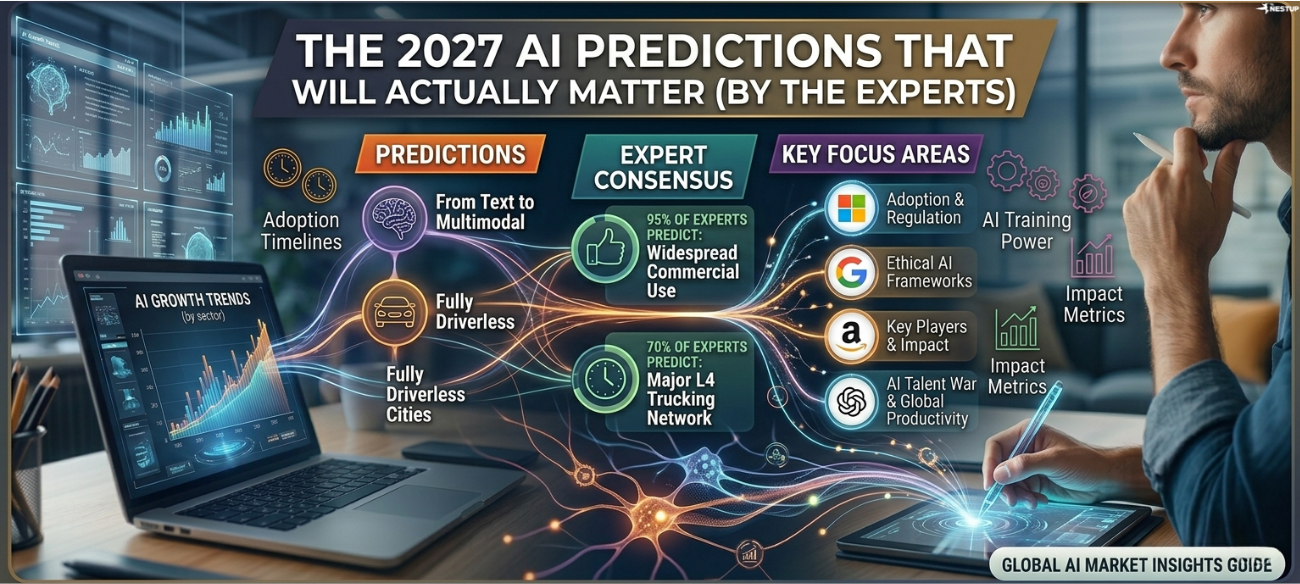
This transition is powered by the rise of Multimodal AI. The future of workflow isn't text-only—it’s the ability of a system to analyze a video meeting, review supporting audio, cross-reference PDF documents, and generate a verified set of action items in a single, multi-step reasoning chain. Leading models are being judged on their ability to verify their own work and correct errors, moving the needle from "generating answers" to "achieving outcomes."
The "Bigger is Better" Era is Ending (The Rise of Small, Efficient Models)
The assumption that progress requires ever-larger, more expensive models is a relic of 2023. Efficiency is the new frontier. We are seeing a massive surge in Small Language Models (SLMs) and "Edge AI," where intelligence is optimized to run locally on standard hardware rather than in a massive, distant cloud.
The pragmatic advantages of these smaller, specialized systems include:
- Lower costs: Massive reduction in infrastructure overhead for enterprises.
- Faster responses: Local inference eliminates the latency of cloud communication.
- Better privacy: Sensitive data stays on-device, critical for regulated industries.
- Practicality: These models prioritize running reliably and cheaply over raw, unoptimized power.
The Job Market Isn't Shrinking; It’s Morphing
The narrative of mass unemployment is being replaced by the reality of workflow redesign. The most concrete example is seen in software development. By 2027, coding will be increasingly AI-native, but this hasn't eliminated the developer. Instead, the role has shifted from "writing every line manually" to supervising, reviewing, and refactoring AI-generated output.
While roles centered on repetitive information processing face disruption, those requiring judgment, leadership, and creative direction remain resilient. We are entering an era of "supervision-based" productivity where the human is the director of an AI-augmented orchestra.
"The key question isn't: 'Will AI take jobs?' It's: 'Which tasks become automated?'"
AI Becomes Invisible Infrastructure
Perhaps the most visionary realization for 2027 is that AI is losing its "cool" factor and becoming a utility, much like electricity. This is driven by a simple economic reality: the cost of inference is falling. As intelligence becomes cheaper, it unlocks entirely new markets and deep integrations into "boring" but essential enterprise functions like supply chain management and compliance monitoring.
We are seeing a patchwork of regulation emerge, particularly in high-stakes sectors like Healthcare and Finance, where transparency and data usage rules are tightening. This regulation isn't an obstacle; it's a sign of maturity. AI is no longer a sandbox experiment; it is the foundation of critical infrastructure.
A Necessary Reality Check: What the Experts Doubt
Pragmatism requires acknowledging what AI won't do by 2027. Despite the headlines, leading researchers remain highly skeptical of:
- Human-Level AGI: Timelines remain speculative and uncertain.
- Fully Autonomous Businesses: Accountability and human oversight remain non-negotiable.
- Robot Workers in the Home: Hardware complexity is lagging far behind software progress.
Conclusion: The Quiet Revolution
As we look toward 2027, we can use a "Plausibility Ranking" to guide our strategy. While human-level AGI remains speculative, the shift toward better agents, falling costs, and AI-assisted coding is "Highly Likely."
The "Quiet Revolution" is not about a single breakthrough; it is about the thousands of smaller integrations that make AI feel inevitable. The most important question for you is no longer whether AI will change your industry, but how you will adapt your workflows to a world where intelligence is cheap, fast, and invisible. When the novelty fades, only the results remain. How will you direct them?