
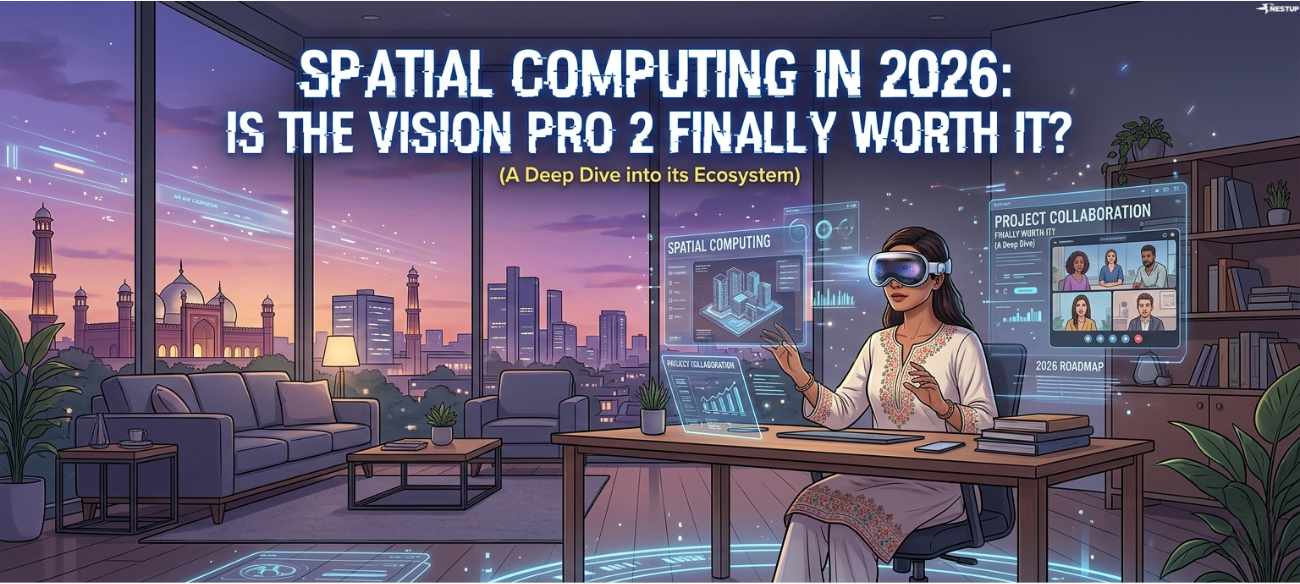
Walk into a quiet airport lounge or a high-end coffee shop in 2026, and the scene has changed. You no longer see rows of professionals hunched over 13-inch glowing rectangles, necks craned in the universal posture of the "laptop slouch." Instead, you see users sitting upright, their eyes moving with intent, their hands making micro-gestures that seem almost like a private sign language.
The "now what?" skepticism that haunted the original 2024 launch has largely evaporated. We’ve moved past the era of the expensive technology demo. In 2026, the conversation isn't about whether eye tracking or gesture navigation works—those legacy strengths are now the baseline—but about how this hardware finally found its purpose. The Vision Pro 2 has matured from a heavy curiosity into a legitimate tool, marking the first time spatial computing feels like a genuine daily platform rather than a parlor trick.
Your Laptop is Now the Bottleneck
For decades, we have been compressing our professional lives and our intellectual output into small geometric shapes. Whether it’s a 14-inch MacBook or a 27-inch Studio Display, the "legacy rectangle" has been a cage for our productivity. The Vision Pro 2 finally breaks that seal.
For traders managing a dozen live streams, researchers cross-referencing massive datasets, and writers surrounding themselves with "floating" source material, the laptop has become the primary bottleneck. The second-generation hardware provides the text clarity and ergonomic relief necessary for high-density work, allowing users to transcend the "portable productivity constraint." We are witnessing the death of the desk; your office is no longer where your computer sits, but wherever you happen to be standing.
Apple’s objective from the beginning was not just to create a peripheral, but to build the "post-laptop interface."
The Enterprise "ROI" Stealth Move
While the public fixates on whether consumers will wear "ski goggles" at the beach, the corporate world has made a much more pragmatic calculation. In the enterprise sector, the "social awkwardness" of the hardware is irrelevant. Companies have realized that ROI matters far more than social acceptance, and the utility of spatial computing is proving undeniable.
The shift is driven by specific, high-stakes use cases where 2D screens fail:
- Healthcare: Real-time medical visualization during surgical planning.
- Architecture: Immersive walkthroughs that allow clients to "feel" a space before a single brick is laid.
- Aviation & Defense: High-fidelity simulation and remote maintenance.
- Engineering & Product Design: 3D design collaboration in real-time.
- Training and Simulation: Reducing errors and travel costs through immersive presence.
AI is the Missing Interface Link
The most significant evolution between the first and second generation isn't the weight—it’s the intelligence. In the early days, we were still effectively "typing into flat windows," a clunky carryover from the desktop era that felt out of place in a 3D environment.
The integration of advanced AI assistants has provided the missing link. AI now manages the "spatial clutter," organizing immersive productivity dashboards and spatial coding environments based on your current task. The relief of moving away from traditional typing cannot be overstated; the AI acts as a linguistic bridge, allowing the user to manipulate complex data through intent rather than friction-heavy input.
The Emotional Weight of "Spatial Memories"
There is a reflective, almost haunting quality to the Vision Pro 2 that traditional media cannot touch. While it is a powerhouse for work, its most "magical" moments are deeply personal. Significant hardware refinements—specifically better passthrough quality and reduced eye fatigue—have made it comfortable enough for users to actually dwell within their memories.
Watching a 100-foot OLED-quality movie is impressive, but it is the spatial video and 3D photography that provide the emotional gut-punch. Seeing a deceased loved one or a child’s first steps with true depth and scale feels fundamentally different from looking at a flat image on a phone.
The emotional reaction people have when viewing spatial memories remains one of the platform’s strongest selling points.
The "Ski Goggle" Tax Still Exists
Despite the leap forward, we haven't reached the "glasses" era yet. The "ski goggle" tax remains a reality: ergonomic friction, the psychological barrier of isolation, and the lack of true all-day untethered use are still present. This isn't a device for casual social media scrolling or checking a quick email; the price-to-utility ratio is still too steep for the average consumer.
However, for those whose work justifies the hardware, the device is finally "worth it." This specialized group includes:
- Remote professionals needing a portable infinite office.
- Developers and designers working in 3D spatial workflows.
- Frequent travelers who refuse to sacrifice productivity on the road.
- Creators pushing the boundaries of immersive media.
The Horizon of the Rectangle
We are witnessing a genuine computing transition, and Apple no longer owns the conversation alone. With Meta, Samsung, and Sony all validating the category with their own hardware, spatial computing is no longer a one-company experiment—it is the next frontier.
The long-term vision remains a pair of lightweight glasses, but the Vision Pro 2 has successfully moved the needle. It has shown us that the power of expanding computing into physical space is a necessary evolution from the geometric constraints of the last forty years. We are left with one final, human question: Does the power of expanding computing into physical space outweigh the personal and social costs of wearing the hardware?