
Introduction: Why Quantum Computing Still Feels Confusing
Quantum computing has been described as the “future of technology” for years, but in 2026 it still feels distant and abstract for most people. The reason is simple: it does not work like traditional computing. Instead of improving what computers already do well, it focuses on solving problems that classical systems struggle with entirely. To understand its real value, it helps to separate practical progress from hype.
What Is a Quantum Computer?
At the core of traditional computing are bits, which represent information as either 0 or 1. Quantum computing replaces this idea with qubits, which can exist in multiple states at once due to a principle called superposition. This means a qubit is not limited to a single value, but can represent a combination of possibilities simultaneously.
To make this easier to imagine, think of a coin. A classical bit is like a coin sitting flat on a table—either heads or tails. A qubit is like a spinning coin in the air, representing both states at the same time until it is measured.
Superposition and Entanglement Explained Simply
Another key concept is entanglement, where two qubits become linked in such a way that the state of one instantly affects the other, even if they are far apart. This creates a system where multiple qubits work together in highly coordinated ways.
A simple analogy is two perfectly synchronized dice. Even if they are rolled in different rooms, they always land on connected results. These properties allow quantum computers to explore many possibilities at once instead of checking them one by one.
Where Quantum Computing Stands in 2026
In 2026, quantum computing is still in what researchers call the “noisy intermediate-scale quantum” phase. This means systems are powerful but still unstable and error-prone. They are not ready for everyday consumer use, and they cannot replace classical computers.
However, progress is real and measurable. Companies are building larger and more stable quantum systems, and cloud access has made early experimentation possible for researchers and enterprises.
Major Players Driving Progress
Several major organizations are leading quantum development.
IBM is focusing on scaling quantum systems and improving error correction so machines can handle more reliable computations.
Google continues to push research into quantum supremacy and improving hardware stability.
IonQ is developing trapped-ion quantum systems, which offer higher accuracy and lower error rates compared to some alternative approaches.
Each company is experimenting with different hardware designs, but all share the same goal: making quantum computing practical for real-world problems
What “Quantum Advantage” Really Means
A key milestone in this field is something called quantum advantage. This is the point where a quantum computer can solve a useful real-world problem faster or more efficiently than a classical computer.
It is important to distinguish this from early demonstrations of quantum power, which often focused on highly specialized tasks. True quantum advantage means solving problems that matter in industries like medicine, finance, or materials science.
In 2026, we are approaching this milestone, but it has not yet been fully achieved at scale.
Real-World Applications Starting to Emerge
Quantum computing is beginning to show practical value in specific industries, even if it is still early.
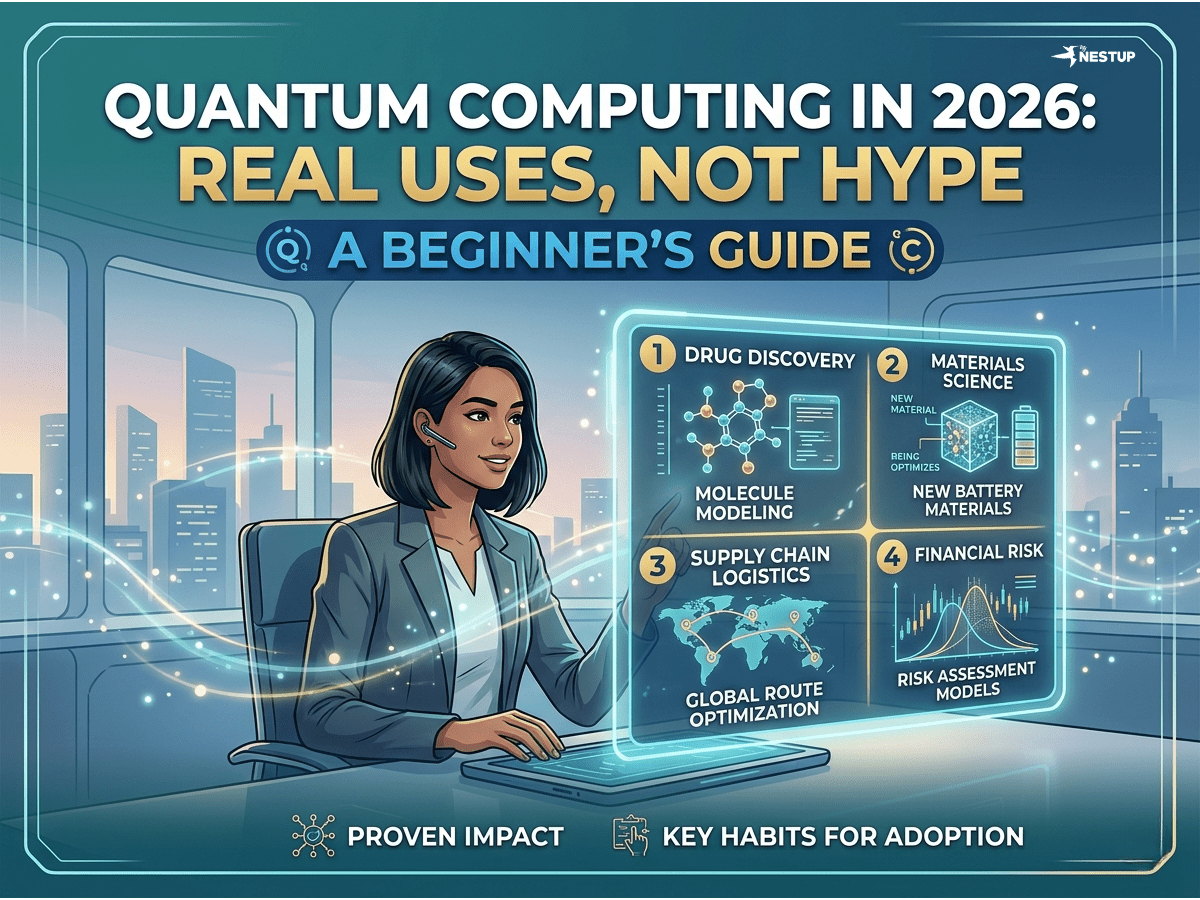
In drug discovery, quantum systems can simulate molecules more accurately than classical computers. Since chemical interactions follow quantum rules, this makes them naturally suited for pharmaceutical research. Instead of testing thousands of possibilities physically, researchers can model interactions at the atomic level.
In finance, quantum computing is being explored for portfolio optimization and risk analysis. These problems involve evaluating huge numbers of possible combinations, which quantum systems can process more efficiently in theory.
In cryptography, quantum computing presents both a threat and an opportunity. Algorithms like Shor’s algorithm could eventually break widely used encryption methods. At the same time, researchers are developing new quantum-safe encryption systems to protect data in a post-quantum world.
The Biggest Challenge: Stability and Errors
One of the main barriers to practical quantum computing is instability. Qubits are extremely sensitive to environmental noise such as heat, radiation, or vibration. Even small disturbances can introduce errors into calculations.
This is why companies like IBM and Google are heavily investing in error correction techniques. Without solving this problem, scaling quantum computers to large, practical systems will remain difficult.
Is Quantum Computing Overhyped?
Quantum computing is often overhyped in the short term but underestimated in the long term. It will not replace laptops or smartphones, and it will not solve everyday computing tasks better than classical systems.
However, its long-term impact could be significant in specialized fields. It is similar to the early internet era—limited in practical use today but foundational for future breakthroughs.
Conclusion: What to Actually Expect
In 2026, quantum computing is not a mainstream technology but an emerging scientific platform. Companies like IBM, Google, and IonQ are steadily improving hardware and exploring real-world applications.
The key takeaway is simple. Classical computers are excellent at doing things step by step. Quantum computers are designed to explore many possibilities at once. As the technology matures, this difference could unlock entirely new categories of problem-solving that are impossible today.