
The Willpower Trap
Most weekly planning fails because it relies on raw willpower rather than a resilient structure. When you face a blank page on Sunday night, your brain is forced to perform a high-effort "cold start," struggling to recall every obligation and deadline. This blank page problem inevitably leads to one of two outcomes: a bloated, unrealistic to-do list or a vague plan that falls apart by Tuesday morning.
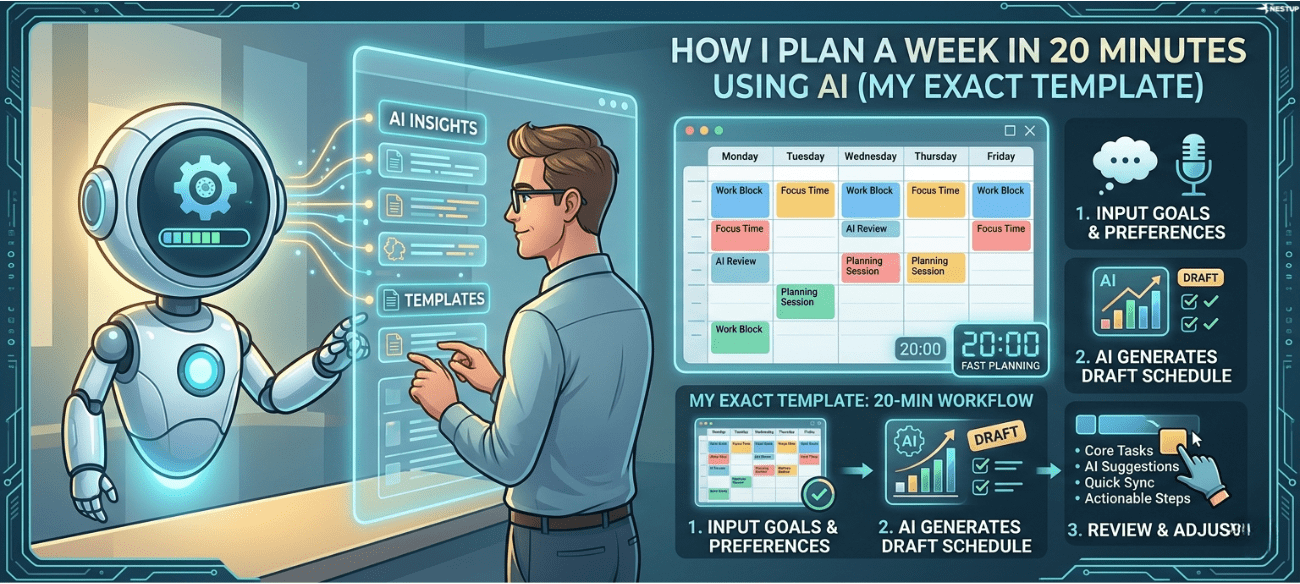
We leverage AI to bypass this cognitive load, transforming the planning process from a creative chore into a guided ritual. Instead of thinking from scratch, you use AI as a connector that bridges the gap between your past performance and your future goals. This 20-minute system ensures your week is built on data and strategy, not just optimistic guesswork.
Takeaway 1: Reflection is the Prerequisite to Planning
Effective planning is impossible without first looking backward to clear your mental clutter. We start with a 5-Minute Weekly Review to ensure you aren't blindly carrying forward the same mistakes, missed deadlines, and inefficiencies. By pasting your previous week’s tasks, wins, and misses into the system, you provide the data necessary for an objective audit.
In this stage, the AI functions as your objective Productivity Coach. It identifies recurring patterns—such as tasks that consistently slip or days where meetings kill your momentum—and generates a "stop doing" list. This prevents you from entering the new week with a cluttered mind and an unexamined schedule.
"Without this, you carry forward the same mistakes and unfinished tasks."
Takeaway 2: Impact vs. Urgency (The Strategic Filter)
High-performing professionals understand that a long to-do list is often just a sophisticated form of procrastination. To move the needle, you must shift your focus from "busywork" to critical outcomes. We use AI as a Strategic Planner to filter your primary goals into a strict list of the Top 5 priorities.
This system forces you to rank every task by impact rather than urgency. A key component of this step is requiring the AI to explain why each priority matters to your long-term objectives. This "why" serves as a psychological safeguard, providing the internal logic you need to stay committed when the week becomes chaotic and distracting.
Takeaway 3: Micro-Tasks are the Enemy of Friction
A priority is merely a wish until it is converted into executable actions. Vague goals like "marketing" or "project research" create decision fatigue because they require too much cognitive effort to initiate. This ambiguity is the primary driver of procrastination and wasted "startup time" each morning.
To eliminate this friction, every priority must be broken down into tasks that are completable in one sitting. For instance, we transform the vague "work on marketing" into a concrete action like "drafting homepage copy." When your tasks are specific and bite-sized, you stop debating where to start and simply begin the work.
Takeaway 4: The Calendar is Your Only Source of Truth
The most common point of failure in any system is the disconnect between the task list and the clock. If a task does not have a designated time slot, it essentially does not exist. This is why the execution layer requires you to move every action item directly into your calendar.
By adopting the persona of a Time Management Expert, the AI helps you organize these tasks into dedicated deep work blocks. The system provides an expert edge by batching similar tasks together to minimize context switching and ensuring you include buffer time for the unexpected. This prevents the common mistake of overloading a single day and ensures your schedule remains realistic.
"The key insight here is that your calendar becomes your source of truth, not your to-do list."
Takeaway 5: The End of Decision Fatigue
The Sunday 20-Minute Ritual is a unified flow that replaces "thinking" with "executing." By following the sequence of Review, Ranking, Breakdown, and Scheduling, you allow the AI to act as the connector between your high-level goals and your daily actions. This removes the need to "re-plan" your life every morning, preserving your mental energy for the work that actually matters.
The most dangerous mistake you can make is skipping the scheduling step or attempting to overload your week. Consistency in this ritual is what builds operational clarity. When the decision-making is done upfront on Sunday, you can spend the rest of your week in a state of flow rather than a state of doubt.
Conclusion: From Reactive to Intentional
The ultimate goal of this system is a radical reduction in your mental load. By outsourcing the structure of your week to an AI-driven ritual, you free yourself from the constant, low-level anxiety of wondering what you should be doing next. You are no longer a passenger in your own schedule; you are the architect.
Take a hard look at your current process and ask yourself: Is it actually driving results, or is it just a list of broken promises? Consider how your output would accelerate if you stopped reacting to every "urgent" fire and started moving with strategic intent. It’s time to stop planning for the sake of planning and start building a system designed for execution.