
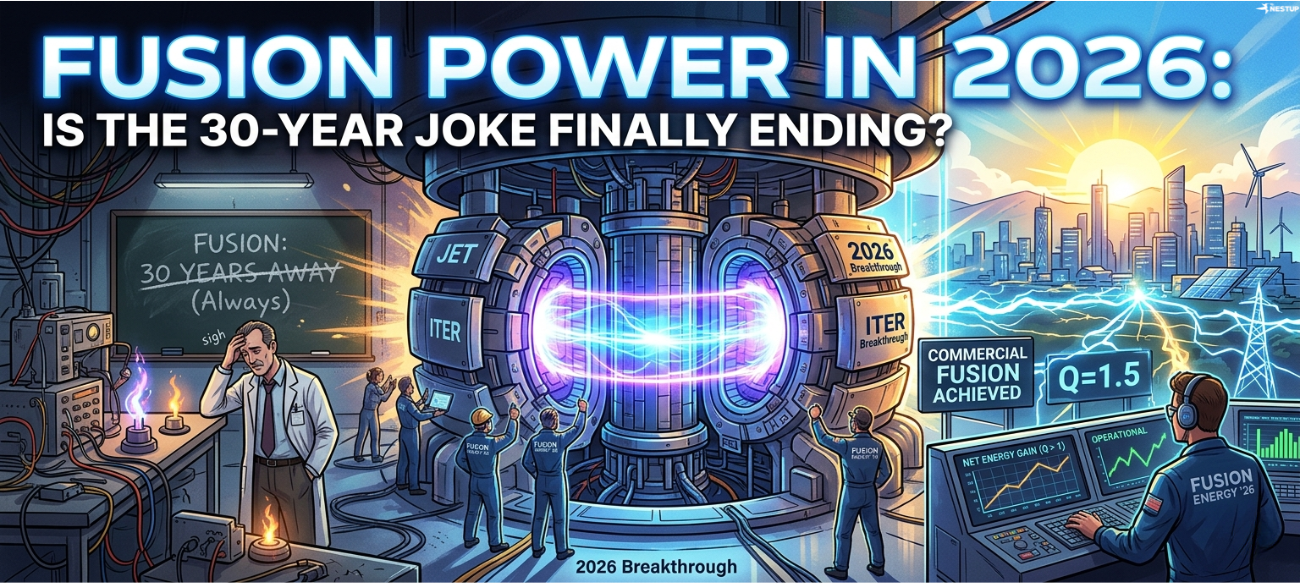
For as long as the nuclear age has existed, fusion has been the energy industry’s most durable punchline: “Fusion is the energy of the future—and it always will be.” It was a joke rooted in the reality of perpetual 30-year horizons and billion-dollar experiments that yielded more data than de-risked hardware.
But as we hit 2026, the joke is finally losing its punchline. We are no longer waiting for a singular "eureka" moment in a chalkboard-filled lab; instead, we are witnessing the infrastructure for the first commercial prototypes breaking ground. This isn’t a narrative shift—it’s a fundamental phase change. The physics of the sun is finally meeting the discipline of the corporate ledger, and the result is a compressed R&D-to-deployment pipeline that the 20th century could never have sustained.
From Science Project to Business Race
The era of fusion as a purely government-led endeavor is over. While state-sponsored projects like ITER remain the industry’s scientific anchor—validating the fundamental physics required to sustain long-duration plasma—the vanguard of the industry has shifted toward private capital. Companies like Commonwealth Fusion Systems (CFS) and Helion Energy are no longer operating on academic timelines; they are operating on venture-backed milestones.
"Fusion is now a business race, not just a physics experiment."
This shift to private industry has fundamentally altered the sector’s risk profile. Private funding brings a level of investor accountability and iteration velocity that traditional public research lacks. In a business race, "good enough for a paper" is replaced by "economically viable for a customer." This commercial pressure has forced companies to move from theoretical modeling to high-fidelity hardware testing at a pace that is finally outrunning the skepticism.
The Invisible Breakthroughs: Engineering Catches Up to Physics
The viability of fusion in 2026 is a story of technological convergence. We didn't need new physics; we needed the maturation of three specific, enabling hardware stacks:
- High-Temperature Superconducting (HTS) Magnets: The "Secret Sauce" for confinement. New REBCO (Rare-earth barium copper oxide) magnets allow for much stronger magnetic fields in smaller, more modular footprints, drastically reducing the scale and cost of reactor designs.
- AI-Driven Plasma Control: Fusion is a fluid dynamics nightmare. Modern AI modeling allows for real-time adjustments to magnetic fields, predicting and stabilizing plasma instabilities before they can terminate a reaction.
- Advanced Materials Science: The development of materials capable of surviving intense, long-term neutron bombardment is transforming reactors from "one-off experiments" into "durable industrial assets."
The AI Hunger: A Market of Real Customers
The strategic driver for fusion has shifted from purely environmental goals to urgent industrial necessity. We are entering the era of "Power-Hungry AI." Modern data centers and the massive electrification of heavy industry require massive, 24/7 baseload power—a requirement that intermittent renewables like solar and wind cannot meet without expensive, large-scale storage solutions.
This "baseload intermittency" gap has created a perfect market pull for fusion. It is no longer just a "green" alternative; it is the "holy grail" for Big Tech’s carbon-neutral mandates. The most prominent evidence of this shift is the landmark power deal between Microsoft and Helion Energy. This isn't a research grant; it is a commercial purchase agreement. The demand for massive energy is now pulling the technology toward the finish line as much as the science is pushing it.
Diversified Bets: The End of the "One Path" Model
The industry has abandoned the "one path" model, adopting a diversified portfolio approach that mimics a high-stakes venture capital strategy. By pursuing multiple technical architectures, the industry has de-risked the probability of total failure.
- Tokamaks (CFS / ITER): The most scientifically validated path. CFS is currently building the SPARC reactor to demonstrate net energy gain, with plans for the ARC commercial plant in the early 2030s.
- Pulsed Fusion (Helion): A high-speed, direct-electricity approach. Helion aims for commercial delivery as early as 2028 by bypassing the efficiency losses of traditional steam turbines—a major strategic differentiator.
- Advanced Fuels (TAE Technologies): The long-term "clean" play. By focusing on hydrogen-boron fusion, TAE aims to eliminate neutron radiation entirely, though the physics required is significantly more difficult.
This competition ensures that the industry is not vulnerable to a single engineering bottleneck. If the complex magnetic confinement of a tokamak proves too capital-intensive to scale, the direct-conversion model of pulsed fusion stands ready to pivot.
A Realistic Reality Check: Timelines vs. Hype
While the 30-year joke is dead, it has been replaced by a 10-to-15-year engineering roadmap. We must distinguish between "working physics" and "economic parity."
Late 2020s: Initial Demonstrations The focus will be on proving "Q > 1" (net energy gain) in commercial-style reactors. These will be small-scale, capital-intensive demonstrators like SPARC and Helion’s 2028 prototype.
Early 2030s: Grid Integration Expect the first pilot plants to begin feeding electrons into the grid. These units will be "first-of-a-kind" and likely expensive, focused on high-value customers like AI data centers.
Mid-2030s to 2040s: Industrial Scaling The true test of fusion lies here: achieving a Levelized Cost of Energy (LCOE) that can compete with the falling costs of solar and wind. This phase requires mass manufacturing of reactor components and standardized regulatory frameworks.
The remaining hurdles are no longer about "if" the physics works, but "how long" the materials can survive and "how low" the costs can go.
Conclusion: Approaching the Starting Line
In 2026, we are witnessing the most significant phase change in energy history: the transition of fusion from scientific curiosity to early-stage industrialization. With multi-billion dollar stakes, a desperate market in the AI sector, and a diversified technical front, the "30-year" horizon has finally collapsed into a tangible roadmap.
We are no longer asking if we can build a star in a bottle; we are asking how quickly we can build a thousand of them. As we approach this starting line, we must grapple with the ultimate question: How does a civilization change when the constraint of "energy scarcity" is removed from the human equation? Fusion is no longer perpetually distant; it is right at the door.