
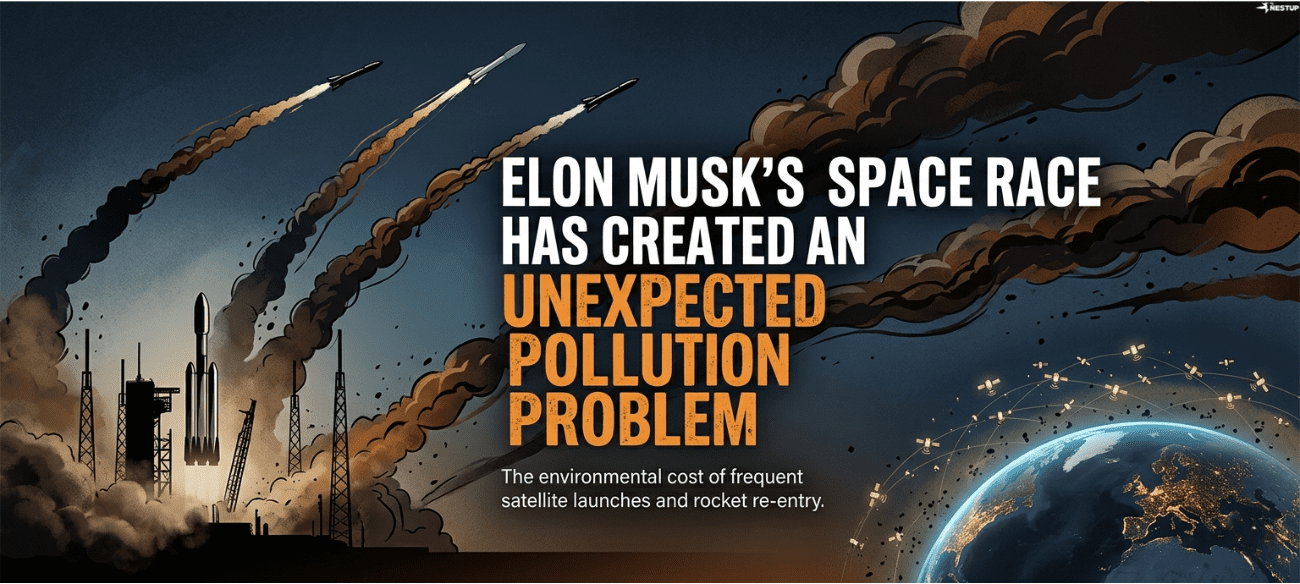
The "Smartphone" Strategy in Orbit: 5 Surprising Costs of the Disposable Satellite Revolution
A few years ago, witnessing a satellite burn through the night sky felt like a cosmic rarity—a stray piece of history ending in a momentary, lonely streak of light. Today, across Europe and North America, these glowing fireballs have become an industrial byproduct, appearing so frequently that they are often mistaken for meteor showers. This is the visible signature of SpaceX’s Starlink, a project that is doing more than just wiring the planet for internet; it is fundamentally redefining the Earth’s atmosphere as a consumable resource. We have moved from an era of celestial observation to one of atmospheric management, where the sky is less a cathedral and more a high-speed hardware refresh cycle.
The End of the "Permanent" Satellite
The traditional philosophy of satellite deployment was built on the concept of the "precious instrument." Engineers spent years hardening hardware to survive 10 to 15 years in the brutal vacuum of space. Starlink has shattered this paradigm, replacing it with a five-year "disposable" cycle. This shift mirrors the planned obsolescence of the consumer electronics industry, turning space hardware into rapidly replaceable nodes in a giant orbital computing network rather than long-term scientific investments.
This evolution is driven by the economics of reusable rockets, which have collapsed the cost of reaching orbit. What was once a prohibitive expense—the continuous launch of replacement hardware—is now a routine business operation. By treating satellites as a "constantly refreshing" grid, SpaceX can upgrade bandwidth capacity and hardware features at the pace of a smartphone release. The atmosphere, in this model, isn't just a barrier to cross; it is the final stage of a hardware refresh cycle where last year’s model is simply wiped away to make room for the next.
Reentry is No Longer an Accident—It’s Infrastructure
In the early space age, a satellite reentering the atmosphere was often a sign of failure or a rare end-of-life event. Today, reentry is a deliberate and frequent pillar of the Starlink business model. When these short-lived satellites are retired, they are intentionally pushed into the atmosphere to vaporize. Current estimates suggest that multiple satellites now reenter the atmosphere every single day, making "fireballs" a routine feature of our modern infrastructure.
"The system was designed to blanket the planet with internet coverage using thousands of low-Earth-orbit satellites. But behind the promise of global broadband is a business model that depends on something unusual — satellites that are intentionally short-lived."
There is a profound irony at the heart of this strategy. Current space regulations are hyper-focused on avoiding collisions and orbital debris (Kessler Syndrome); consequently, regulators actively encourage satellites to burn up quickly to keep low-Earth orbit "clean." However, this creates a massive regulatory blind spot. By incentivizing the removal of physical debris from orbit, we have institutionalized the dumping of vaporized industrial materials into the atmosphere. We are solving a collision problem by creating a pollution problem.
The "Invisible" Pollution of Alumina Nanoparticles
The most significant environmental threat of this new era is chemical, occurring far above the weather systems where it remains largely invisible and unregulated. As satellites vaporize, they release significant quantities of aluminum oxide, or alumina, into the upper atmosphere. Unlike ground-level industrial emissions, this pollution occurs in sensitive regions where it can persist for years.
Atmospheric scientists are concerned that these alumina nanoparticles could interfere with ozone chemistry and alter atmospheric heating patterns. Models suggest these particles may accumulate particularly near the poles, where they could contribute to ozone depletion reactions. Because the technology is scaling globally before we have the scientific tools to measure its full impact, we are essentially running a planetary-scale chemistry experiment with no off-switch.
We are Losing the Scientific Night Sky
The "smartphone" strategy in orbit has created a dual crisis for astronomy, threatening both our visual and auditory windows into the universe. Visually, the sheer volume of satellites creates constant interference; streaks of reflected sunlight regularly contaminate long-exposure telescope images used for deep-space surveys. While SpaceX has experimented with darker coatings, these mitigations are struggling to keep pace with the sheer scale of deployment.
The impact on radio astronomy is perhaps even more invasive. Recent studies have detected Starlink-related signals "leaking" into protected frequency bands reserved for scientific research. This electronic noise threatens the ability of researchers to perform sensitive observations of the early universe. We are reaching a point where the goal of global broadband is directly degrading our ability to perform fundamental scientific research, as our protected windows into the cosmos become crowded with industrial "leakage."
The "Strategic Trap" of Commercial Satellites
Regulating the environmental costs of these constellations is uniquely difficult because they have transitioned from commercial luxuries to essential national infrastructure. Programs like Starshield have integrated these "disposable" networks into the heart of defense and intelligence operations. When a private satellite network becomes critical for disaster response and national security, slowing its expansion for environmental reasons becomes a political impossibility.
This creates a "strategic trap" for regulators. As governments become hooked on the rapid innovation and redundancy of private constellations, the leverage to demand environmental accountability diminishes. The dependency of the state on a single, privately controlled network changes the regulatory equation, making it harder for agencies to push back against the invisible atmospheric costs of the satellite replacement cycle.
The "smartphone" strategy is no longer an outlier; it is becoming the global standard. With Amazon’s Project Kuiper preparing to launch and rival systems from China and Europe entering the fray to avoid dependence on Musk-controlled infrastructure, the atmosphere is poised to become an even larger dumping ground. We are witnessing an orbital arms race that prioritizes rapid deployment over atmospheric preservation. As these megaconstellations become a permanent fixture of our reality, we must ask: have we created a profound new form of pollution that we are fundamentally unequipped to measure, let alone control?