
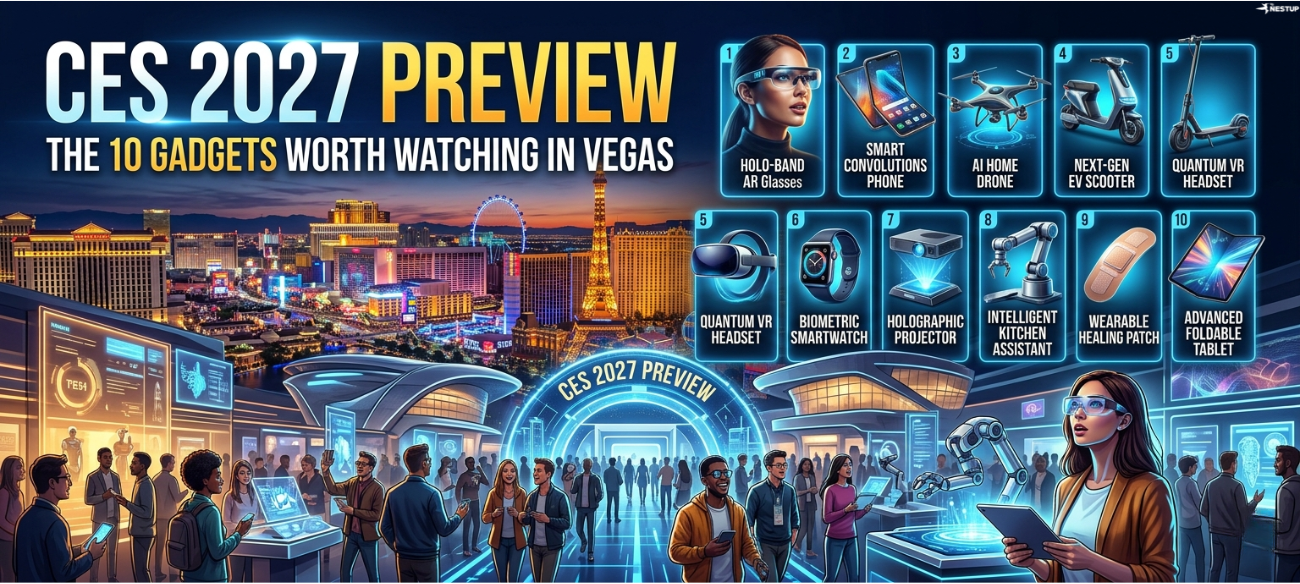
The neon lights of Las Vegas are humming with a different frequency this year. As CES 2027 kicks off from January 6 to 9, the atmosphere has shifted from the breathless hype of the mid-2020s to something far more grounded—and far more functional. We’ve spent years weathering the fatigue of tech "concepts" that promised the world and delivered only sleek renders. But if 2026 was the experimental era of trial and error, 2027 is the year of real-world execution. The frontier has moved beyond the cloud; the focus now is the seamless integration of local AI, Matter 2.0, and hardware that finally addresses the physical friction of our daily lives.
Your Future Roommate is a Humanoid Assistant
The era of robots as mere novelties or viral dance videos is over. Leading the charge is the Unitree G2 Humanoid Assistant. A far cry from the stumbling bipedal prototypes of years past, the G2 exhibits an uncanny fluidity. Its advanced spatial reasoning and delicate tactile sensor hands allow it to navigate the messy, unpredictable geometry of a family home to fetch items without crushing them.
Joining the G2 is the LG CLOiD Gen-2 Home Helper, a production-ready domestic worker that trades in human-like form for pure utility. The CLOiD utilizes locally processed reasoning models to tackle the chores we hate most: autonomously categorizing laundry, unloading standard dishwashers, and mapping out cleaning patterns in real-time.
"The shift at CES 2027 represents a pivotal move from the research lab to production-ready home automation, where robots are no longer 'future concepts' but functional tools for household management."
The "Screenless Shift" is Making Tech Invisible
In 2027, the most impressive hardware is the kind you almost forget is there. We are witnessing a "screenless shift," where tech becomes a subtle digital layer rather than a distracting glowing rectangle in your palm.
- Even Realities G3 Spatial Glasses: Ditching the "glass-hole" bulk of previous headsets, the G3 adopts a classic everyday form factor. It provides a minimalist heads-up navigation and real-time audio translation, acting as a proactive companion that whispers context into your ear and eyes without demanding your total attention.
- Omi Wearable Pod (Gen-2): This compact, clip-on device is the vanguard of "proactive productivity." Using advanced acoustic context, the Omi doesn't wait for a prompt; it listens to your world to subtly summarize conversations and draft action items via voice control, effectively automating the "mental load" of administrative life.
While AI is disappearing into our wardrobes through these invisible wearables, it is simultaneously gaining the mechanical muscle to tackle the architectural hurdles of our homes.
Finally, the Vacuum Can Climb the Stairs
For a decade, the "smart home" was defeated by a simple set of stairs. The Roborock Rover Stair-Climbing Vacuum has finally solved this ancient friction point. Born from the "Saros Rover" mechanical leg prototypes, this commercial-ready beast transitions effortlessly between floors. It doesn’t just skip the stairs; it vacuums each individual tread with precision. It is a milestone in autonomous maintenance, proving that AI-driven hardware is finally ready to navigate the world as it is built, not just on flat, unobstructed planes.
The Kitchen Now Thinks for You
The kitchen is evolving from a collection of "dumb" boxes into a proactive ecosystem. The Samsung Family Hub "Gemini-Plus" Refrigerator is no longer just a screen on a fridge; it’s a vision-based inventory manager. Using integrated multimodal vision models, it tracks every head of lettuce and carton of milk in real-time. By processing this data locally to ensure your eating habits stay private, it proactively suggests low-waste recipes based on what’s actually expiring. This is the shift from reactive tech (waiting for you to check the app) to proactive tech (reminding you that the pesto needs to be used tonight).
Local AI Muscle is Replacing the Cloud
A massive undercurrent of CES 2027 is the "Edge AI" revolution. Privacy concerns and latency issues have pushed processing away from distant servers and back onto our desks. The Nvidia GeForce RTX 50 Super Series (including the 5070 and 5080 Super) is the engine room of this movement.
These cards utilize dense 3GB GDDR7 memory chips, a technical leap that allows even mid-range rigs to keep massive Large Language Models (LLMs) entirely within VRAM. This isn't just about path-traced gaming; it's about having the hardware backbone to run a personalized, private AI that doesn't need to phone home to a corporate data center just to process a request.
"A massive 50% boost in VRAM capacity marks a milestone for local AI, allowing hardware to handle path-traced gaming and complex AI workflows effortlessly and privately."
"Smart Bricks" and the End of Silent Play
Even the toy chest isn't immune to the "Physical AI" trend. The Lego Smart Play Engine Sets introduce a "Smart Brick" ecosystem that feels like magic. These standard-sized bricks house microscopic ASIC chips and orientation sensors that detect magnetic fields and proximity. As you build, built-in mini speakers and haptic feedback generate dynamic audio soundscapes that respond to your movements. It turns a static plastic model into a responsive environment, proving that even the most traditional play can be reinvented through microscopic hardware.
The Verdict: Real-World Execution over Buzzwords
The preview for CES 2027 signals the end of the "AI as a buzzword" era. We’ve moved into the era of the "Job to be Done." Whether it’s a humanoid navigating your living room, a graphics card protecting your privacy, or a vacuum conquering the stairs, the focus is on fixing the everyday friction of human existence. The experimental phase is over; the hardware has finally caught up to the software.
Which of these gadgets would you want in your home first? Or perhaps the bigger question: Are we ready for a home where the most intelligent presence in the room is the refrigerator—and it’s judging our preference for expired yogurt?