
1. The End of the Stablecoin Monopoly
For the better part of a decade, the digital liquidity landscape has been defined by a comfortable, private-sector monopoly. Stablecoins like USDT and USDC have operated as the undisputed plumbing for cross-border payments, crypto-asset trading, and the decentralized finance (DeFi) ecosystem. However, this era of private dominance is facing a structural reckoning.
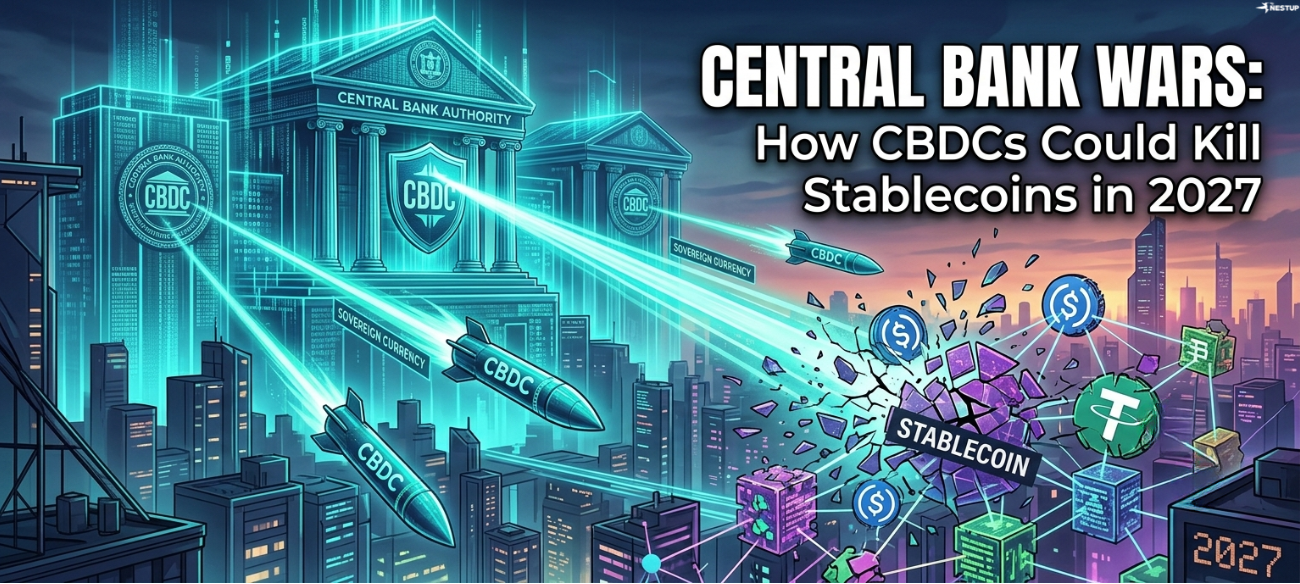
As we approach 2027, the global financial apparatus is preparing for a "Sovereign Strike." Central Bank Digital Currencies (CBDCs) are transitioning from theoretical white papers into weaponized, high-leverage software deployments. This is no mere technological refresh; it is a fundamental battle for the control of money itself. The days of private issuers operating without sovereign competition are over.
2. Vertical vs. Horizontal: The Unfair Advantage of Scale
The most immediate threat to the stablecoin status quo lies in the divergent Adoption Paths. While private fintech firms have built impressive silos, they lack the structural reach inherent to the nation-state.
- Horizontal Growth: Private stablecoins expand horizontally. Their growth is throttled by onboarding friction—requiring users to manually open exchange accounts, manage complex self-custodial wallets, and navigate the technical maze of Web3.
- Vertical Growth: CBDCs scale vertically and instantly. When a central bank deploys a digital dollar, euro, or yuan, it does not wait for viral adoption. It injects the currency directly into the commercial banking apps and payment terminals already used by millions.
In this environment, the "average consumer" won't need to understand blockchain architecture. The technology will be an invisible utility, disintermediating the current gatekeepers of the crypto economy.
"CBDCs scale vertically and instantly by using existing payment terminals and apps, effectively bypassing the complex user onboarding that currently limits mainstream stablecoin adoption."
3. Compliance as a Weapon: The Regulatory Walled Garden
Central banks possess a unique strategic advantage: they don't just play the game; they write the rules. As sovereign digital assets come online, we expect to see Regulatory Shifts designed to systematically tilt the scales.
- Systemic De-risking: Regulators are increasingly likely to impose draconian capital requirements, making it prohibitively expensive for private entities to back their tokens with traditional assets like Treasury bills.
- Walled Gardens: Governments are already signaling the intent to restrict private tokens from critical public infrastructure. This includes blocking stablecoins from national retail tax collections, government payrolls, and utility payment gateways.
Institutional capital is inherently risk-averse. When forced to choose between a private token vulnerable to a sudden regulatory freeze and the "absolute legal clarity" of a sovereign asset, the flight to safety will be swift and decisive.
4. The Neutrality Defence: Permissionless Liberty in a Regulated World
Despite the overwhelming weight of the state, private tokens possess a strategic silver lining. Stablecoins maintain a distinct edge in areas where central banks are structurally incapable of competing: the DeFi Engine and geopolitical neutrality.
Central banks are inherently cautious and bound by the leaden weight of geopolitical alignments and sanctions. A digital dollar issued by the Federal Reserve will always be a political instrument, subject to freezes and strict programming limits. In contrast, private stablecoins offer a hyper-flexible, permissionless medium of exchange that operates outside traditional banking hours and political borders. Because CBDCs will likely be barred from interacting with experimental or volatile protocols, stablecoins will remain the essential, unshakeable fuel for automated market makers and Web3 lending platforms.
"Stablecoins will continue to serve as the foundational, unshakeable fuel for automated market makers and Web3 lending platforms, operating where sovereign currencies fear to tread."
5. Yield Wars: The Shift in Your Digital Portfolio
While stablecoins may win on utility, their profitability is under siege. For years, issuers like Tether and Circle have enjoyed a "free ride," generating massive revenue by holding interest-bearing government debt (T-bills) while passing none of that yield to the token holder. This model is facing an abrupt end.
If CBDCs begin offering interest-bearing accounts, or if the "Sovereign Strike" forces private issuers to share their yields to remain competitive, the current revenue models for private issuers will collapse. We are entering a period of sharp issuer divergence. "Compliant" issuers who integrate with institutional networks and provide transparent auditing may survive as specialized tools, but algorithmic or under-collateralised tokens will likely disintegrate under the structural pressure of a high-rate, state-backed digital economy.
6. Conclusion: A Division of Territory
The future of digital money is not a zero-sum game, but a tactical division of territory. CBDCs are positioned to dominate domestic retail, state-level financial systems, and high-volume B2B settlements due to their sheer scale and legal backing. Meanwhile, private stablecoins will evolve into specialised liquidity layers for the global internet economy—the permissionless "neutral" ground for the Web3 world.
The ultimate takeaway is a tiered reality: sovereign systems will provide the security and scale for the masses, while private tokens provide the flexibility for the innovators.
Are you looking at the rise of CBDCs as an inevitable step toward mainstream digital efficiency, or do you view them as a threat to financial privacy?