

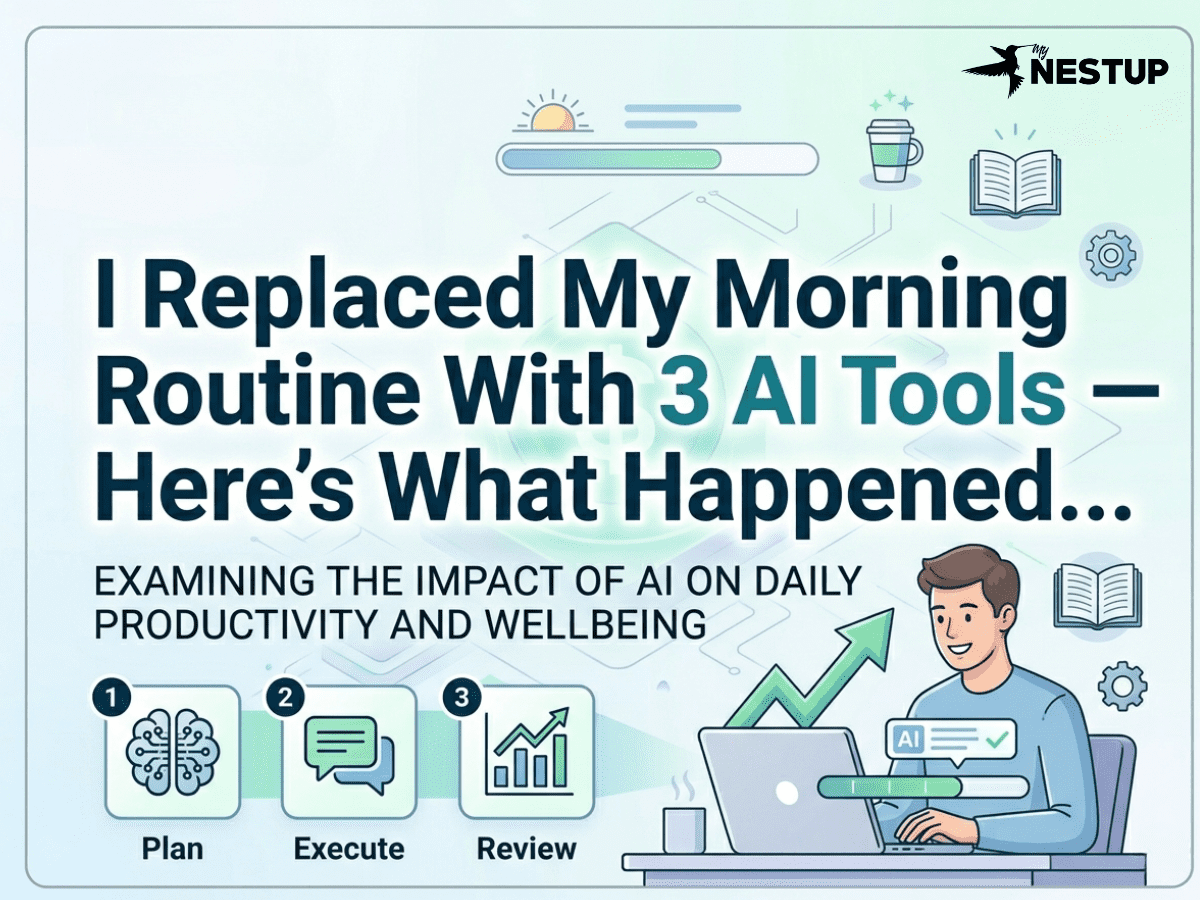

For years, my mornings followed a familiar pattern: scroll the news, check emails, vaguely plan the day, and somehow still feel behind before 10 a.m. So I ran a 30-day experiment—replacing my entire morning routine with just three AI tools.
The goal was simple: save time, reduce stress, and start the day with clarity instead of chaos. What I didn’t expect was how uneven the experience would be. Some parts felt like the future. Others… not so much.
The Setup: My 3-Tool AI Stack
I intentionally kept things minimal. No over-optimization, no complex workflows.
- Morning Briefing: ChatGPT
- Health Check-In: Whoop
- Daily Planning: Notion AI
Each had a clear role:
- ChatGPT summarized news and emails
- Whoop tracked sleep, recovery, and readiness
- Notion AI turned my messy to-do list into a focused plan
No switching between 10 apps. No doomscrolling. Just signal over noise.
Week 1: The “This Is Magic” Phase
The first few days felt almost suspiciously smooth.
Instead of scrolling headlines, I asked ChatGPT for:
“Give me a 5-minute briefing on global news, tech, and anything important for my work.”
In under a minute, I had something better than my usual 20-minute scroll.
Whoop added another layer. It didn’t just tell me how long I slept—it told me whether I should push hard or take it easy. That alone changed how I approached mornings.
Notion AI was the biggest surprise. I dumped a chaotic list of tasks into it and got back:
- 3 priorities
- A realistic schedule
- Suggested time blocks
For the first time in a while, my mornings felt… intentional.
Week 2–3: Friction Starts to Show
The honeymoon didn’t last.
1. AI Still Needs Babysitting
ChatGPT summaries were good—but not perfect. Sometimes:
- Important niche news was missing
- Context felt generic
- Sources weren’t always transparent
I found myself double-checking key information, which added back some friction.
2. Health Data ≠ Health Decisions
Whoop gave great data, but interpreting it wasn’t always straightforward.
A “low recovery” score didn’t answer:
- Should I skip work or just skip intense exercise?
- Is this mental fatigue or physical?
AI gave insight—but not always clear action.
3. Planning Still Depends on You
Notion AI could organize my day—but it couldn’t:
- Predict interruptions
- Understand shifting priorities in real time
- Say “this doesn’t actually matter” with confidence
In other words, AI can structure your day, but it can’t own it.
The Metrics: Did It Actually Work?
After 30 days, I tracked three things:
Time Saved
- Old routine: ~60–75 minutes
- AI routine: ~25–30 minutes
Net savings: ~40 minutes per day
That’s over 20 hours per month—not trivial.
Stress Levels
This was the biggest win.
- Less information overload
- Fewer decisions early in the day
- Clearer starting point
Mornings felt calmer—not rushed.
Consistency
AI made it easier to stick to a routine.
Why? Because it removed friction:
- No “what should I do first?”
- No app-hopping
- No decision fatigue
The Unexpected Downsides
Not everything improved.
Over-Reliance Creeps In
I noticed I was trusting summaries a bit too much. Skipping primary sources entirely isn’t always smart—especially for nuanced topics.
Less Serendipity
When you stop scrolling, you also stop discovering random, interesting things.
AI gives you what you ask for—not what you didn’t know you needed.
The “Samey” Effect
AI-generated plans sometimes felt repetitive. Efficient, yes—but not always inspiring.
What Stayed vs. What Got Cut
After 30 days, I didn’t keep everything.
What Stayed
- ChatGPT for morning briefings → biggest time saver
- Notion AI for planning → best for clarity
What Got Cut (or Reduced)
- Whoop (daily reliance) → still useful, but not essential every morning
Health insights are valuable—but not something I needed to check obsessively.
The Real Lesson: AI Doesn’t Replace Routine—It Refines It
Going into this experiment, I thought AI might completely transform my mornings.
It didn’t.
What it did instead was more subtle—and more useful:
- It compressed time
- It reduced noise
- It made decisions easier, not automatic
The best way to think about it is this:
AI didn’t take over my morning. It removed the parts that didn’t matter.
Final Verdict: Is an AI Morning Routine Worth It?
Yes—but only if you use it deliberately.
If you expect AI to:
- Think for you → you’ll be disappointed
- Replace discipline → it won’t
But if you use it to:
- Filter information
- Structure your day
- Reduce friction
Then it’s easily one of the highest-ROI upgrades you can make.
If You Want to Try This Yourself
Start simple:
- Ask ChatGPT for a 5-minute daily briefing
- Use one AI tool to prioritize your tasks
- Add health tracking only if you’ll actually act on it
Don’t build a 10-tool system. That defeats the point.
Bottom line:
AI didn’t give me superhuman productivity.
It gave me something better—a calmer, clearer start to every day.