
For decades, the concept of lunar mining was the exclusive province of cyberpunk novels and the aspirational daydreams of the "New Space" billionaire class. It was a vision of the future that always seemed to remain perpetually thirty years away.
In 2026, that vision finally collided with geopolitical reality.
The Moon is no longer a destination for symbolic exploration or the fleeting prestige of planting flags. We have entered a pivot point where the lunar surface is being reclassified as a strategic economic zone. The shift is fundamental: we are no longer asking if we can reach the Moon, but how we will manage the industrial assets and resources found there. In 2026, the "infrastructure stack" moved from theoretical white papers to actual deployment.
The New Gold Rush: Chemistry and Collision Courses
The primary driver of this modern lunar economy isn't gold or diamonds; it is water ice and rare metals. Found primarily in the permanently shadowed craters of the lunar South Pole, this ice represents the most valuable real estate in the solar system.
The value proposition is rooted in basic chemistry. By separating water into hydrogen and oxygen, operators can manufacture rocket fuel (H2/O2) on-site. This completely upends the "gravity well" economics of space travel. Instead of the prohibitive expense of launching heavy, fully fueled craft from Earth’s deep gravity, spacecraft can eventually refuel at a lunar staging ground.
However, this isn't a wide-open frontier. Because nearly every major lunar program—both national and commercial—is targeting the same handful of resource-rich craters, we are on a strategic collision course. These specific sites are the primary refueling stations and logistics hubs for the future of deep-space missions, making them high-stakes territory for the first movers.
The End of the Monolith: NASA as a Customer
The architecture of space exploration has undergone a structural revolution, shifting away from the government-run "monolith" model of the 1960s. During the Apollo era, the state designed, owned, and operated every piece of hardware. Today, NASA has successfully transitioned into a "customer" role, purchasing services from a burgeoning commercial payload ecosystem.
This shift is best exemplified by the rise of companies like Intuitive Machines. Utilizing robotic, cargo-focused landers like the Nova-C, private industry is now assuming the risk and responsibility for the logistics of lunar delivery. This isn't just about science; it's about building a commercial transportation network. By treating NASA as one of many potential customers, these firms are laying the groundwork for a self-sustaining industrial presence where the government provides the demand, but the private sector provides the infrastructure.
The Great Split: A Tale of Two Moons
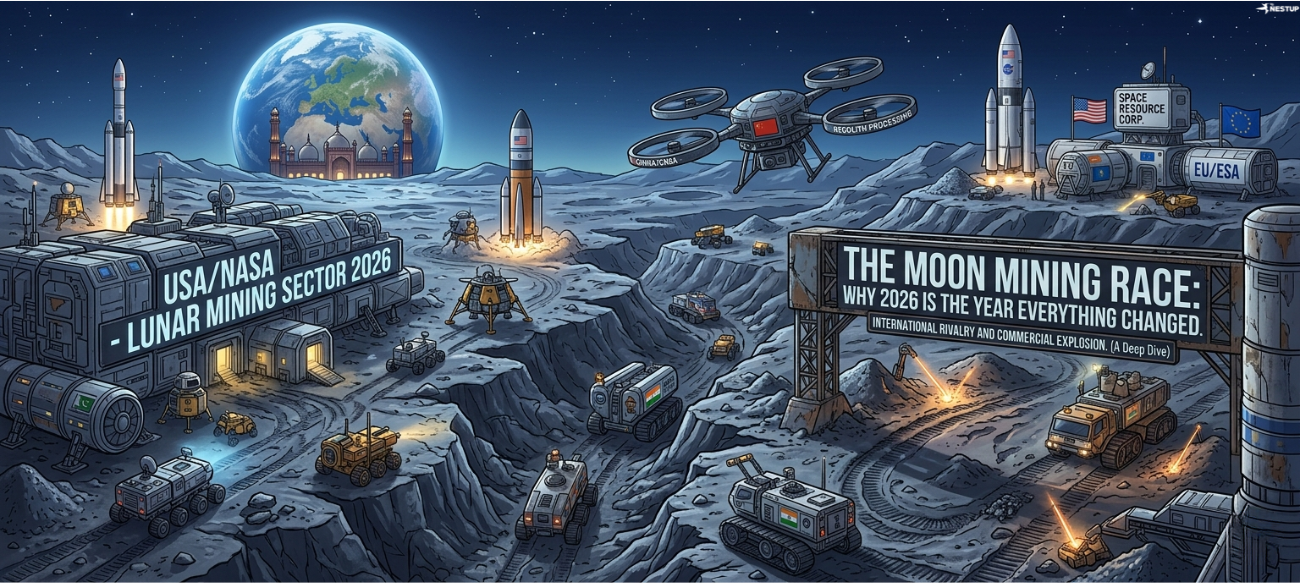
As the lunar economy matures, a stark geopolitical divide is emerging. Instead of a unified global effort, we are seeing the emergence of competing space ecosystems: the US-led Artemis coalition and the China-led International Lunar Research Station (ILRS). This "Great Split" presents a significant challenge for global stability.
"That raises uncomfortable geopolitical questions: Who controls lunar infrastructure? Who defines property rights? Who gets access to resources? What happens if resource zones overlap?"
We are witnessing the Moon become a theater for great-power competition. If two different legal and technical ecosystems begin to overlap in the same resource-rich craters at the South Pole, the potential for friction—and the need for new "rules of the road"—becomes the defining diplomatic challenge of the 2020s.
Living Off the Land: The ISRU Revolution
A sustainable presence on the Moon requires a departure from the "Earth-reliant" model. This is the ISRU (In-Situ Resource Utilization) revolution—the practice of "living off the land" to reduce the capital-intensive nature of space flight.
The key materials driving this industrial shift include:
- Water Ice: The feedstock for life support and cryogenic fuel.
- Rare Metals: Essential components for the high-tech hardware and energy systems required for lunar survival.
- Regolith (Lunar Soil): An abundant raw material for 3D-printing habitats and construction.
- Oxygen-bearing Minerals: Processed to provide breathable air and chemical oxidizers.
ISRU marks the transition from short-term "visits" to a strategy of permanent industrial settlement and manufacturing nodes.
The Hostile Reality: Physics Doesn't Care About Hype
Despite the momentum, the Moon remains a brutal environment that defies easy industrialization. It is hostile in ways that often escape the public imagination. Apollo astronauts identified lunar regolith as their greatest operational hurdle; it is sharp, abrasive, and electrostatically charged, capable of shredding seals and destroying delicate machinery.
Beyond the dust, engineers must solve for:
- Extreme Thermal Swings: Equipment must survive the brutal transition between intense solar radiation and the deep freeze of the lunar night.
- One-Sixth Gravity: Simple tasks like drilling or excavation become technical nightmares when machinery lacks the weight to gain traction.
- Communication Delays: Even the slight lag between Earth and the Moon complicates the remote robotic operations essential for mining.
Industrializing the Moon is a capital-intensive gamble that only makes sense if the resources extracted are used to support further space operations. We aren't mining the Moon for Earth; we are mining the Moon for the rest of the solar system.
Debunking the Helium-3 Myth
Whenever lunar mining hits the headlines, Helium-3 is often cited as a "miracle fuel" for nuclear fusion. However, as a strategic analyst, it is vital to separate the "theoretical" from the "near-term."
While Helium-3 is a fascinating prospect, commercial fusion has not yet been solved. This makes Helium-3 a highly speculative, long-term opportunity rather than an immediate market. For the next decade, the "real" lunar economy will be built on much humbler, more practical materials: oxygen, water, and construction regolith. These are the resources that will provide a return on investment by supporting immediate infrastructure.
Operating on a 1960s Playbook
Perhaps the greatest hurdle is that we are operating on a 1960s legal playbook in a 2020s industrial landscape. The Outer Space Treaty of 1967 prohibits "sovereign claims" over celestial bodies, but it is dangerously vague regarding whether a private company can own the materials it extracts.
The US-led Artemis Accords argue that resource extraction is legal and that private ownership of materials is the only way to incentivize the massive capital investment required. China and its partners may interpret these governance rules differently. Because large-scale industrialization requires legal certainty, this ambiguity remains the primary barrier to entry for major institutional investors.
Beyond the Hype: The 2030s Outlook
We have seen space hype cycles before, but the 2026 shift feels different because the "infrastructure stack" is finally coming together. Reusable rockets have collapsed the cost of access, robotics have advanced to handle complex remote tasks, and strategic competition has turned the Moon into a high-priority national interest.
This race is no longer about the prestige of the journey or the "small steps" of a few explorers. It is about who will control the logistics, transportation networks, and industrial nodes of deep space. As we look toward the 2030s, the Moon is evolving from a scientific outpost into a military-strategic concern and a manufacturing hub.
The central question of the lunar frontier has shifted. We are no longer asking "Can we go?" We are asking "Who will own what is there?"