

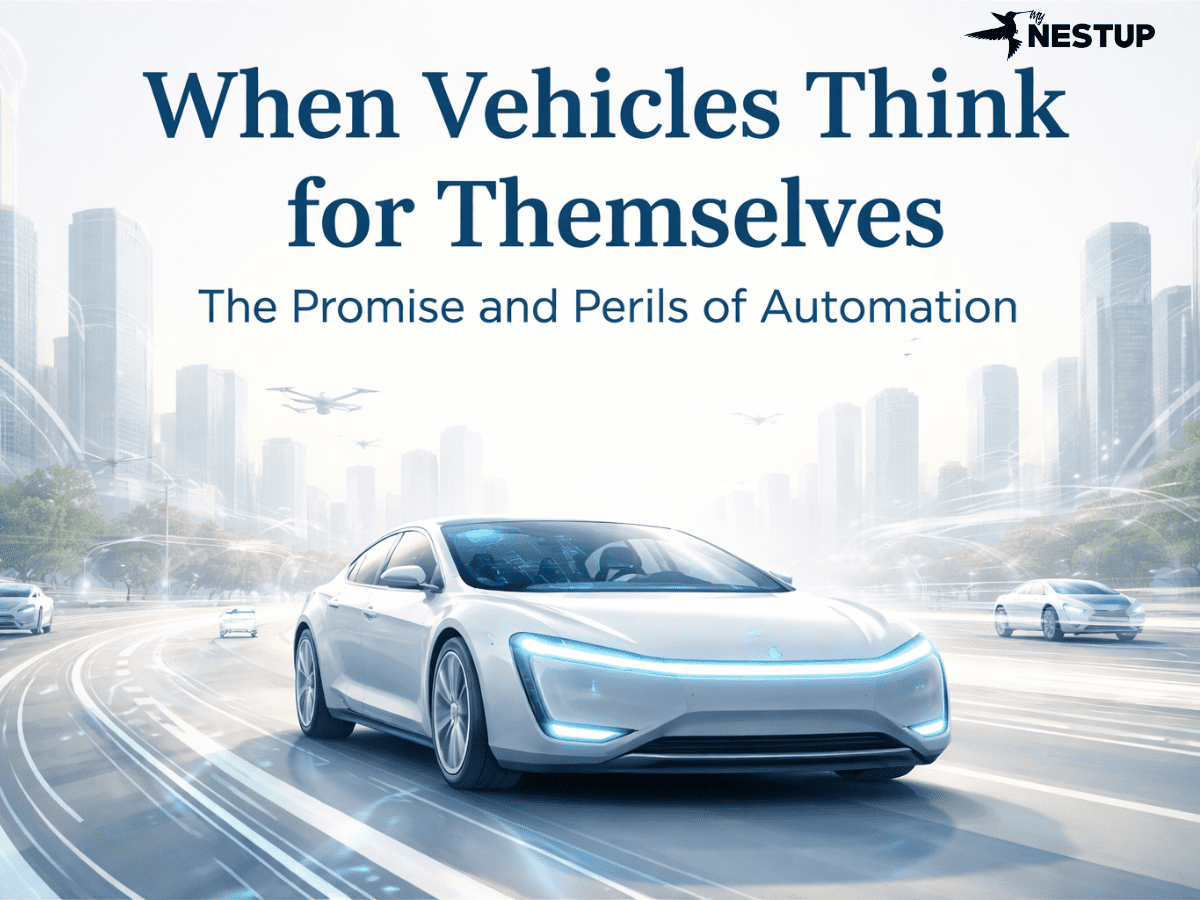

An autonomous vehicle, often called a self-driving or driverless vehicle, is designed to move from one place to another without a person controlling it. It relies on a mix of sensors, cameras, radar systems. and AI to understand its surroundings and make driving decisions on its own. For a vehicle to be considered truly autonomous, it should be able to follow a set route. It should handle all driving tasks by itself, even on regular roads that have not been specially modified.
These vehicles could transform the way we travel in the future. They may help ease traffic and cut down on road accidents. They open the door to new services like autonomous ride-hailing and driverless freight transport.
A number of major companies are working on or testing this technology. These include Audi, BMW, Ford, Google, General Motors, Tesla, Volkswagen and Volvo. Waymo (Alphabet’s self-driving initiative) has been running a fleet of autonomous cars such as the Toyota Prius and Audi TT, logging hundreds of thousands of miles on city streets and highways.
Vehicles with self-driving technology
Waymo is one of the closest examples we have to a truly autonomous vehicle. Its cars can handle most of the driving by themselves. Although a human is still required to sit behind the wheel in case the system needs to be overridden. So, while the vehicles are not completely driverless, they are capable of operating on their own under the right conditions and demonstrate a high degree of autonomy.
Most vehicles on the market today are not fully self-driving yet. There are still hurdles to clear. These hurdles range from technical limitations to safety concerns and strict regulations. Tesla is often praised for moving the industry toward autonomous driving but despite having many advanced features their vehicles still struggle with complex technology.
Even though fully autonomous cars are not widely available, many consumer vehicles now come with partial self-driving features. Some of the commonly found functions include:
• Hands-free steering: Keeps the car centered in its lane without the driver’s hands on the wheel, though the driver must stay alert.
• Adaptive cruise control (ACC): Automatically keeps a set distance from the car ahead.
• Lane-centering assist: Gently steers the vehicle back toward the center if it begins drifting over lane lines.
• Self-parking: Uses built-in sensors to steer and maneuver the car into a parking spot with little or no help from the driver.
• Highway driving assist: Combines ACC with lane-centering to support drivers during highway travel.
• Lane-change assist: Checks surrounding traffic and helps the driver switch lanes safely, either by providing alerts or steering automatically.
• Lane departure warning (LDW): Alerts the driver when the vehicle starts to drift into another lane without signaling.
• Summon (Tesla): Allows the car to move out of a parking space and drive toward the owner’s location on its own.
• Evasive steering assist: Helps the driver steer away from an imminent crash.
• Automatic emergency braking (AEB): Detects possible collisions and activates the brakes to avoid or reduce impact.
Features of Autonomous Vehicle
Several automakers now combine different levels of autonomous features and driver-assistance systems in their vehicles. Some examples include:
• Audi offers Traffic Jam Assist. They can handle steering, braking and acceleration during slow, congested driving.
• Cadillac (from General Motors) has Super Cruise. It is a hands-free driving system designed for compatible highways.
• Genesis uses tech that studies a driver’s habits and then adjusts its semi-autonomous driving style to match those preferences.
• Tesla equips its cars with Autopilot. This includes lane-departure alerts, lane-keeping, adaptive cruise control, parking assist, Summon and other advanced self-driving functions.
• Volkswagen provides IQ.Drive with Travel Assist, combining adaptive cruise control with lane-centering.
• Volvo features Pilot Assist, which supports semi-autonomous driving with both lane-centering and adaptive cruise control.
Technologies Behind Autonomous Vehicles
Self-driving cars rely on a mix of sensing tools (radar, GPS, cameras and lidar) to observe their surroundings and build a detailed 3D picture of the world around them. This includes everything from road markings and traffic lights to nearby cars, pedestrians, and signs. High-powered onboard computers analyze all this incoming information and decide how the vehicle should move. They are constantly adjusting steering, speed, braking and acceleration based on real-time sensor feedback.
Machine learning and artificial intelligence are at the heart of how these systems work. With machine learning, the vehicle processes huge amounts of data and uses it to refine the algorithms that guide its decisions. This helps it get better at handling different driving situations. AI allows the vehicle to make choices on its own, rather than waiting for pre-programmed instructions for every scenario it might face on the road. Another key component is connected-vehicle technology. Using radio signals, these cars can exchange information with nearby vehicles and roadway infrastructure. This lets them detect road users. Also gives the vehicle a more complete understanding of its environment. As a result, roads can become safer not only for drivers but also for pedestrians and cyclists.
Levels of Autonomy in Autonomous Vehicles
The Society of Automotive Engineers (SAE) defines six stages of driving automation, ranging from no automation at all to fully autonomous operation:
• Level 0 – No Automation:
The driver is responsible for every aspect of driving. The vehicle does not assist with steering or speed control.
• Level 1 – Driver Assistance:
The car can help with either steering or acceleration/braking, but not both at the same time. The driver must stay fully involved.
• Level 2 – Partial Automation:
The vehicle can manage steering and speed together. It includes using two or more automated features at once. Even so, the driver must remain alert and ready to take over immediately.
• Level 3 – Conditional Automation:
The car can handle all driving tasks in specific situations, such as certain highway stretches. The system may request the driver to step in when conditions change.
• Level 4 – High Automation:
The vehicle can drive itself without needing input as long as it is within approved or designed scenarios. Human involvement becomes optional in these areas.
• Level 5 – Full Automation:
The car is capable of driving on its own in all environments and conditions, with no driver participation required.
The Pros and Cons of Self-Driving Vehicles
Self-driving vehicles bring together a wide range of advanced technologies. While they are improving quickly, they come with both advantages and drawbacks.
Benefits of autonomous vehicles
One of the biggest selling points of autonomous vehicles is improved safety. According to estimates from the U.S. Department of Transportation and the NHTSA, about 40,990 people died in traffic crashes in 2022, and more than 13,500 of those deaths involved alcohol. Since autonomous cars do not get distracted or drive under the influence, they have the potential to reduce many of the human-related factors behind these accidents. That said, they are still not immune to mechanical failures or other technical issues that can lead to crashes.
If most vehicles on the road were self-driving, traffic could move more smoothly, easing congestion. Fully autonomous cars would also let passengers use their travel time for work or relaxation instead of focusing on the road. People who cannot drive because of disabilities or health-related limitations might also gain new independence and access to jobs that require transportation.
There is also progress being made in the trucking industry. In the U.S. and Europe, autonomous trucks have been tested to allow drivers to rely on autopilot during long hauls. This approach, often called truck platooning, uses adaptive cruise control, collision-avoidance systems and vehicle-to-vehicle communication.
Disadvantages of self-driving cars
Not everyone feels comfortable riding in a car without a human behind the wheel, especially in the early years of adoption. Another concern is that as people get used to automated systems, they might become too dependent on them. When drivers stop paying attention, they may fail to intervene during software errors or mechanical problems.
A Forbes report also noted that self-driving cars currently experience about twice as many accidents per mile compared to traditional vehicles. There have been high-profile incidents, too. In 2022, Tesla faced backlash after footage surfaced showing one of its cars hitting a child-sized test dummy during a braking test. Several real-world crashes have also raised concerns about Tesla’s Full Self-Driving mode. In one 2023 case, a student getting off a school bus was struck by a Tesla Model Y operating in FSD mode. Although the student initially had severe injuries, their condition improved in the days that followed.
Cost is another challenge. Developing, producing and testing autonomous vehicles requires enormous investment. There are also ethical debates about how self-driving systems should be programmed to respond in unavoidable crash situations. Weather can create additional obstacles. Sensors that cars rely on may be blocked by mud or blinded by heavy rain, snow, or fog. This can limit the vehicle’s ability to accurately perceive its surroundings.
Autonomous vehicle safety and challenges
Autonomous vehicles have to recognize an enormous variety of objects that might appear in their path. This includes everything from fallen branches and trash to animals, cyclists and pedestrians. They also face many tricky real-world situations, such as tunnels that disrupt GPS signals, construction zones that shift lanes and moments that call for quick judgment. Such as figuring out where to pull over for an approaching emergency vehicle.
These systems need to decide instantly whether to brake, steer away or maintain their speed. Developers are still working to perfect this. There have been cases where self-driving cars reacted too cautiously, hesitating or swerving when they did not need to.
One major example was a deadly crash in March 2018 involving an autonomous Uber test vehicle. The software detected a pedestrian but mistakenly classified the reading as a false alarm, causing the car not to avoid the collision. After this incident, Toyota paused public-road testing and shifted its evaluations to controlled environments. The Toyota Research Institute later built a 60-acre testing facility in Michigan to further advance its automated driving research.
Accidents like these raise tough questions about legal responsibility. Lawmakers still have not clearly defined who is liable when an autonomous vehicle is involved in a crash. There are also cybersecurity concerns. Experts worry that the software running these cars could be hacked, and automakers are working to strengthen protections. In the United States, companies must follow the Federal Motor Vehicle Safety Standards set by NHTSA. China, however, is taking a different route. Instead of simply adjusting cars to fit existing roads, the government is redesigning infrastructure, policies and even city layouts to better support autonomous vehicles. This includes creating rules for how people move through public spaces. It also includes partnering with mobile network providers to handle part of the data processing needed for self-driving systems. China’s centralized political structure allows these changes to move faster than in the U.S., where decisions must pass through a more complex, legalistic system.
Conclusion
Supporters of fully automated driving believe that, if the technology reaches its highest level, it could improve road safety by removing the human mistakes that cause most crashes. They also argue that self-driving cars could change how cities are designed. They help in encouraging more car-sharing, reducing the need for individual parking spaces and offering new mobility options for children, older adults and people with disabilities.
Critics, however, see potential downsides. They worry that if cars can drive themselves, people may travel even more than they already do. This will end up in creating heavier traffic and worsening pollution. Some also argue that easier commutes could push people to live farther from city centers, contributing to more urban sprawl.
In coming years, drivers could already buy vehicles equipped with partial automation features like adaptive cruise control, lane-keeping assist and traffic-jam assist. Fully autonomous vehicles, though, still are not available for everyday use. Estimates differ, but many experts expect that Level 4 automation may become accessible to consumers sometime between 2030 and 2035.
References
https://www.twi-global.com/technical-knowledge/faqs/what-is-an-autonomous-vehicle
https://www.synopsys.com/glossary/what-is-autonomous-car.html