
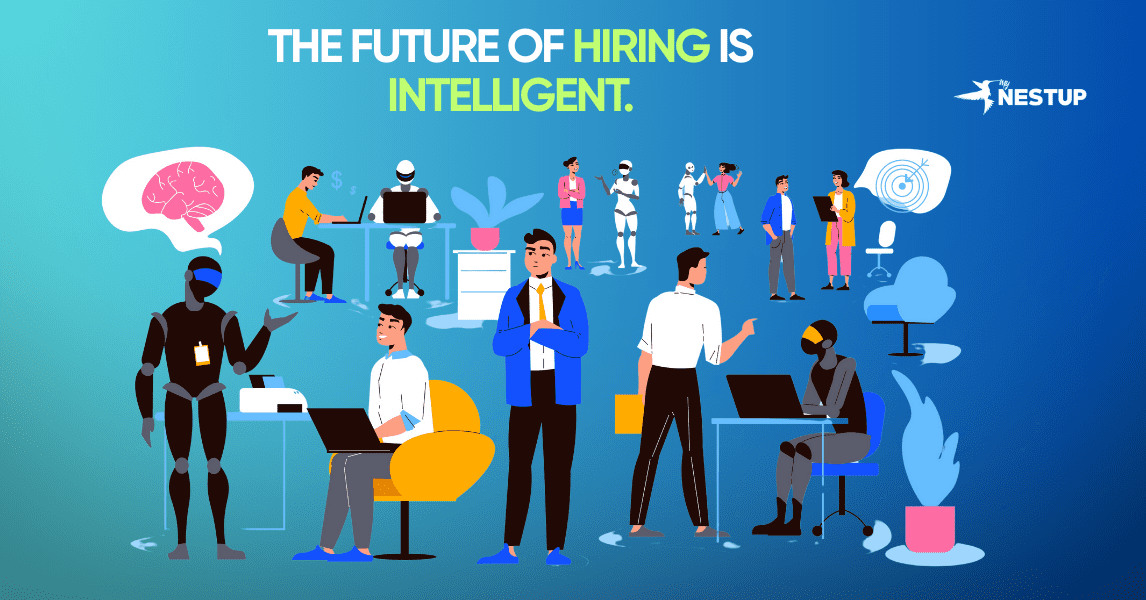

What is AI in HR?
Artificial Intelligence (AI) is quickly changing how companies manage their human resources and find new talent. In recruiting, AI tools are taking over repetitive and time-consuming tasks, like screening hundreds of resumes or answering common candidate questions via chatbots. This shift allows recruiters to move faster, dedicating less time to administrative work and more time to connecting with and evaluating top candidates. This increased efficiency significantly reduces the time and cost of hiring for organizations, freeing up HR professionals to focus on more strategic, human-centric parts of their jobs, such as assessing cultural fit and negotiating offers.
Key AI Applications:
Resume Screening:
The implementation of AI in resume screening transforms the daunting task of reviewing massive applicant pools into a streamlined, high-precision operation. Through Contextual Matching, AI leverages Natural Language Processing (NLP) to move beyond rudimentary keyword searches, instead interpreting the nuance of a candidate’s professional history and how it aligns with specific role requirements. This technology also serves as a critical tool for Bias Reduction; when properly configured, these systems are programmed to ignore demographic markers and focus exclusively on objective skills, fostering a more equitable “top-of-funnel” selection process. By employing Ranking and Scoring mechanisms, AI can instantly evaluate thousands of submissions to generate a compatibility score. This allows recruiting teams to bypass manual sorting and dedicate their expertise to the top 5% of talent immediately, significantly reducing time-to-hire.
Chatbots:
AI-powered chatbots serve as a 24/7 bridge between the organization and its applicants, significantly enhancing Candidate Engagement by providing instant responses to inquiries about application status, company culture, and benefits. Beyond simple communication, these virtual assistants act as a first line of defense through Initial Vetting, conducting automated “knock-out” rounds that ask critical qualifying questions regarding certifications, relocation, or work authorization. This interaction also facilitates seamless Data Collection, as the chatbot captures candidate sentiment and vital information that is fed directly into the Applicant Tracking System (ATS). By automating these early touchpoints, companies can maintain a responsive brand image while ensuring that only the most qualified candidates progress through the funnel.
Interview Scheduling:
AI-driven scheduling tools eliminate the administrative burden of coordinating calendars by facilitating Seamless Integration with both the hiring manager’s and the candidate’s digital calendars, such as Google Calendar or Outlook, to identify mutually available time slots in seconds. This automation extends to Automated Logistics, where the system independently distributes vital information, effectively ending the traditional back-and-forth email “ping-pong.” Furthermore, the system provides significant Rescheduling Flexibility; if a conflict occurs, candidates can use a self-service link to adjust their appointment time, which triggers an automatic update to the recruiter’s schedule and notifies all relevant parties instantly.
Benefits of using AI in HR:
- Faster hiring cycles: A major advantage of using AI in talent acquisition is the ability to improve both the speed and quality of hiring. AI-powered platforms can quickly analyze massive amounts of data from applications, social profiles, and historical hiring patterns to identify candidates who are most likely to succeed in a specific role. AI helps in creating a more objective hiringprocess by focusing on skills and qualifications, which can help minimize unconscious human biases that often creep into manual screening. By looking at a candidate’s entire profile rather than just relying on a few keywords, AI ensures that qualified individuals aren’t overlooked simply because their resume didn’t match a rigid search filter.
- Predictive analytics: It transforms recruitment from a reactive process into a data-driven science by forecasting a candidate’s potential for long-term success. Through Success Modeling, AI analyzes the specific traits, performance histories, and skill sets of an organization’s current top performers to build a “success profile,” allowing recruiters to identify similar high-potential patterns in new applicants. This foresight extends to Retention Forecasting, where models examine historical turnover data to estimate the likelihood of a candidate remaining with the company, effectively mitigating the high costs associated with attrition. By identifying specific Performance Indicators, AI moves the hiring decision away from subjective “gut feelings” toward objective, measurable outcomes.
- Bias Reduction: AI plays a pivotal role in fostering a more equitable hiring process by evaluating candidates objectively on their skills rather than subjective factors. Through Blind Screening, these systems can automatically redact names, gender markers, ages, and even specific universities from resumes, ensuring that the initial evaluation remains strictly focused on core competencies. This promotes a Standardized Evaluation process where, unlike human recruiters who may be susceptible to “affinity bias,” the AI applies identical evaluation criteria to every applicant without the risk of decision fatigue. Language Neutralization tools analyze job descriptions and external communications to ensure the use of gender-neutral language, which helps in attracting a more diverse and balanced candidate pool from the very beginning of the recruitment cycle.
- Wider Sourcing: AI expands the talent pipeline by identifying qualified individuals who may be overlooked due to non-standard terminology or a lack of active application. Through Semantic Search, the technology moves beyond rigid keyword matching; it recognizes that terms like “Customer Success,” “Client Relations,” and “Account Management” often represent identical skill sets, allowing the system to capture high-quality talent that traditional filters would miss. Additionally, Passive Candidate Discovery enables AI to scan external professional networks and social platforms to uncover “hidden” talent whose profiles align with the role requirements, even if they haven’t submitted a formal application. This is further enhanced by Transferable Skills Mapping, where the system identifies candidates from adjacent industries by recognizing that their core technical or soft skills are highly applicable to the current opening, significantly broadening the diversity and depth of the sourcing pool.
Challenges of using AI in HR:
Despite the many benefits, the integration of AI in recruiting is not without challenges, especially concerning ethics and fairness. Since AI systems learn from the data they’re fed, which might reflect a company’s past biases, there is a significant risk of algorithms unintentionally perpetuating or even amplifying discrimination based on factors like gender or race. For example, if a company has historically hired more male candidates, the AI may be trained to favor men for similar roles. This “algorithmic bias,” along with concerns over data privacy and the lack of transparency in how some AI systems make their decisions, means that organizations must prioritize human oversight and regular audits to ensure their tools are operating fairly and legally.
Algorithmic Bias:
While AI offers efficiency, it carries the significant risk of Algorithmic Bias, where systems can replicate and even magnify historical human prejudices. This often stems from Training Data Flaws, where models trained on historically non-diverse datasets incorrectly learn that specific demographic traits are markers of success. Without rigorous audits, these systems can create Feedback Loops, where biased hiring decisions are re-entered into the system as “successes,” hardwiring prejudice into the long-term recruitment strategy.
Transparency Issues:
The complexity of AI models often leads to Transparency Issues, commonly referred to as the “Black Box” Problem, where the logic behind a hiring recommendation is opaque even to the developers. This lack of clarity creates Explainability Gaps, making it difficult for recruiters to provide rejected candidates with actionable feedback or to justify decisions in professional contexts. As a result, Regulatory Compliance is becoming increasingly critical; new legal frameworks, such as the EU AI Act and NYC’s Local Law 144, now demand that organizations conduct independent bias audits to ensure these automated systems do not operate as gatekeepers.
Data Privacy:
Implementing AI in HR necessitates a robust approach to Data Privacy to protect the massive volumes of sensitive personal information collected throughout the hiring lifecycle. Beyond standard Sensitive Data Handling of Personally Identifiable Information (PII) and biometric data from video interviews, organizations must prioritize Informed Consent, ensuring candidates understand how their data is used and can exercise their “right to be forgotten” under frameworks like GDPR. Companies must manage Third-Party Risk, as relying on external AI vendors requires strict security protocols to prevent candidate data from being exposed or misused in training other organizations’ models.
AI in Resume Screening:
Modern resume screening is no longer about simple keywords. In 2025, tools use NLP to grasp context and true potential. MokaHR delivers screening results 3x faster with 87% accuracy. Eightfold.ai focuses on skills over job titles. Paradox uses an assistant named Olivia for easy automation. Harver uses data to predict actual performance. Platforms like GenFuse AI offer simple no-code setups. These innovations can cut time-to-hire by 90%. They save companies a lot of money. Yet, hurdles still exist. AI can mirror human bias if the data is flawed. It also lacks the heart to judge cultural fit. Balancing speed with human intuition is still vital.
AI in Workforce Analytics:
Workforce analytics has become a vital health check for modern companies. It provides live data on the entire employee lifecycle. Leaders now use these insights to predict when someone might quit. They track engagement and burnout signals before it is too late. These tools also map out internal skills. This helps companies plan for future needs through better training. Platforms like Visier lead the pack with their digital assistant, Vee. Workday uses AI to find hidden gaps in workforce planning. ActivTrak focuses on how teams work to boost efficiency. Teamtrics is unique because it monitors employee wellness. It balances high output with genuine care for the staff. This tech turns raw data into a better workplace culture.
Conclusion:
The rise of AI has turned HR into a powerhouse of efficiency. These tools handle the heavy lifting so professionals can focus on real human connections. Smart data now helps companies find great talent while keeping their current teams happy and healthy. We have a clearer view of organizational success than ever before. Still, technology is not a total replacement for the human touch. We must stay alert to risks like algorithmic bias and data privacy. The most successful workplaces will be those that mix smart tech with a human heart. Finding this perfect balance is the true key to the future of work.