

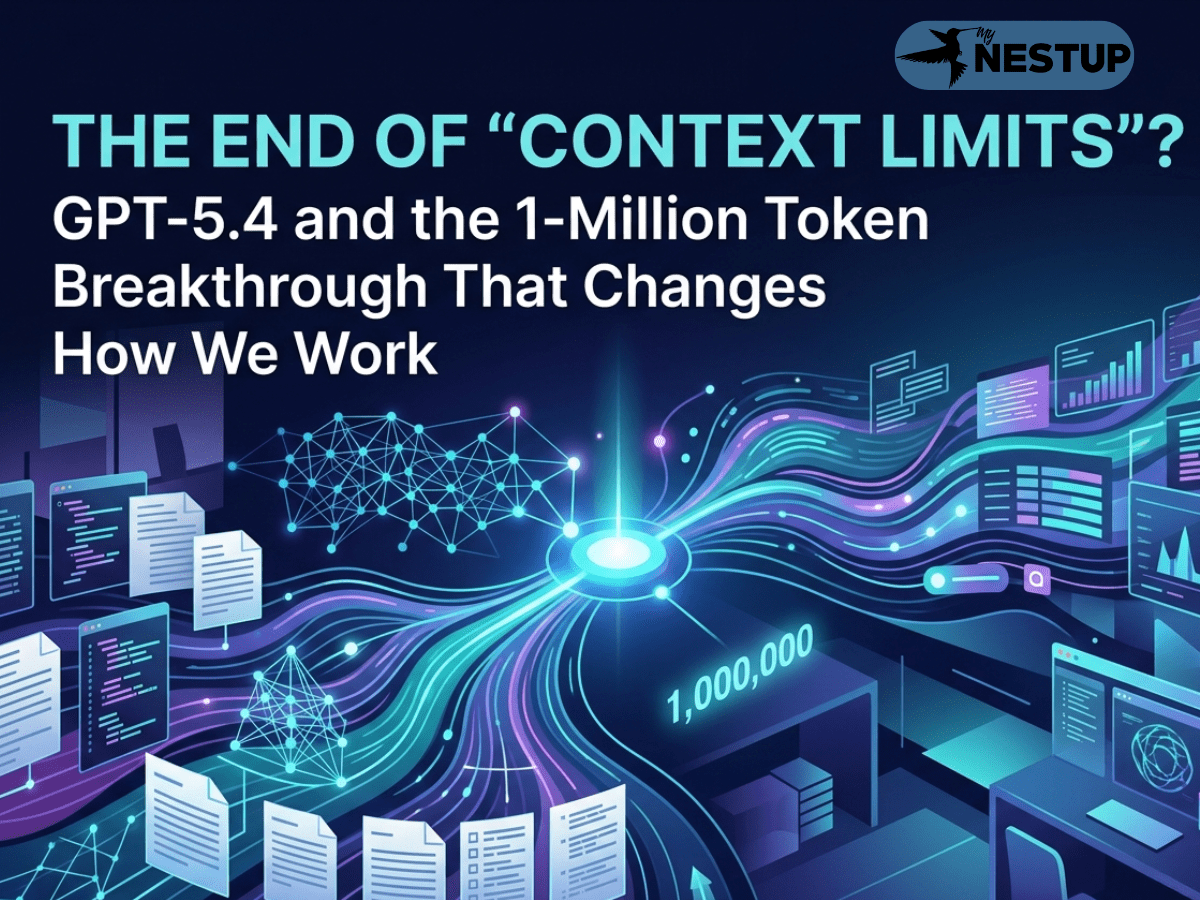

Artificial intelligence models have grown dramatically in capability over the last few years. But one limitation has quietly shaped how we use them: context window size—the amount of information an AI model can read and remember during a single interaction.
With GPT-5.4 introducing a 1-million token context window, that limitation is starting to disappear. This isn’t just a technical upgrade. It fundamentally changes how professionals, researchers, and businesses can use AI for real work. Let’s break down what this actually means.
What Is a Context Window — and Why Does It Matter?
The context window is an AI model’s working memory: the total volume of text it can read, hold, and reason about in a single session. When that window is small, the model loses earlier information as a conversation grows longer. When it’s large, far more stays in view.
For most of AI’s recent history, this limitation has quietly shaped every workflow. You chunked documents. You engineered retrieval pipelines. You accepted that the AI only ever saw a slice of your actual problem.
GPT-5.4 changes that. Here’s where we’ve come from:
| Model Generation | Context Window |
|---|---|
| Early ChatGPT (2023) | ~8,000 tokens |
| GPT-4 (2024) | ~128,000 tokens |
| Claude 3.5 / Gemini 1.5 Pro | ~200,000 tokens |
| GPT-5.4 (2025) | 1,000,000 tokens |
One million tokens equates to roughly 750,000 words — the entire Lord of the Rings trilogy, hundreds of research papers, or thousands of pages of technical documentation, all processed in a single prompt.
What This Actually Unlocks
A larger context window doesn’t just mean longer chats. It fundamentally changes the nature of what AI can do — and for whom.
Software Engineering at the Systems Level
Developers have long had to work around context limits by feeding AI code file by file, losing the thread of how components connect. With a million-token window, a model can ingest an entire codebase — source files, documentation, architecture notes, and error logs — simultaneously.
AI stops acting as a code autocomplete tool and starts functioning more like a systems analyst: capable of identifying cross-file dependencies, spotting architectural issues, and proposing refactors that account for the full project.
Research Synthesis at Scale
Synthesising literature has always meant reading dozens of papers manually, reconciling contradictions, and building a picture over weeks. With extended context, AI can hold an entire literature review in memory at once — enabling real-time cross-paper comparison, rapid hypothesis generation, and meta-analysis that previously took weeks, compressed into minutes.
Legal and Regulatory Intelligence
Legal professionals deal in volume. Contracts, case law, compliance frameworks, and regulatory documents rarely fit into a few thousand words. A million-token context means entire legal cases, overlapping contracts, and regulatory frameworks can be analysed together — surfacing clause conflicts, flagging compliance gaps, and summarising case histories with full context intact.
Organisational Knowledge as a Living Resource
Enterprises generate enormous volumes of internal knowledge that largely sits unused — too voluminous and fragmented to query effectively. Extended context turns that archive into something coherent and queryable. AI can reason across an organisation’s entire knowledge base in a single session, surfacing patterns and informing decisions with the full weight of institutional memory.
What does 1 million tokens actually look like?
- An entire software repository with full documentation and commit history
- Several years of customer feedback and support logs
- A company’s complete regulatory and compliance archive
- Hundreds of research papers read simultaneously
The Quiet Efficiency Gain: Less Engineering, More Work
There’s a less obvious benefit worth highlighting. Large context windows dramatically reduce the complexity of working with AI.
Until now, reasoning over large document sets required significant engineering overhead:
- Chunking documents into manageable pieces
- Building vector embedding pipelines for semantic retrieval
- Orchestrating multi-step retrieval and summarisation chains
These techniques work — but they require expertise to implement, introduce failure points, and add latency. With a sufficiently large context window, many of these pipelines disappear. The instruction becomes: “Here are 40 documents. Analyse them.” That accessibility matters. More people can use AI effectively, without specialised infrastructure.
Real Limitations Worth Acknowledging
A one-million token context window is a genuine breakthrough — not without constraints.
Compute Cost
Processing large contexts requires substantial compute. For organisations using AI at scale, this translates to higher usage costs. Efficient context management — providing what’s relevant rather than everything available — remains a meaningful practice.
Attention Dilution
Research consistently shows that model performance can degrade as context grows. Models may give uneven attention to information buried deep in long inputs. Thoughtful document structuring and prompt design help — but the limitation is real.
Response Latency
Larger contexts take longer to process. For interactive applications where speed matters, this is a practical consideration that shapes how extended context is best deployed.
A Shift in How We Think About AI
The deeper significance here isn’t technical — it’s conceptual. For most of AI’s recent history, working with a model meant managing its limitations: carefully scoping inputs, accepting incomplete context, working around what it could hold in mind.
A million-token window removes most of those constraints for most real-world use cases. That changes the nature of the interaction. AI is no longer a smart assistant you brief carefully — it’s a system you can hand an entire body of work to, and ask to reason about it whole.
The fundamental shift
From AI that answers questions about fragments of your work…
…to AI that understands the full context of your work.
The jump to a one-million token context window may turn out to be one of the most consequential infrastructure changes in the practical history of AI — not because it makes any individual response better, but because it removes the ceiling on how much an AI can meaningfully reason about at once.
When that ceiling disappears, the role of AI in serious work changes. It moves from assistant to collaborator — one capable of holding the full complexity of a problem in mind, rather than responding to carefully managed slices of it.