


If you’ve ever used an AI like ChatGPT to write an email, debug code, or brainstorm ideas, you’ve likely experienced a moment of awe. The text it produces is so coherent, so nuanced, and so human-like that it can feel like you’re interacting with a thinking, reasoning mind. It feels like magic.
But what’s really happening behind the curtain when you type in a prompt and hit enter? Is the AI truly “understanding” your request in the way a person does? The reality is both simpler and more profound than you might think.
Drawing from a recent lecture on the foundations of Large Language Models (LLMs), this article will pull back the curtain to reveal three surprising insights. These takeaways demystify the technology, separating the science fiction from the facts and revealing the true nature—and transformative power—of the AI reshaping our world.
1. At Their Core, They’re Just Predicting the Next Word
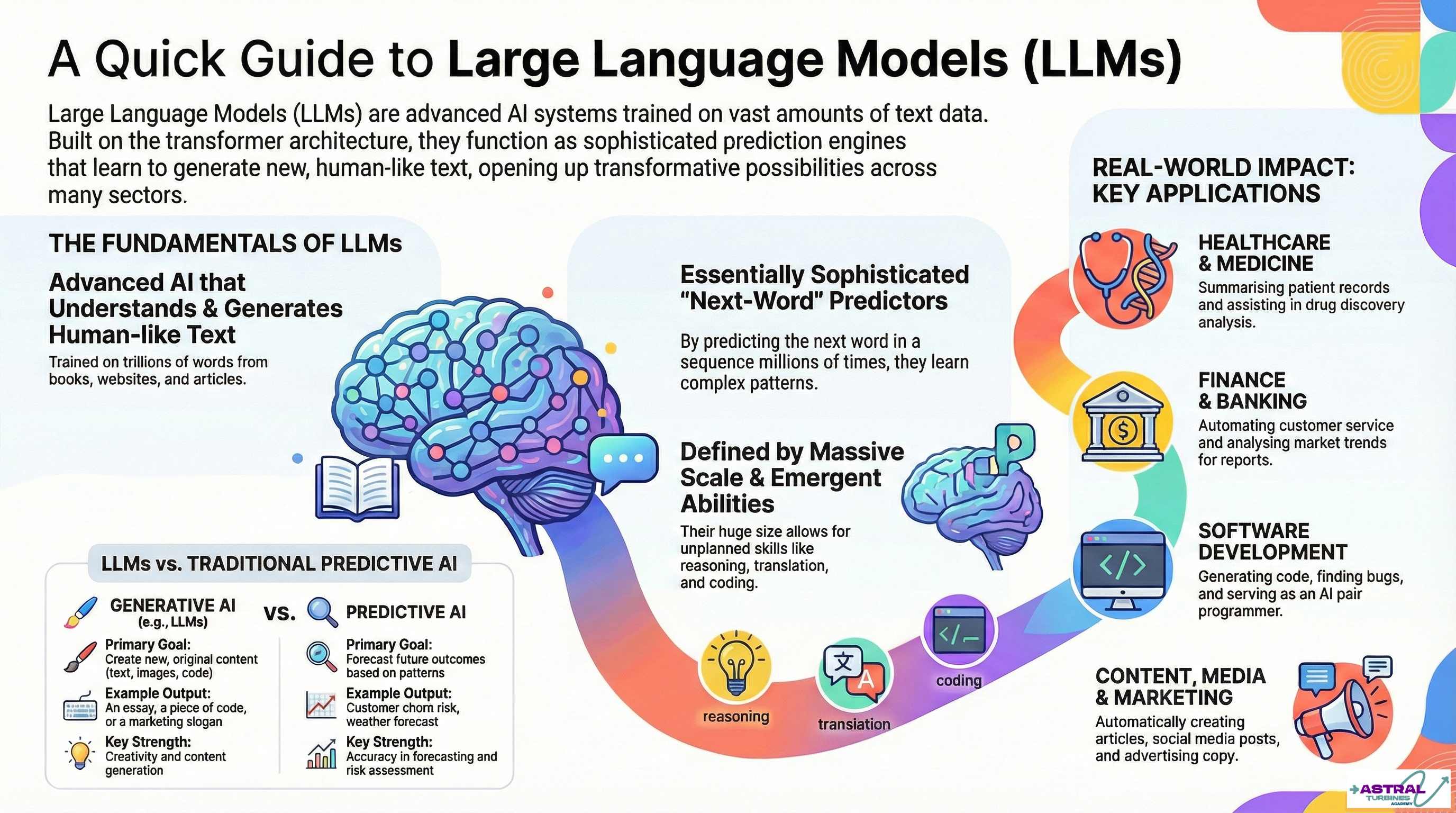
The single most important concept to grasp about LLMs is this: their fundamental task is incredibly simple. At their core, these models are designed to do one thing—predict the next most likely word (or “token”) in a sequence.
For example, if you give a model the phrase, “The cat sat on the…”, it analyzes the patterns it has learned from trillions of words of text and calculates that the most probable next word is “mat.” That’s it. The entire breathtaking complexity of an LLM is built upon this single, foundational skill.
The “magic” emerges from scale. By performing this next-word prediction task billions and billions of times on a massive dataset of books, articles, websites, and code, the model begins to internalize the intricate patterns of language. This scale is what unlocks emergent abilities—complex skills like reasoning and coding that weren’t programmed in, but arise naturally from the model’s deep understanding of linguistic patterns.
LLMs are essentially massive statistical prediction machines.
This insight removes the mystique and reframes LLMs for what they are. They are not thinking beings or conscious entities. They are extremely powerful, sophisticated pattern-matching systems that have learned to statistically mimic human language and knowledge with astonishing fidelity.
2. They Don’t Predict the Future—They Generate the Present
The term “AI” is often used as a catch-all, lumping different technologies together. However, there is a crucial difference between the Generative AI that powers LLMs and the Predictive AI used in forecasting. Confusing the two leads to a fundamental misunderstanding of what they do.
The distinction comes down to their primary goals, data needs, and outputs.
- Predictive AI analyzes structured historical data to forecast a specific, future outcome. Its output is typically a probability or a numerical forecast—think of weather models that predict tomorrow’s temperature or financial models that estimate future stock prices.
- Generative AI learns patterns from vast, unstructured data (like the entire internet) to create entirely new, original content that has never existed before. Its output is novel content, such as a written essay, a piece of music, or a block of computer code.
As the lecture notes emphasize, LLMs are the flagship example of generative AI—they don’t just predict what comes next in a sentence; they use that skill to generate entirely new, coherent, and useful content.
This distinction is critical. While you might ask an LLM to “predict” how a story might end, you are asking it to create a plausible narrative, not to make an accurate forecast about a real-world future event. Its strength lies in creation and synthesis, not in divination.
3. They Are More Than Chatbots—They’re Transforming Core Professions
As of 2026, while most people interact with LLMs as public-facing chatbots, their most significant and revolutionary impact is happening much deeper. They are being integrated as powerful tools within core industries to augment human expertise, delivering tangible value far beyond just answering questions.
Here are just a few of the surprising and impactful applications happening today:
- Healthcare: Summarizing patient records, assisting medical professionals with preliminary diagnosis suggestions based on patient notes, and supporting drug discovery by analyzing vast amounts of research literature.
- Legal Services: Performing complex legal research in minutes instead of days and conducting initial contract analysis to flag potential issues for lawyers to review.
- Software Development: Acting as an “AI pair programmer” for developers by generating, debugging, and optimizing code, dramatically accelerating development cycles.
- Manufacturing: Analyzing machinery logs to perform predictive maintenance, identifying potential equipment failures before they happen and preventing costly downtime.
These applications show how LLMs are rapidly becoming essential tools for automating complex knowledge work, enhancing human productivity, and unlocking new insights from data.
From Pattern-Matching to Transformation
The “magic” of AI, therefore, isn’t magic at all. It’s the astounding result of statistical prediction executed at an unimaginable scale. By looking past the illusion of “thought,” we can see the technology more clearly.
We’ve seen that at their core, they are next-word predictors operating at an unbelievable scale. We’ve clarified that they are powerful content generators, not future-predicting oracles. And most importantly, we’ve seen that they are already transforming foundational industries, acting as powerful partners to human professionals.
This simple mechanism—predicting the next word—is the engine driving one of the most complex technological shifts of our time.
Which industry do you think will be most transformed by LLMs in the coming years?