
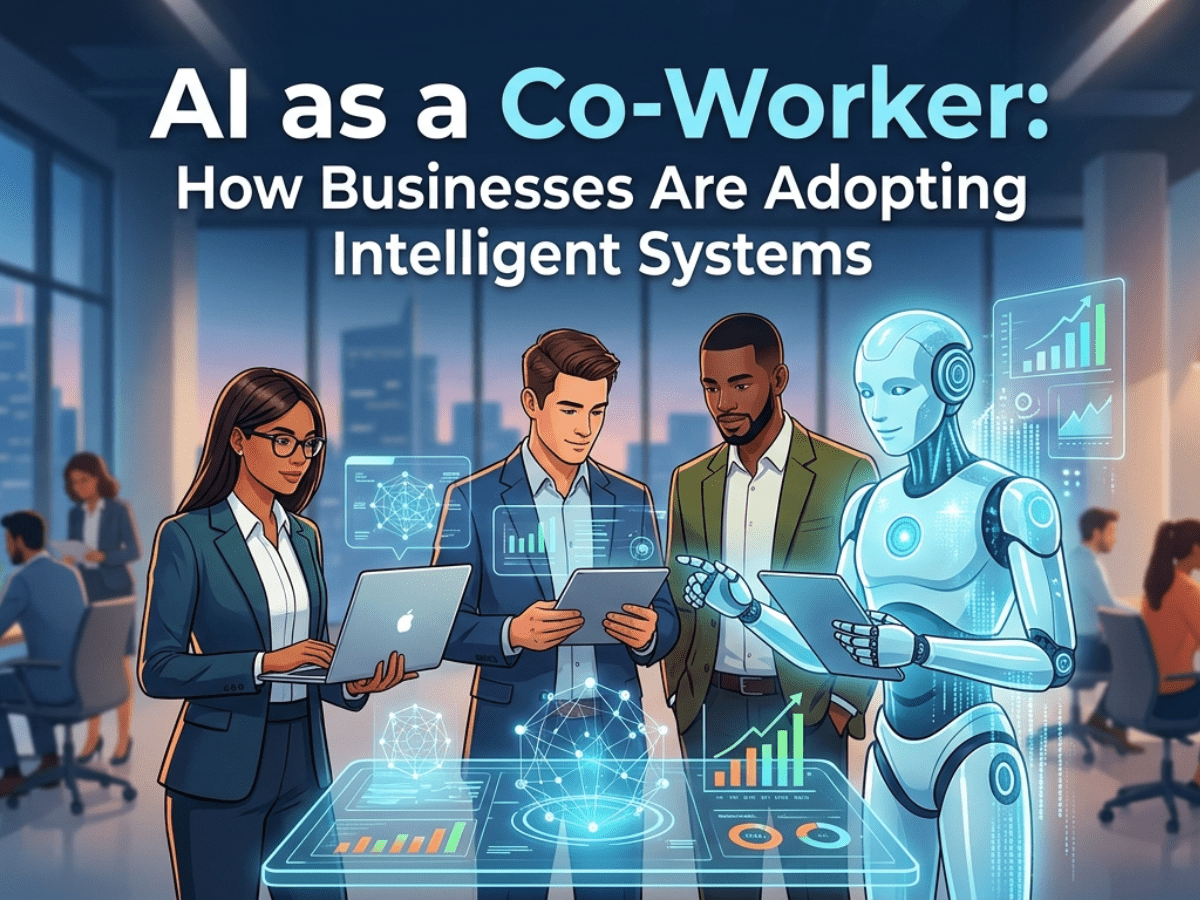

Introduction: From Assistant to Collaborator
For years, artificial intelligence has been positioned as a productivity tool—something that helps employees work faster by automating repetitive tasks. But a deeper shift is now underway. AI is no longer just assisting work; it is starting to participate in it. Across industries, businesses are beginning to treat AI as a co-worker—an intelligent system that can collaborate, contribute, and in some cases, operate with a level of independence.
This transition marks a fundamental change in how organizations think about technology. Instead of tools that require constant direction, companies are adopting systems that can understand goals, make decisions, and execute tasks alongside human teams.
What Does It Mean for AI to Be a Co-Worker?
Calling AI a “co-worker” is not just a metaphor—it reflects a real change in capability. Modern AI systems can handle multi-step workflows, adapt to changing inputs, and produce outcomes that previously required human judgment. They can analyze data, draft reports, respond to customers, and even assist in strategic planning.
Unlike traditional software, which follows predefined rules, these systems can interpret context and adjust their behavior. This makes them far more flexible and useful in dynamic business environments. In many cases, employees are no longer just users of AI—they are managers of it, assigning goals and reviewing outcomes rather than performing every step themselves.
Where Businesses Are Seeing the Impact
The adoption of AI as a co-worker is already visible across multiple functions. In customer service, AI systems are managing entire support interactions, resolving queries without human intervention while escalating complex cases when necessary. In marketing, they generate content, analyze campaign performance, and optimize messaging in real time.
Finance teams are using AI to monitor transactions, detect anomalies, and generate forecasts. In operations, AI helps streamline supply chains, predict demand, and automate logistics decisions. Even in software development, AI is assisting with code generation, debugging, and testing, accelerating the development lifecycle.
What makes this shift significant is not just the variety of use cases, but the level of autonomy involved. AI is no longer confined to isolated tasks—it is embedded in workflows, contributing continuously.
Productivity Gains and Organizational Change
One of the most immediate benefits of AI co-workers is increased productivity. Tasks that once took hours can now be completed in minutes, and teams can handle larger workloads without proportional increases in staffing. This creates opportunities for growth and efficiency that were previously difficult to achieve.
However, the impact goes beyond speed. The presence of AI is reshaping roles within organizations. Employees are spending less time on routine execution and more time on oversight, creativity, and decision-making. New roles are emerging as well, focused on managing, training, and optimizing AI systems.
This shift requires a change in mindset. Businesses must learn not just how to use AI, but how to work with it.
Trust, Accountability, and Human Oversight
As AI takes on more responsibility, questions of trust and accountability become increasingly important. Businesses need to ensure that AI systems are reliable, transparent, and aligned with organizational goals. When an AI system makes a mistake, it must be clear how that decision was made and who is responsible for correcting it.
Human oversight remains essential. While AI can operate independently in many scenarios, it still requires guidance, monitoring, and intervention when needed. The most effective organizations are those that strike the right balance—leveraging AI’s capabilities while maintaining human control over critical decisions.
Challenges in Adoption
Despite its potential, adopting AI as a co-worker is not without challenges. Integration with existing systems can be complex, and not all workflows are easily automated. There may also be resistance from employees who are concerned about job displacement or uncertain about how AI will change their roles.
Data quality is another critical factor. AI systems rely on accurate and well-structured data to function effectively. Without it, their performance can be inconsistent or unreliable.
To succeed, businesses must invest not only in technology but also in training, culture, and change management.
The Future of Work: Human + AI Collaboration
The rise of AI co-workers is shaping a new model of work—one defined by collaboration between humans and intelligent systems. Rather than replacing people, AI is augmenting their capabilities, enabling them to focus on higher-value activities.
In the future, teams may consist of both human employees and AI agents working together seamlessly. Tasks will be distributed based on strengths, with AI handling speed and scale, and humans providing judgment, creativity, and ethical guidance.
This hybrid workforce has the potential to unlock new levels of innovation and efficiency.
Conclusion: Redefining the Workplace
AI as a co-worker is more than a technological trend—it is a redefinition of the workplace itself. As businesses continue to adopt intelligent systems, the nature of work, roles, and collaboration will evolve.
Organizations that embrace this shift thoughtfully will be better positioned to compete in an increasingly digital world. The goal is not to replace humans, but to empower them—creating a future where people and AI work side by side, each enhancing the other’s strengths.