
Introduction: A New Kind of Intelligence at Work
For years, artificial intelligence has largely been defined by its ability to process and generate text. It could write emails, answer questions, and assist with research—but it remained confined to a single mode of interaction. That era is ending.
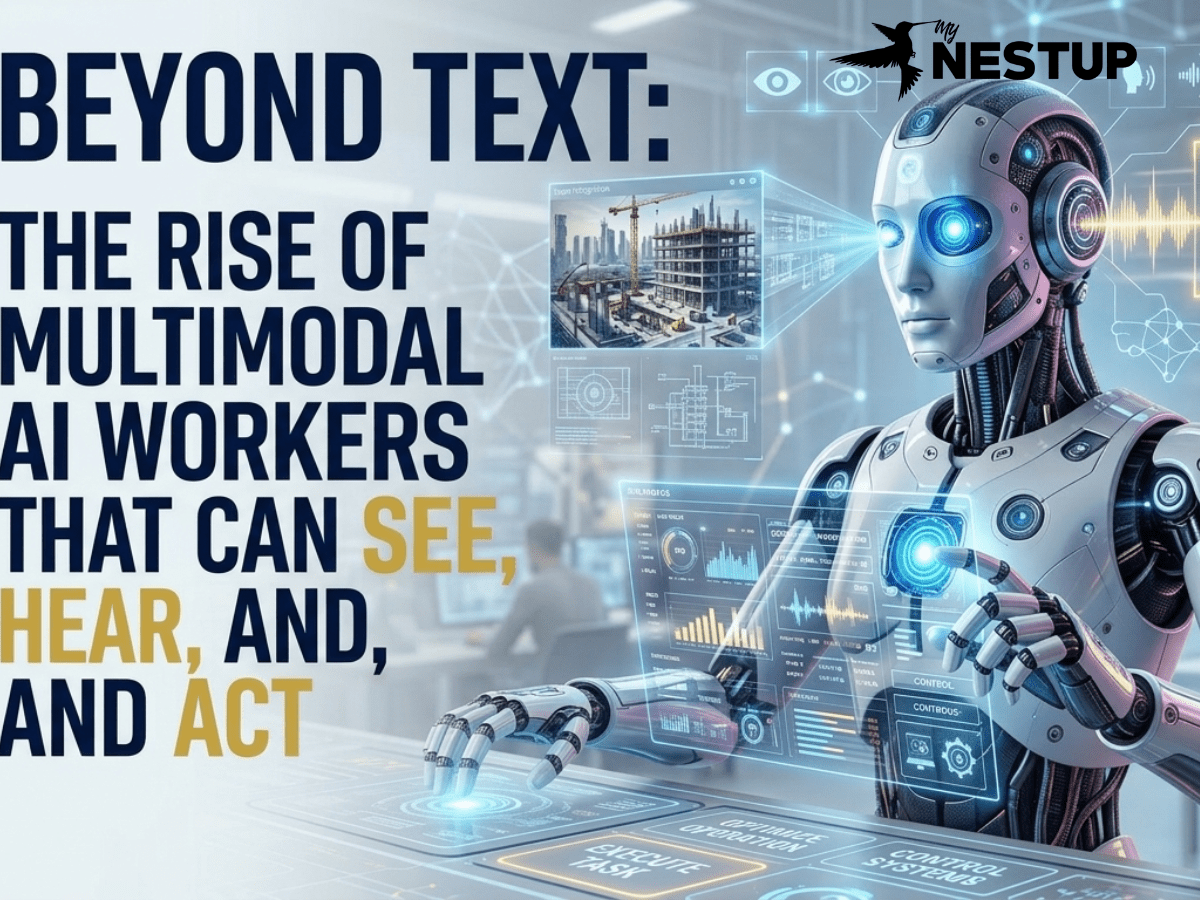
We are now entering the age of multimodal AI workers—systems that can simultaneously understand images, interpret audio, process text, and even take actions in the real world. These AI systems don’t just respond; they perceive and operate, bringing them closer than ever to functioning like human workers.
What Is Multimodal AI?
Multimodal AI refers to systems that can process and integrate multiple types of data inputs—such as:
- Vision (images, video feeds, facial expressions)
- Audio (speech, tone, environmental sounds)
- Text (documents, chats, instructions)
- Action (interacting with software, devices, or physical environments)
Instead of treating these inputs separately, multimodal AI combines them into a unified understanding of the world. This allows it to interpret context in a far more human-like way.
For example, a multimodal AI assistant can:
- Watch a video and summarize it
- Listen to a meeting and generate action items
- Read documents and cross-reference visual data
- Control software systems based on spoken commands
From Assistants to Workers
Traditional AI tools act as assistants—they wait for instructions and respond step-by-step. Multimodal AI workers, however, represent a shift toward autonomy.
These systems can:
- Observe: Monitor dashboards, camera feeds, or workflows
- Understand: Combine visual, auditory, and textual cues
- Decide: Determine next steps based on context
- Act: Execute tasks without constant human prompting
In practical terms, this means AI is evolving from a passive tool into an active participant in workflows.
Real-World Applications
1. Customer Service That Truly Listens
Imagine a support agent that not only reads chat messages but also hears customer frustration in their voice and sees screenshots of issues. Multimodal AI can analyze all these inputs to provide faster, more empathetic responses.
2. Healthcare Assistance
In medical environments, multimodal AI can combine:
- Patient records (text)
- Medical imaging (vision)
- Doctor-patient conversations (audio)
This integrated understanding can support diagnostics, flag anomalies, and reduce human error.
3. Smart Surveillance and Safety
Security systems powered by multimodal AI can detect unusual behavior by analyzing video, sound patterns, and contextual data—far beyond simple motion detection.
4. Creative and Content Work
From generating videos with synchronized voiceovers to editing content based on visual and narrative cues, multimodal AI is transforming creative workflows into faster, more dynamic processes.
5. Autonomous Business Operations
Multimodal AI workers can monitor emails, attend virtual meetings, analyze reports, and update systems—all while coordinating across tools. This creates a new layer of digital workforce automation.
Why This Changes Everything
Context Awareness
Humans rely heavily on context—tone of voice, body language, visual cues. Multimodal AI brings machines closer to this level of understanding.
Reduced Friction
Instead of switching between tools (typing, uploading images, explaining context), users can interact naturally—speaking, showing, and instructing in one flow.
Increased Productivity
By handling complex, multi-step tasks independently, these AI workers can dramatically reduce the time spent on repetitive or coordination-heavy work.
The Challenges Ahead
Despite its promise, multimodal AI raises important concerns:
- Privacy Risks: Systems that can see and hear require access to sensitive data
- Bias and Misinterpretation: Incorrect interpretation of visual or audio cues can lead to flawed decisions
- Over-Automation: Relying too heavily on AI workers may reduce human oversight
- Ethical Boundaries: Determining what AI should be allowed to do is still an evolving debate
Organizations will need strong governance frameworks to ensure responsible deployment.
The Future: AI as a Colleague, Not a Tool
The rise of multimodal AI workers signals a fundamental shift in how we interact with technology. We are moving from issuing commands to collaborating with intelligent systems that understand the world in richer ways.
In the near future, your “AI coworker” may:
- Join your meetings
- Analyze discussions in real time
- Execute follow-ups automatically
- Adapt based on your preferences and behavior
The question is no longer whether AI can assist us—but how deeply it will integrate into the way we work and live.
Conclusion
Multimodal AI workers represent the next frontier of artificial intelligence—where machines don’t just process information but truly experience it across multiple dimensions.
As these systems continue to evolve, they will reshape industries, redefine productivity, and challenge our understanding of what it means to work alongside machines.
The future of AI isn’t just smarter responses.
It’s smarter perception, smarter decisions, and smarter action—all at once.