

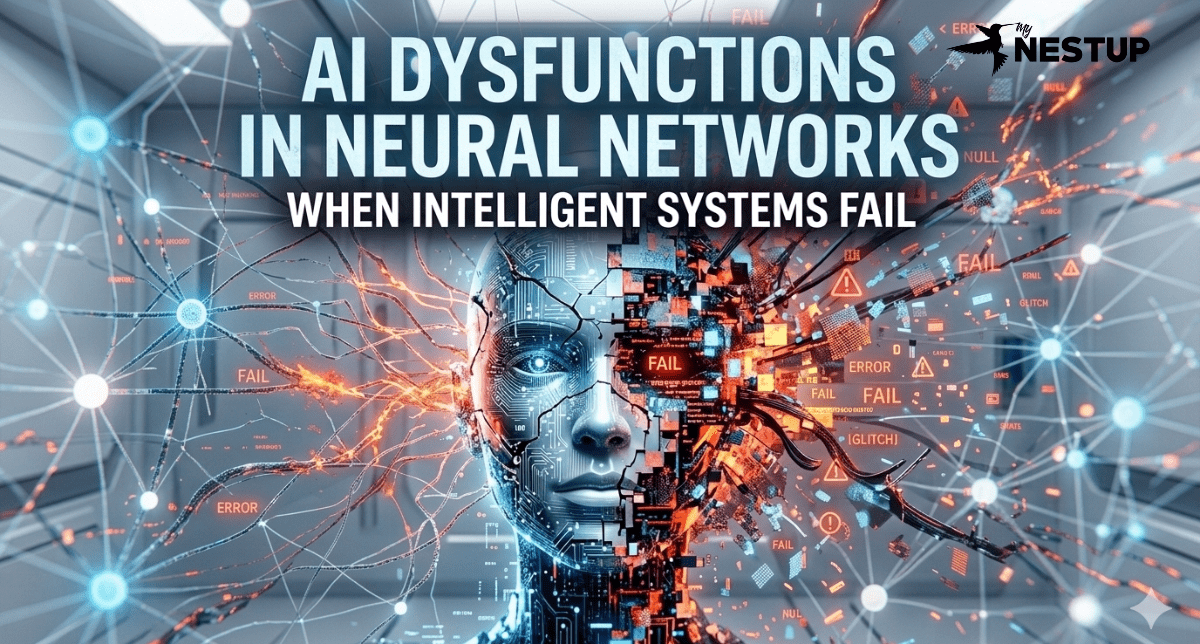

Artificial intelligence has advanced dramatically in recent years, driven primarily by neural networks—layered computational systems loosely inspired by the human brain. These models excel at tasks like image recognition, language translation, medical diagnosis, and generating human-like text. Yet, despite their power, neural networks remain imperfect. Their complexity can lead to dysfunctions that produce biased, unreliable, or outright erroneous outputs.
As AI integrates deeper into high-stakes domains—healthcare, finance, education, criminal justice, and autonomous systems—understanding and mitigating these dysfunctions becomes essential for building trustworthy technology.
How Neural Networks Work—and Where They Falter
Neural networks consist of interconnected layers of nodes (“neurons”) that process input data, extract patterns, and produce outputs. Training involves iteratively adjusting billions (or trillions) of parameters to minimize prediction errors on large datasets, enabling generalization to new examples.
However, this process introduces inherent vulnerabilities. Errors can arise from flawed data, optimization dynamics, architectural choices, or unforeseen interactions, often proving opaque and hard to diagnose.
Key Types of Neural Network Dysfunctions
- Overfitting and Underfitting Overfitting occurs when a model memorizes training data—including noise and idiosyncrasies—rather than learning generalizable patterns. It shines on seen data but fails on new inputs. Underfitting is the reverse: the model is too simplistic or undertrained to capture core patterns, yielding consistently poor performance. Both compromise reliability, especially in dynamic real-world settings.
- Bias Amplification and Data Reflection Neural networks inherit and often magnify biases present in training data. Historical datasets reflecting societal inequalities can lead AI to discriminate—e.g., facial recognition systems performing worse on certain ethnic groups or hiring tools favoring specific demographics. This dysfunction underscores a core truth: AI mirrors the data it’s fed, including its flaws.
- Adversarial Vulnerability Neural networks can be deceived by imperceptible input perturbations, known as adversarial examples. A tiny tweak to an image might cause a model to misclassify a panda as a gibbon or a stop sign as a yield sign. These attacks exploit the models’ reliance on superficial correlations rather than robust understanding, posing grave risks for safety-critical applications like self-driving cars and cybersecurity.
- Catastrophic Forgetting In continual or lifelong learning scenarios, neural networks often overwrite old knowledge when trained on new tasks—a phenomenon called catastrophic forgetting. Unlike humans, who build cumulatively on prior learning, most models suffer sharp performance drops on earlier tasks. Recent advances, such as memory-augmented architectures, neural ordinary differential equations, and paradigms like Nested Learning, show promise in mitigating this, but the challenge persists, especially in large models.
- Hallucinations and Confabulation (Particularly in Large Models) Modern large language models and multimodal systems frequently generate plausible but factually incorrect outputs—known as hallucinations. These arise from pattern-matching over true reasoning, gaps in training data, or overconfidence in probabilistic predictions. Hallucinations represent a fundamental limitation: even massive models cannot eliminate them entirely, as they stem from statistical approximations rather than grounded understanding.
- Lack of Interpretability (The Black-Box Problem) Deep neural networks often function as opaque “black boxes.” Even when accurate, their reasoning pathways are hard to trace, making it difficult to explain decisions or debug failures. This opacity erodes trust, hinders accountability, and complicates regulatory compliance in sensitive fields.
Why These Dysfunctions Matter
The stakes are high. Misdiagnoses in healthcare, discriminatory lending in finance, flawed risk assessments in justice systems, or deceived autonomous vehicles can cause real harm. As models grow more autonomous and agentic, undetected dysfunctions amplify risks, potentially reinforcing inequalities or enabling misuse.
Strategies to Mitigate Dysfunctions
Researchers continue to tackle these issues through multifaceted approaches:
- Curating diverse, debiased, and high-quality datasets
- Applying regularization, dropout, and data augmentation to combat overfitting
- Developing adversarial training and certified defenses for robustness
- Advancing explainable AI (XAI) techniques, such as feature attribution, mechanistic interpretability, and surrogate models
- Creating continual learning frameworks (e.g., replay buffers, parameter isolation, or hybrid ODE-transformer designs) to reduce forgetting
- Incorporating uncertainty estimation, retrieval-augmented generation, and fact-checking mechanisms to curb hallucinations
These efforts aim to produce more robust, transparent, and ethically aligned systems.
Toward Trustworthy AI
Neural networks power today’s most capable AI, yet their dysfunctions highlight the gap between narrow pattern recognition and genuine intelligence. Overcoming these challenges demands technical innovation alongside ethical frameworks, rigorous testing, regulatory oversight, and cross-disciplinary collaboration.
By addressing dysfunctions proactively, we can steer AI toward reliably benefiting society—rather than unintentionally amplifying harm or uncertainty. The future of AI depends on building systems that are not only powerful, but also safe, interpretable, and aligned with human values.