Term Definitions:
- Space Economy: The full range of activities and resources that create value and benefits to human beings in the course of exploring, researching, understanding, managing, and utilizing space. It includes both government and private-sector commercial activities. These commercial activities could be satellite manufacturing, launch services, space tourism, and services derived from space data.
- LEO (Low Earth Orbit): An orbit relatively close to Earth, typically defined as an altitude between 180 km and 2,000 km above the surface. Satellites in LEO orbit the Earth quickly and require a large “constellation” to provide continuous global coverage.
- Starlink: A satellite internet constellation operated by SpaceX (an American aerospace company). It utilizes thousands of small, mass-produced satellites in LEO to provide high-speed, low-latency broadband internet access globally, especially to remote or underserved areas.
- Satellite Constellation: A group of artificial satellites working together as a system. Unlike a single, large satellite, a constellation provides persistent global or near-global coverage through a networked fleet.
Current Trends & Challenges in the Satellite Sector:
Satellites are the backbone of the modern space economy and are absolutely vital for many daily services. They enable communications, from providing the internet and TV broadcasts to supporting cell phone calls. Satellites also power navigation systems, such as GPS and other Global Navigation Satellite Systems (GNSS). They are crucial for Earth observation, constantly monitoring our planet for weather forecasting, mapping, and tracking disasters. Because satellites can effortlessly cover vast areas and reach places inaccessible to ground infrastructure, they frequently offer the most efficient solution.
The satellite industry is seeing rapid change, bringing both exciting innovations and serious challenges:
- Shrinking Size: The development of tiny satellites, like CubeSats and smallsats, is making things cheaper and easier. Their small size allows for more flexible and frequent launch opportunities.
- The Rise of Mega-Constellations: Companies are deploying huge fleets of hundreds or thousands of satellites, particularly in Low Earth Orbit (LEO). These constellations work together to provide seamless, global services such as high-speed broadband internet.
- Space Congestion: As more satellites are launched, the risk of collisions and the accumulation of space debris is growing. Managing this increasingly crowded environment is a critical challenge.
- Regulatory Hurdles: Satellites need specific radio frequencies and assigned orbital locations to operate without interference. These are governed by complex international agreements and rules.
- Focus on Sustainability: There’s a growing push to ensure that satellites are designed, operated, and ultimately disposed of (de-orbited) in a responsible way to protect the long-term health of the space environment.
Growth in Space Economy:
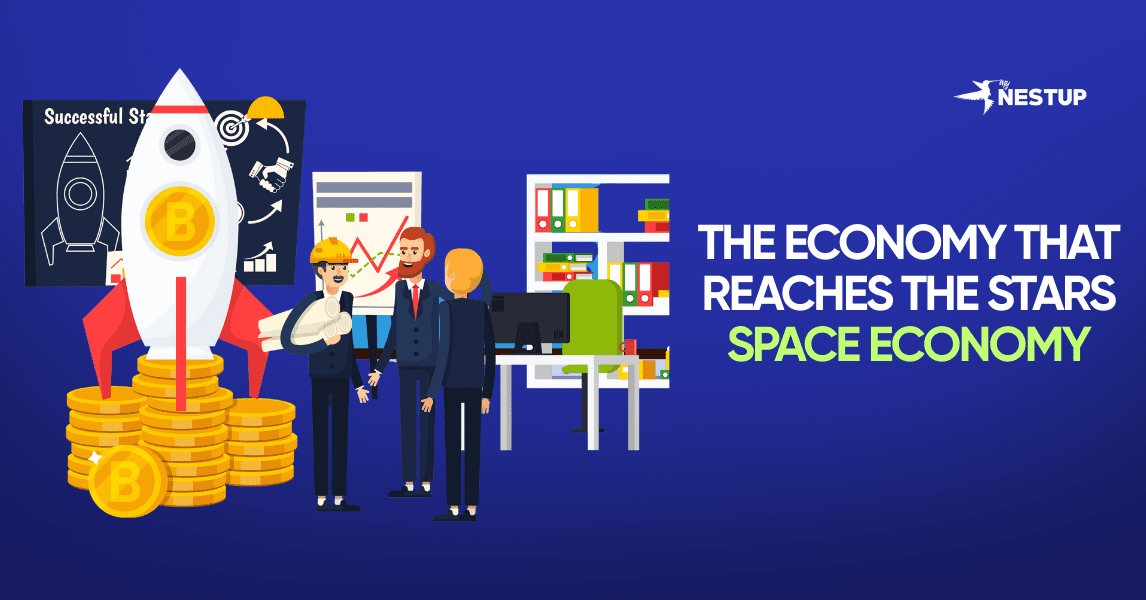
The space economy is in a period of rapid and significant growth. In 2023, the sector was valued at about US $570 billion, marking a strong increase of roughly 7.4% compared to the year before. This rapid expansion continued, pushing the valuation to an estimated US$613 billion in 2024. A key takeaway is that the majority of this surge is driven by commercial (private) space activities, which is about 78%. Major research organizations predict massive continued expansion. By 2035, the entire space economy is projected to reach approximately $1.8 trillion, which is nearly triple its current size. This impressive growth is fundamentally fueled by two main factors: reduced costs and technological improvements. The expense of sending things into orbit has decreased. This was largely due to innovations like reusable rockets, and the development of smaller satellite types has made them more economical to manufacture and operate. This sector is seeing increased investment and competition as more countries and private businesses pour resources into developing their own space capabilities.
What is LEO (Low Earth Orbit)?
Low Earth Orbit (LEO) is the region of space closest to Earth where many satellites and the International Space Station (ISS) orbit. There’s no single, strict boundary, but LEO is generally considered to range from about 160 kilometers (100 miles) up to 2,000 kilometers (1,200 miles) above the surface. Satellites in LEO travel at very high speeds, around 27,000 kilometers per hour (17,000 miles per hour), which allows them to complete an orbit around the Earth in about 90 minutes. Because they are so close to Earth, satellites in this orbit must constantly fight a tiny amount of atmospheric drag, the friction from the thin upper atmosphere, which slowly pulls them down, so they occasionally need small boosts to maintain their altitude.
LEO is the most popular orbital destination because it takes the least amount of energy and rocket power to reach compared to higher orbits. This closer distance offers significant advantages, particularly for communication and Earth observation. For communications, the short distance means a much smaller delay (lower latency) when sending and receiving signals, which is vital for real-time applications like video calls and high-speed internet. For observing the Earth, LEO’s proximity allows satellites to capture high-resolution images, making it the preferred orbit for spy satellites, weather monitoring, and environmental tracking.
The increasing use of LEO has led to the deployment of large groups of satellites called mega-constellations, such as SpaceX’s Starlink and Amazon’s Kuiper, designed to provide global internet coverage. While beneficial, this concentration of objects in LEO poses challenges, mainly the growing risk of collisions with space debris. The high orbital speed means even small pieces of debris can cause severe damage. Scientists and space organizations are actively working on ways to track debris, manage satellite traffic, and ensure that satellites are designed to de-orbit safely after their mission is complete, helping to keep LEO usable for future missions.
What is SpaceX Starlink coverage?
SpaceX’s Starlink is a satellite internet service that relies on a large group, or constellation, of satellites orbiting Earth in Low Earth Orbit (LEO). These LEO satellites fly much closer to the ground—typically around 550 kilometers (340 miles)—compared to traditional internet satellites, which orbit much farther out at about 35,786 km (22,236 miles) in Geostationary Orbit (GEO). Because the LEO satellites are so much closer, the time it takes for a signal to travel from your device to the satellite and back, known as latency or delay, is significantly reduced. This low latency makes Starlink suitable for activities like online gaming and video calls, which struggle with the high latency of traditional satellite internet.
To provide continuous, widespread coverage, Starlink uses thousands of satellites that constantly move across the sky. Unlike a single GEO satellite that can cover a vast area, LEO satellites can only cover smaller patches, so a large constellation is necessary to ensure one satellite is always in view of a user’s ground dish. As of 2025, Starlink is already available in over 125 countries and territories globally, serving millions of active users. The company is continually launching more satellites and improving the network to achieve near-global coverage, with plans to expand services to even more remote areas like parts of Africa and the polar regions. The Starlink website provides an interactive map for users to check availability in their specific location.
The key to Starlink’s coverage and performance is its technology, including the use of optical space lasers (or inter-satellite links) on the newer satellites. These lasers allow the satellites to beam data to each other in space, creating an interconnected “mesh” network. This means data doesn’t always have to travel down to a ground station and back up, which makes the transmission faster, especially over long distances like oceans. As this laser network grows, Starlink aims to offer even higher speeds and lower latency, potentially reaching speeds comparable to fiber-optic connections in the future.
Conclusion:
The space economy is currently undergoing a radical transformation, driven by massive growth projections and foundational technological shifts. The rapid deployment of mega-constellations in Low Earth Orbit (LEO) is redefining global connectivity by offering low-latency services. This boom is fueled by reduced costs from reusable rockets and the development of smaller, more affordable satellites. However, this progress brings critical challenges, particularly the urgent need to manage space congestion and debris. It also establishes international regulations to ensure the long-term sustainability of the space environment for all users. The future of this nearly $1.8 trillion sector will depend on balancing innovation with responsible stewardship of our orbital resources.
References: