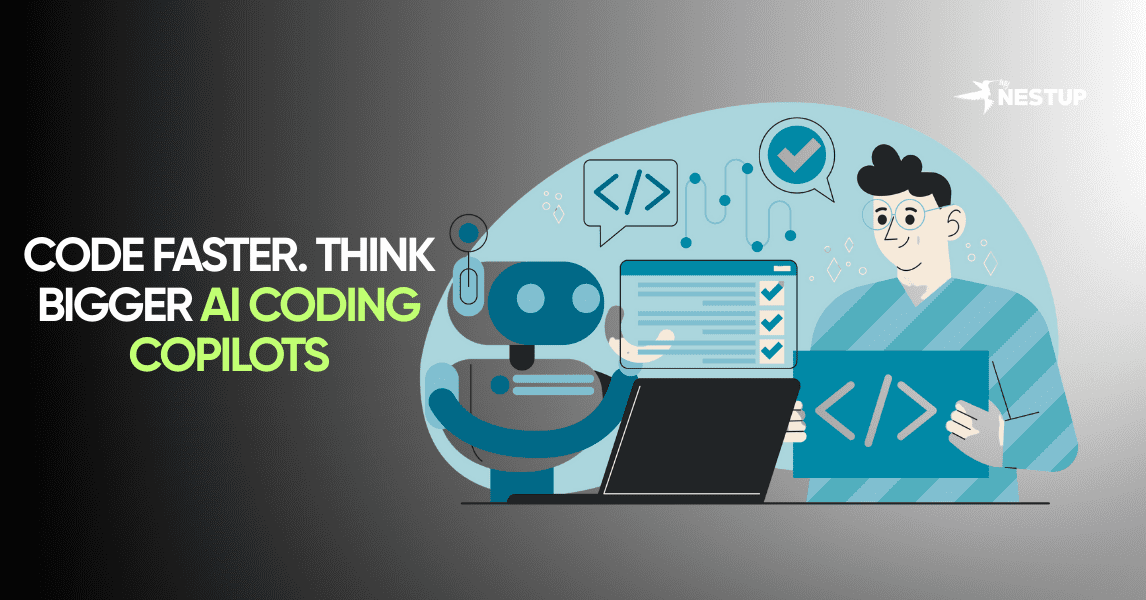
What are AI coding copilots?
A coding copilot is basically an AI helper for developers, fitting right into their existing programming environment (IDE). Think of it as a smart assistant that’s been trained on a massive library of public code. Because of this training, it understands how people usually write software, what the common patterns are, and the best ways to do things. Its main job is to make coding faster and easier by giving you suggestions as you type. It helps with handling all those boring, repetitive jobs automatically, and even writing entire chunks of code when you just describe what you need in plain language. It’s designed to boost efficiency and help you spend less time on boilerplate and more time on the complex stuff.
Examples of AI coding copilots:
- GitHub Copilot
- Trending Competitors
What is GitHub Copilot?
A partnership between OpenAI and Microsoft resulted in the creation of GitHub Copilot, which was one of the first successful applications of AI for pair programming. The tool employs a cutting-edge large language model to process context from the surrounding code and developer comments, enabling it to suggest full functions and several lines of code at a time. GitHub Copilot acts as an AI partner right there in your coding workflow. You have two simple ways to use it: you can start writing your code and let the AI finish the lines for you, or you can simply describe what you want to build using everyday language. The AI will generate the required code snippet. Copilot isn’t limited to a few specific languages; it can write code in any programming language found in public repositories, like JavaScript, Python, TypeScript, and Ruby. You can access this assistant primarily inside your coding program (IDE) and even when working in your command line interface. If you happen to be using an enterprise version, you also get access to Copilot directly on the GitHub website.
Key Features of GitHub Copilot:
- Copilot Chat: This is a chat window built right into your coding environment where you can ask the AI questions, have it explain tricky parts of the code, or get help with finding and fixing bugs.
- In-line Suggestions: While you’re typing, the tool cleverly proposes potential code, often called “ghost text”. You can instantly accept and insert into your file just by hitting a key.
- Copilot Edits: A neat function that lets you tell the AI what changes you need, and it will handle making those updates across several files at the same time.
Trending competitors:
The AI copilot space is constantly expanding, and many rival tools are emerging with their own unique strengths.
1. Tabnine:
This tool is particularly popular because it prioritises security and data privacy for large companies. It offers flexible setup options, including running the tool locally on your own servers (on-premises). It can also be customised using a company’s confidential code. Crucially, it promises a zero-data-retention policy, meaning it doesn’t store your code, which is a major difference from Copilot.
2. Amazon Q Developer:
These assistant shines when you’re working on cloud-based projects within the Amazon Web Services (AWS) environment. It not only offers code suggestions but also makes sure they follow recommended AWS best practices. A standout feature is its ability to perform real-time security checks for vulnerabilities as you code.
3. Replit Ghostwriter:
Integrated seamlessly into Replit’s online, browser-based editor, this tool is highly accessible and perfect for students or teams collaborating on projects. It’s known for giving very detailed explanations of the code it generates and can quickly set up the basic structure of a whole project based on a single request.
4. Cursor:
This is a code editor built from the ground up for AI. It offers deep understanding of your code’s context and can even handle making edits across multiple files simultaneously. A key advantage is its flexibility, allowing developers to switch and use different underlying AI models (like those from OpenAI or Anthropic) to best suit the task they are working on.
5. Tembo:
This tool goes beyond being a simple copilot; it acts as an autonomous software engineer. It actively monitors a project’s codebase and automatically creates pull requests to proactively fix problems, optimise performance, and even implement new features without direct prompting. It’s essentially designed to automate code maintenance.
Pros and Cons of AI Coding Copilots:
Pros:
- Boosted Development Speed: These AI partners dramatically accelerate the development cycle. By taking over the creation of repetitive, boilerplate code, they free up developers to concentrate their energy on the more challenging and creative aspects of their work. Research, such as a study from Harvard Business School, indicates that AI can lead to significant productivity jumps, ranging from 17% to 43%.
- A Powerful Learning Companion: Copilots serve as excellent educational tools for all skill levels. They guide junior developers by suggesting standard best practices and help seasoned professionals by offering insights into legacy systems. They also help by proposing efficient alternative coding approaches.
- Reduced Coding Errors: The AI acts as a real-time safety net. By providing accurate, syntactically correct code snippets and flagging potential mistakes. They also significantly cut down on the number of common errors.
- Enhanced Operational Efficiency: Many tedious and time-consuming duties are now streamlined. Automating tasks like generating comprehensive test cases, restructuring existing code, and writing clear project documentation saves substantial time and effort across the entire development process.
Cons:
- Security and Confidentiality Risks: A major concern revolves around data leakage. Most coding copilots utilise cloud-based services and are trained on vast public datasets. Businesses are wary of transmitting proprietary source code to third-party servers where its privacy is not guaranteed.
- Variable Code Reliability: The code produced by AI is not a guaranteed fix-all. It can still introduce subtle bugs and potential security vulnerabilities. This means developers cannot simply accept the output and must maintain discipline in thoroughly reviewing and testing every piece of AI-generated code.
- Erosion of Core Skills: There’s a risk that too much dependence on automated suggestions could dull a developer’s essential problem-solving abilities over the long term. While the AI is excellent at delivering solutions, it inherently lacks the deep, creative human understanding necessary for true innovation and complex architectural design.
- Intellectual Property and Copyright Puzzles: The origin of AI-generated code is often foggy. Because the models learn from existing public codebases, the output can occasionally replicate segments of copyrighted material. This creates tricky legal and licensing questions regarding code ownership and potential infringement.
- The Adjustment Period (Learning Curve): Successfully adopting a copilot requires more than just installing software. Developers must invest time and effort to adapt their existing workflows and learn how to write effective prompts (inputs) to steer the AI toward the highest quality results.
Conclusion:
The world of coding is rapidly changing thanks to AI tools, with GitHub Copilot leading the charge. These AI helpers are essentially smart assistants that write code, suggest fixes, and help programmers finish their work much faster, which is a huge boost to getting things done. Lots of rivals are popping up, including big names like Amazon CodeWhisperer and other new platforms that can handle more complex tasks than just basic suggestions. Companies are embracing these tools not just to write code quickly, but to make sure the code is high quality and secure. All this shows that AI is becoming a must-have part of modern software development.
References: