


What is 5G Technology?
5G, short for fifth-generation mobile technology, is the latest evolution in wireless communication networks. Rolled out commercially from 2019 onward, it is the result of years of research and major upgrades to telecom infrastructure. Compared to earlier mobile standards, 5G operates across a broader range of frequencies. It marks a significant leap forward in overall network performance.
One of the most noticeable improvements is speed. While 4G networks typically top out at around 1 Gbps, 5G can deliver speeds of up to 20 Gbps. In practical terms, this means tasks that once took minutes (like downloading a high-definition movie) can now be completed almost instantly.
Another key advantage of 5G is its extremely low latency, meaning data is sent and received with only a few milliseconds of delay. This near-real-time responsiveness makes smoother video calls possible. It opens the door to advanced applications such as remote medical procedures, autonomous vehicles and real-time industrial automation.
In addition, 5G is designed to support a massive number of connected devices at the same time. This capability is essential for enabling smart cities, connected infrastructure and the continued expansion of the Internet of Things (IoT).
How Does 5G Work?
5G delivers faster speeds and minimal delay radio frequencies with advanced network technologies. Several key components make this possible.
Use of different frequency bands:
5G operates across both lower and higher radio frequencies. Sub-6 GHz bands offer broad coverage. These are well suited for large areas, including suburban and rural regions. In contrast, millimeter wave (mmWave) frequencies, typically between 24 and 40 GHz, provide extremely high data capacity. These higher bands are mainly used in dense urban locations and places with heavy network demand, such as stadiums and shopping districts.
Advanced antenna technology (MIMO):
5G networks use Multiple Input, Multiple Output (MIMO) antennas. These allow several data signals to be transmitted and received at the same time. This significantly increases network capacity and helps maintain strong performance even when many devices are connected simultaneously.
Small cell infrastructure:
To maintain reliable coverage and high speeds, 5G depends on small cell base stations. These compact units are installed on structures like lamp posts, building rooftops and utility poles. Small cells strengthen network coverage and improve performance in crowded areas where traditional cell towers may struggle.
Efficient spectrum management (OFDMA):
Orthogonal Frequency-Division Multiple Access (OFDMA) improves how radio spectrum is used by dividing it into smaller sections that can be shared among multiple users. This allows the network to handle heavy traffic more efficiently without slowing down data transmission.
Network slicing:
5G introduces network slicing. This enables operators to run multiple virtual networks on the same physical infrastructure. Each slice can be optimized for specific needs, such as ultra-low latency for autonomous vehicles or high bandwidth for video streaming services.
Edge computing integration:
To further reduce delays, 5G works alongside edge computing. It means data is processed closer to the user instead of being sent to distant data centers. This speeds up response times and reduces strain on central network resources. This results in smoother and more reliable performance.
Use Cases of 5G Technology
5G is expected to transform multiple industries by delivering faster speeds, dependable connectivity. It offers the capacity to support large numbers of connected devices at once. Sectors such as healthcare, automotive, entertainment and manufacturing stand to gain the most from this next-generation network.
5G supports applications that were previously limited by slower networks by enabling real-time communication and data processing. From remote medical services to smart factories and immersive digital experiences, its impact extends well beyond mobile internet.
Healthcare
In healthcare, 5G has the potential to significantly improve how medical services are delivered. High-speed, low-latency connections allow healthcare professionals to monitor patients remotely and receive real-time health data. This is especially valuable for managing chronic illnesses and post-treatment care. Telemedicine also becomes more reliable, enabling virtual consultations without delays or interruptions. One of the most promising uses of 5G in healthcare is remote robotic surgery. Since 5G minimizes communication delays, surgeons can operate robotic systems with high precision from distant locations. This capability can help bring advanced medical procedures to rural or underserved regions where specialist care is limited.
Automotive
The automotive industry relies heavily on fast and dependable communication. This makes 5G a key enabler of autonomous driving technologies. Self-driving vehicles must constantly exchange information with nearby vehicles and traffic control systems to operate safely. The low latency and high data capacity of 5G make this level of coordination possible. In addition, 5G supports intelligent traffic management systems that can track road conditions and vehicle movement in real time. These systems can adjust traffic signals and suggest optimized routes. This helps to reduce congestion, lower emissions and improve overall transportation efficiency.
Entertainment
In the entertainment industry, 5G opens the door to richer and more interactive digital experiences. High data speeds and minimal lag allow users to stream ultra-high-definition content smoothly. It also allows users to enjoy cloud-based gaming and engage with virtual and augmented reality applications without disruptions. Beyond traditional media, 5G also enables entirely new forms of entertainment. Live events, such as concerts or sporting matches, can be experienced through VR. It helps in giving users a sense of presence even when attending remotely. This creates more immersive and engaging ways to consume entertainment.
Manufacturing
In manufacturing, 5G plays a vital role in advancing smart factory concepts. By connecting machines and control systems through a single high-speed network, manufacturers can monitor equipment performance in real time. and make faster. This leads to higher productivity, reduced downtime and improved workplace safety. 5G also supports the use of autonomous robots and drones within industrial environments. These technologies can handle tasks like material transport, quality inspection and equipment monitoring. This results in reduces human risk and improving operational efficiency.
Advantages of 5G
Beyond significantly faster download and upload speeds, 5G introduces several improvements that clearly set it apart from earlier 3G and 4G networks.
- Compact infrastructure: 5G relies on smaller transmitters compared to previous generations. This makes them easier to install discreetly on buildings, street fixtures, or other unobtrusive locations. These smaller base stations (often called small cells) also consume less power. It makes the network more energy efficient while improving coverage in dense areas.
- Improved data accuracy: One of 5G’s key strengths lies in its advanced modulation and coding techniques. This improves how data is transmitted between devices. This results in a very low error rate across the network. If error levels begin to rise, the system automatically adjusts transmission speeds to maintain accuracy. In practice, this means 5G prioritizes reliability in real time, keeping data errors close to zero.
- Greater bandwidth capacity: 5G can operate across a much wider range of frequencies than earlier networks. By using both lower and higher spectrum bands 5G dramatically increases overall network capacity. This allows more devices to connect simultaneously without affecting performance, making it ideal for high-demand environments.
- Ultra-low latency: Latency, or the delay in data transmission, is drastically reduced with 5G. While 4G networks typically have delays of around 200 milliseconds, 5G can reduce this to as little as one millisecond. This near-instant responsiveness enables faster cloud interactions, real-time applications and smoother performance for time-sensitive tasks.
Disadvantages of 5G Technology
Despite its benefits, 5G also presents challenges that organizations and users need to carefully consider before adopting it fully.
- Cybersecurity risks: Although 5G introduces stronger security mechanisms than earlier generations, it is not immune to cyber threats. One concern lies in encryption practices. While individual applications may use encryption, the 5G New Radio (NR) standard does not provide full end-to-end encryption, potentially exposing the network to certain types of attacks.
- Network slicing vulnerabilities: Network slicing, one of 5G’s standout features, allows operators to create multiple virtual networks for different use cases. However, this flexibility can also introduce security risks. If a virtual slice is compromised, malicious software could spread across connected systems or even affect wider network infrastructure. This poses serious risks for large enterprises.
- Infrastructure costs: Transitioning to 5G requires significant investment. Businesses must upgrade existing hardware and replace incompatible equipment. They need to train staff to manage the new technology. For organizations that have already invested heavily in 3G or 4G infrastructure, the cost and effort involved in migrating to 5G can be a major barrier.
- Limited coverage: Although 5G deployment is expanding rapidly, coverage is still uneven. Urban areas are more likely to have reliable access, while rural or remote locations may experience limited or no 5G service. Companies considering adoption should assess whether consistent coverage is available in the areas where they operate.
- Signal penetration challenges: 5G signals, especially those using higher frequencies, can be easily obstructed by physical objects such as walls, buildings and trees. This makes signal planning more complex in indoor environments like factories and offices. In some cases, businesses may need to redesign layouts or install additional equipment to ensure stable connectivity.
What Is 6G Technology?
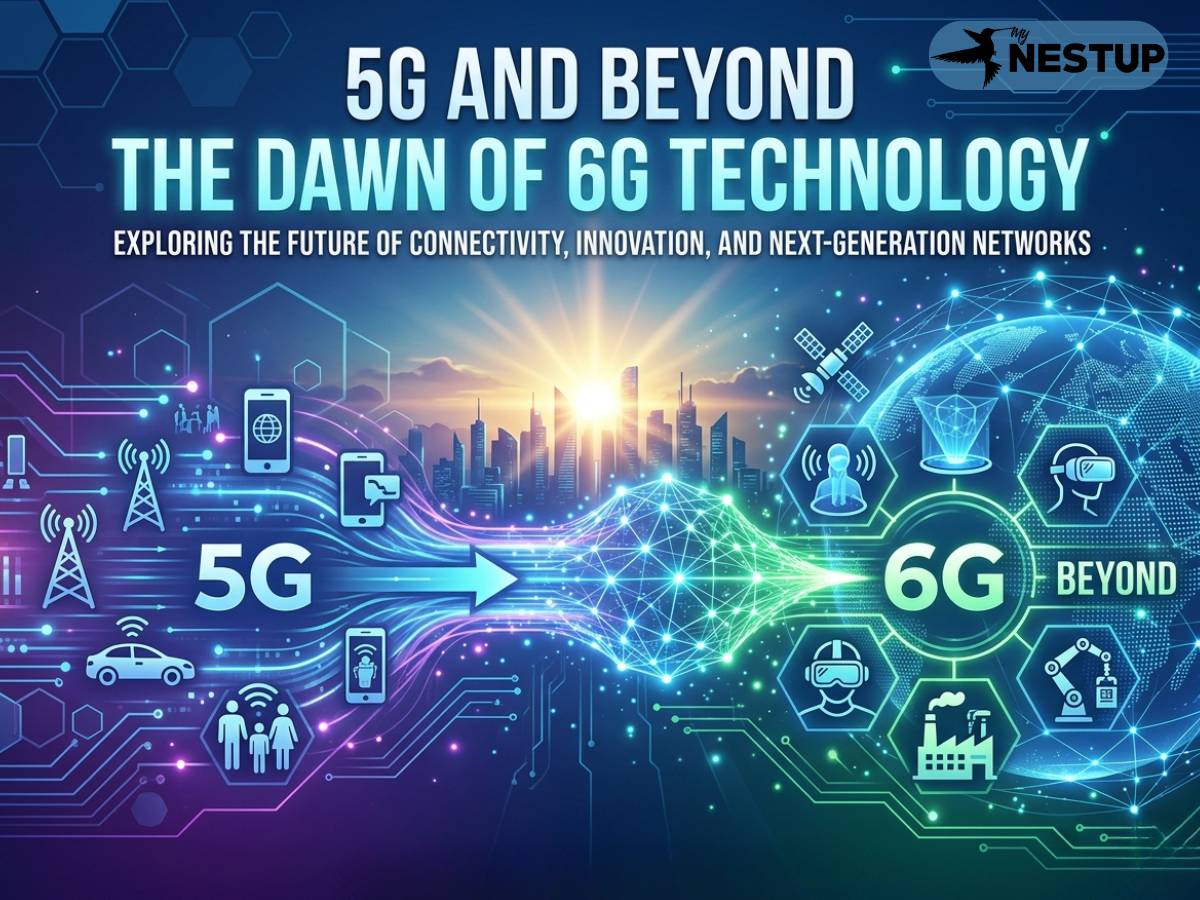
6G, or sixth-generation wireless technology, is the next step after 5G and is widely expected to begin rolling out globally around 2030. Compared to 5G, 6G networks are designed to operate at much higher frequencies. This enables dramatically greater data capacity and extremely low latency. One of the core ambitions of 6G is to support communication delays as low as one microsecond. It is roughly a thousand times faster than the one-millisecond latency typical of current networks.
The 6G market is expected to drive major advances in fields such as high-resolution imaging, immersive presence technologies and precise location tracking. When combined with artificial intelligence, 6G infrastructure will be capable of intelligently determining where computing tasks should take place. Whether that involves local devices, edge systems or cloud platforms. This includes optimizing where data is stored and processed. This helps in unlocking new levels of performance and enabling innovative use cases across many industries.
Like previous generations, 6G will be developed under standards defined by the 3rd Generation Partnership Project (3GPP). This is the same body responsible for 5G and 5G New Radio (NR). However, 6G is still in the research and development phase. While governments and private organizations are investing heavily in its development, formal specifications and commercially available 6G products are still several years away. Industry leaders, including companies such as Ericsson, estimate that early commercial deployments are unlikely to appear before the early 2030s.
Advantages of 6G Compared to 5G
Like 5G, 6G will use different types of radio signals to send data. However, it will make greater use of very high-frequency signals, which can carry much more information. Although 6G is still being developed and exact speeds are not yet confirmed, early tests suggest it will be far more powerful than today’s networks.
Some early experiments already show what might be possible. In test settings, companies and researchers have successfully sent 6G signals over short distances at extremely high speeds. Experts believe that, in ideal conditions, 6G could be fast enough to transfer huge amounts of data almost instantly, especially over short ranges.
To understand how big this upgrade could be, consider download speeds. Even the best 5G networks today are much slower than what 6G aims to deliver. If 6G reaches its expected performance, it could be thousands of times faster than 5G.
Here’s a simple example:
- On 3G, downloading a high-quality movie could take hours
- On 4G, it might take around 20 minutes
- On 5G, it can take just a couple of minutes
- With 6G, the same movie could download in less than a second
Speed is not the only improvement. 6G is also expected to respond almost instantly, with barely any delay. This will make digital experiences feel much more natural and real-time.
Because of these improvements, 6G could support new and advanced technologies such as self-driving vehicles, realistic virtual and mixed-reality experiences, smart cities and digital copies of real-world systems. It will also be able to handle many users and devices at the same time without slowing down, making networks more reliable and efficient. 5G has already begun reshaping the way we connect and innovate by delivering faster speeds, lower latency and support for billions of connected devices. As we look beyond 5G toward the emergence of 6G, the future of wireless technology becomes even more transformative. 6G promises to push the boundaries of connectivity with near-instant response times, massive data capacity, and deeper integration of intelligent and immersive technologies. Together, 5G and 6G mark a shift toward a fully connected digital world. One that will power smarter cities, advanced healthcare, autonomous systems and richer human experiences in the decades ahead.
References:
https://www.tdk.com/en/tech-mag/past-present-future-tech/what-is-5g-and-why-is-it-important