


We just got our hands on a fascinating document: a lecture transcript from 2026 titled ‘Claude’s Identity.’ It lays out a future where the AI race isn’t about a monolithic chase for capability, but a diverse ecosystem of specialized tools. What truly differentiates these models under the hood? By analyzing the surprising truths about Claude from this future-looking text, we can see exactly where the entire industry is headed.
1. Safety Isn’t an Afterthought—It’s the Entire Foundation
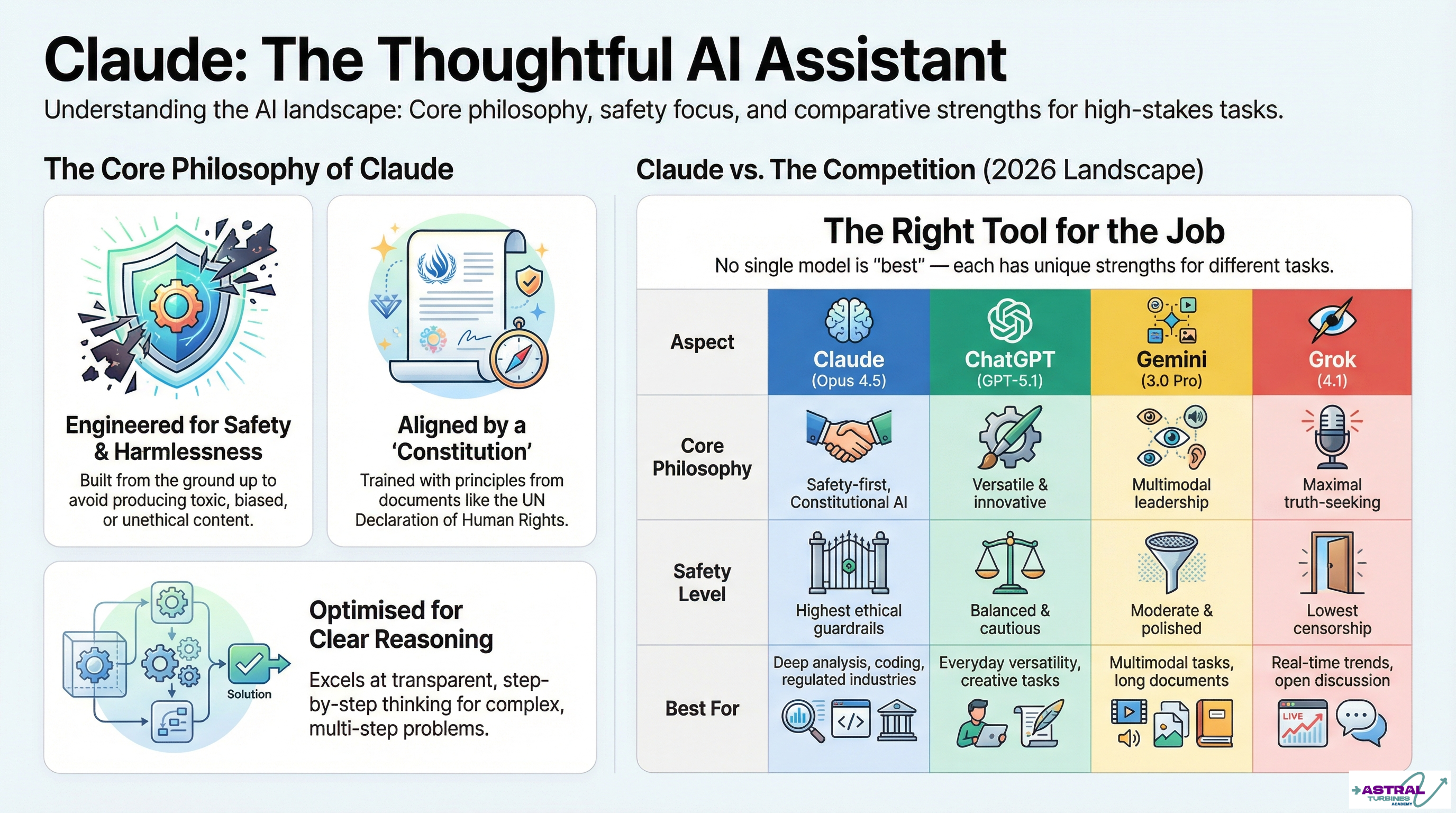
Unlike many models that prioritize raw capability first and then attempt to apply post-hoc safety measures, Claude is built from the ground up on a philosophy of responsibility. Its entire design is woven around three intertwined pillars: Safety & Harmlessness, Alignment, and Reasoning. The practical result of this foundation is that Claude tends to politely refuse unsafe requests, explain its reasoning for doing so, and reduce evasive “I can’t answer” responses. This “safety-first” approach is a significant and counter-intuitive strategy in a competitive landscape often defined by a race for pure performance.
2. It Follows a “Constitution,” Not Just Human Feedback
Most AI models are trained using Reinforcement Learning from Human Feedback (RLHF), where humans manually rate responses. Claude takes a different approach called Constitutional AI. It is given a “constitution”—a set of explicit principles inspired by documents like the UN Universal Declaration of Human Rights. During its training, Claude learns to critique and revise its own responses against these principles, using AI feedback (RLAIF) to reinforce helpful, honest, and harmless behavior. This creates a system guided by clear, ethical rules rather than just fluctuating human preference.
In short: Claude aims to be the AI you can trust for high-stakes, thoughtful work — not just the fastest or most creative responder.
3. It’s Not Trying to Be the “Best” at Everything
The 2026 landscape described in the lecture presents a mature market where the future of AI is a diverse ecosystem of specialized tools, not a single monolithic intelligence. The transcript makes it clear: there is no single “best” AI model. Claude has carved out a specific niche where it aims to lead: trustworthy reasoning, safety, and complex professional work. This stands in contrast to the stated strengths of its competitors, such as ChatGPT’s versatility, Gemini’s leadership in multimodality, or Grok’s focus on open, real-time discussion.
4. Its “Flaws” Are Actually Its Most Important Features
At first glance, Claude’s limitations—being more conservative, sometimes wordy or overly cautious, and having a higher refusal rate on borderline requests—might seem like flaws. However, these are not bugs; they are the direct and intended consequences of its safety-first design. For users in high-stakes fields like finance, law, and medicine, these “flaws” are critical features. They represent a commitment to reliability and safety, which is far more valuable than unrestricted creativity when accuracy and ethical conduct are paramount.
5. It’s Built for Marathons, Not Sprints
While many AIs are used for quick brainstorming, Claude’s true power is revealed in deep, complex work sessions. This excellence in methodical, long-horizon tasks is a direct result of its core optimization for clear, step-by-step reasoning. Examples include analyzing documents with over 200,000 tokens, executing complex multi-file code refactoring, and detailed multi-step planning. In fact, the lecture notes that Claude frequently ranks as the top choice for software engineering and agentic workflows, making it an engine for deep work, not just quick answers.
Conclusion: The Future is Thoughtful, Not Just Fast
Ultimately, Claude represents a bet that the future of AI belongs to systems that are predictably safe and thoughtfully aligned, not just raw power. As frontier models grow more capable, this philosophy becomes increasingly important. This glimpse into 2026 suggests a future where trust, reliability, and ethical grounding are the most valuable currencies.
Which of these strengths resonates most with the kind of work you do?